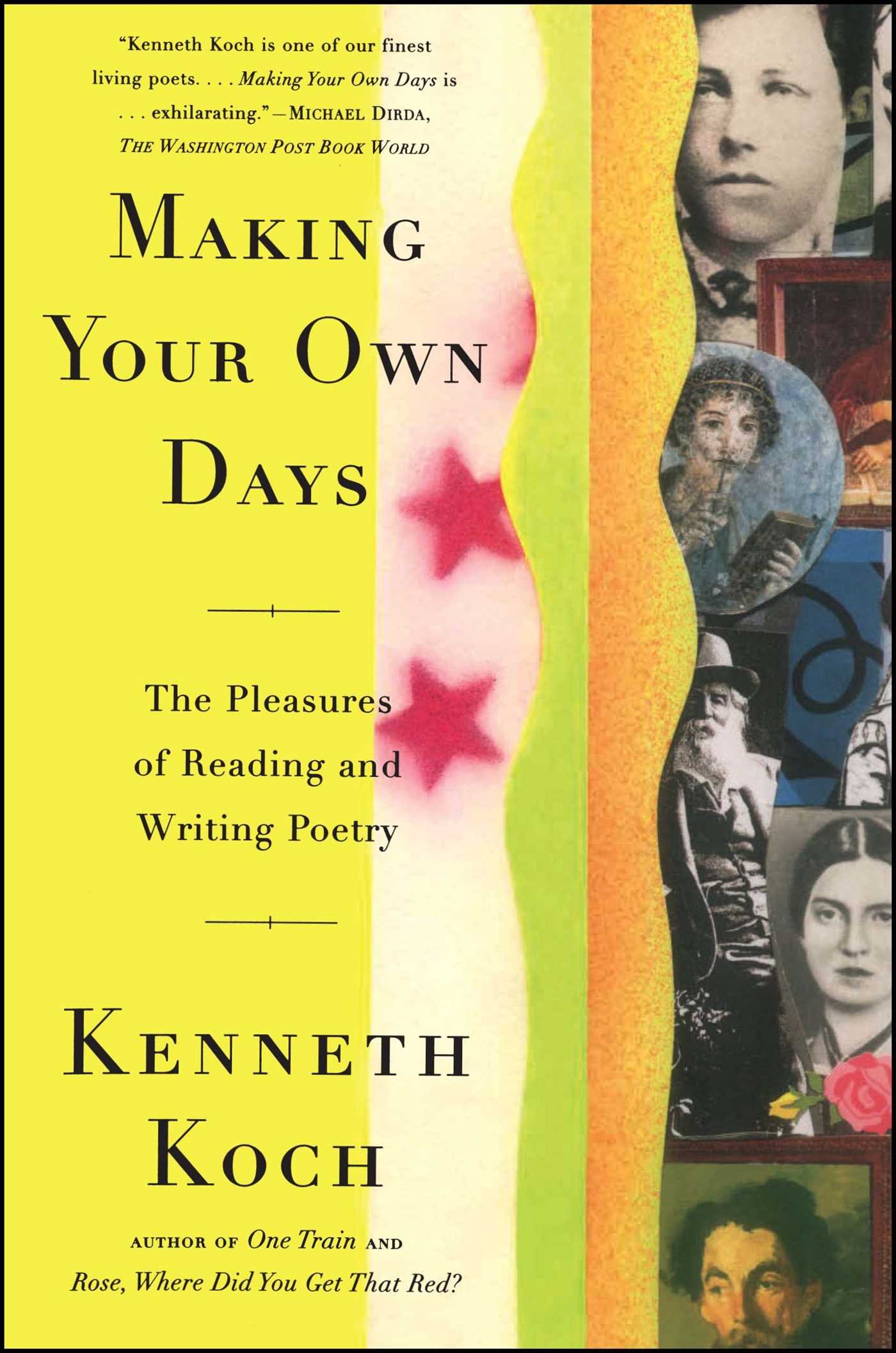



From one of the most esteemed American poets of the twenty-first century comes a celebration of poetry and an invitation for anyone to experience its beauty and wonder. Full of fresh and exciting insights, Making Your Own Days illuminates the somewhat mysterious subject of poetry for those who read it and for those who write it—as well as for those who would like to read and write it better. By treating poetry not as a special use of language but as a distinct language—unlike the one used in prose and conversation—Koch clarifies the nature of poetic inspiration, how poems are written and revised, and what happens to the heart and mind while reading a poem. Koch also provides a rich anthology of more than ninety works from poets past and present. Lyric poems, excerpts from long poems and poetic plays, poems in English, and poems in translation from Homer and Sappho to Lorca, Snyder, and Ashbery; each selection is accompanied by an explanatory note designed to complement and clarify the text and to put pleasure back into the experience of poetry. Michael Dirda The Washington Post Book World Kenneth Koch is one of our finest living poets.... Making Your Own Days is...exhilarating. David Lehman American Poetry Review A poet of the highest originality....[Koch] has stretched our ideas of what it is possible to do in poetry. Frank Kermode I would recommend Koch's way of teaching poetry above all others. His book is informative, witty, and surprising. It's also authoritative...it is a precious defense of poetry. Ned Rorem Koch is that rare phenomenon, the poet who can write prose -- prose that is necessary and lucid. In his book, he offers a new and healthy dimension to the life of virtually everyone. Kenneth Koch is the author of many books of poetry, most recently Straits, and won the Bollingen Prize for Poetry in 1994. He has also published fiction and plays, as well as books on the teaching of poetry: Wishes, Lies and Dreams; Rose, Where Did You Get That Red?; and I Never Told Anybody. He lives in New York City, where he is professor of English at Columbia University. Chapter 1 The Two Languages Poetry is often regarded as a mystery, and in some respects it is one. No one is quite sure where poetry comes from, no one is quite sure exactly what it is, and no one knows, really, how anyone is able to write it. The Greeks thought, or at least said, that it came from the Muse, but in our time no one has been able to find her. The Unconscious has been offered as a substitute, but that, too, is hard to locate. How anyone is able to write it is explained in this way: the poet is a Genius who receives inspiration. One way to get a little more clarity on the subject was suggested to me by something Paul Valéry said when he was thinking about the things that could be said in poetry and not otherwise: he said that poetry was a separate language or, more specifically, a "language within a language." There would be, in that case, the ordinary language -- for Valéry French, for us English -- and, somehow existing inside its boundaries, another: "the language of poetry." Valéry let it go at that; he went on to talk about other things. I thought it worth taking literally and seeing where it might lead; I thought it might explain something important about how poems are written and how they can be read. According to this idea, a poet could be described as someone who writes in the language of poetry. Talent is required for doing it welt, but there are things that can help this talent to appear and to have an effect -- for example, you have to learn this particular language, which you do by reading it and writing it. The language itself helps to explain inspiration, which is always, at a certain point in its development, the appearance of some phrase or sentence in the poetic language. You may be moved by the West Wind, but until the words come to you "O wild West Wind" the inspiration is still in an early, pre-verbal phase. Once "wild West Wind" is there, it leads to more of this oddly useful language; once the tone, the channel, the language level is found, the poem can take off in a more purely verbal way. Before I came on this idea of poetry as a separate language, I had been thinking of the analogy of a verbal synthesizer, computer, or pipe organ. You sat down at this instrument and played; you didn't tap out a clear message in teletypical prose. Whatever you said would be accompanied by music, and there were keys to press, to make comparisons, to exaggerate and lie, to personify, and so on. This idea of a synthesizer seemed to help explain the joy, even the intoxication, poets may feel when about to write, and when writing, and the similar joy and intoxication others may feel in reading their works. This joy seemed to me an element that was left out of most explications of poetry, or of the "poetic process." The synthesizer idea finally seemed to me a little askew, though, because it was too far aw