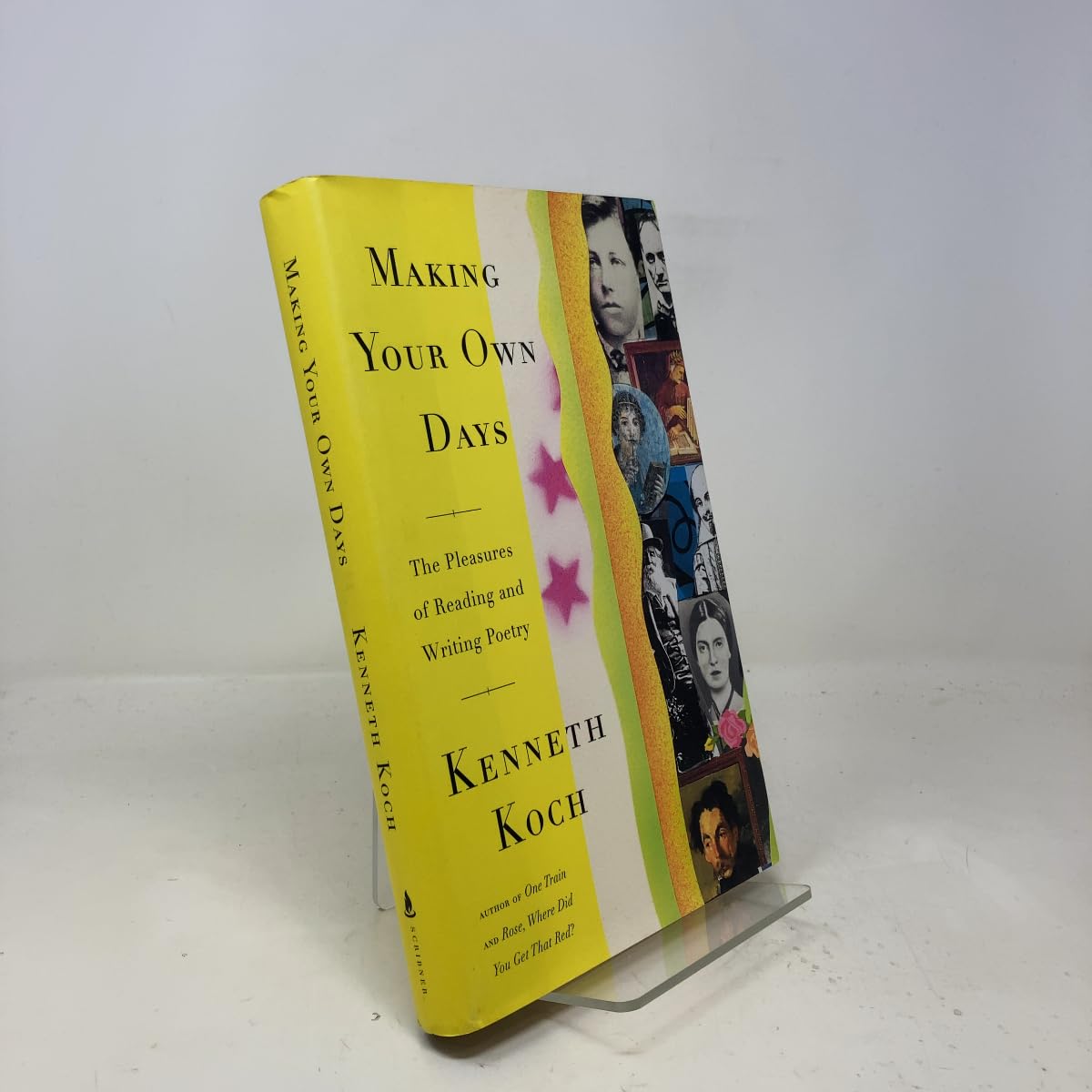



In Making Your Own Days, celebrated poet Kenneth Koch writes about poetry as no one has written about it before -- and as if no one had written about it before. Full of fresh and exciting insights and experiences, this book makes the somewhat mysterious subject of poetry clear for those who read it and for those who write it -- and for those who would like to read it and write it better. Koch accomplishes this revelation of poetry by presenting the idea that poetry is a separate language, a language in which music and sound are as important as syntax or meaning. Thus he is able to clarify the many aspects of poetry: the nature of poetic inspiration, what happens when a poet is writing a poem, revision, and what actually goes on while one is reading a poem -- how confusion or only partial understanding eventually leads to truly experiencing a poem.The language of poetry, like other languages, can be learned by reading it and writing it. To assist the reader in learning the language of poetry, Koch provides a rich anthology of poems -- each accompanied by an explanatory note -- specially designed to complement and illuminate his text. There are lyric poems, excerpts from long poems and from poetic plays, poems in English and in translation. Among the poets whose work is included are Homer, Ovid, Sappho, Shakespeare, Byron, Dickinson, Baudelaire, Li Bel, Stevens, Williams, Lorca, Ashbery, and Snyder.In this book, Kenneth Koch's genius for making poetry clear and bringing out its real pleasures is everywhere apparent. Ordinary mortals and poet scholars alike will find something to love in Koch's down-to-earth approach to making sense of that most head scratching of literary genres. Asserting that "poetry ... is a separate language," he steers clear of the stodgy, hidden-meaning school of deciphering poems (wherein the reader digs through the poem "for some elusive and momentous significance") and takes us instead on a tour through the tonal, rhythmical, and metrical aspects of poetry. Yes, it's about the music: "The sound of words is raised to an importance equal to that of their meaning, and also to the importance of grammar and syntax." But rather than asking us to simply take his word for it, Koch provides lively and insightful examples (including many rarely anthologized poems). For instance, why does "two and two are rather green" have little or no meaning, while "two and two / Are rather blue" smacks of the truth? Why does "I don't know whether or not to commit suicide" plop from the mouth like so much cold oatmeal, while "To be or not to be, that is the question" is so pleasing to the ears? Resonance, says Koch. "Poetry lasts because it gives the ambiguous and ever-changing pleasure of being both a statement and a song." Moving from poetry's music to its methods (comparisons, personifications, and apostrophe, to name a few), Koch continues to offer up an amusing and edifying array of excerpts and analogies to clarify his point that with poetry, "as with baseball ... one has to understand a little in order to enjoy it...." Insightful, yet never patronizing, Making Your Own Days is for anyone who's ever read a poem and wished it were more "like a newspaper article." Though Koch can't tell us why Wallace Stevens wrote "I placed a jar in Tennessee," or why "So much depends / upon / a red wheel / barrow" (William Carlos Williams), he helps us listen to--and savor--that sometimes bewildering conglomeration of words otherwise known as poetry. --Martha Silano Koch, a preeminent American poet and author of two best-selling books on teaching poetry to children, has at last produced a guide for adults. This book is divided into two parts: a series of essays on subjects such as meter, rhyme, and personification and an anthology of favorite poems. Most remarkably, non-English poems often appear with several translations, underscoring the flexibility of poetic language. Making Your Own Days will be most useful to writers already familiar with the basics. However, while some of the playfulness that marked Wishes, Lies and Dreams (HarperCollins, 1980) and Rose, Where Did You Get That Red? (Vintage, 1990) creeps in, the overall tone is that of a lecturer, and Koch covers the same ground as Kim Addonizio and Dorianne Laux's The Poet's Companion: A Guide to the Pleasures of Writing Poetry (LJ 10/15/97), though in a less engaging manner.?David Kirby, Florida State Univ., Tallahassee Copyright 1998 Reed Business Information, Inc. Frank Kermode I would recommend Koch's way of teaching poetry above all others. His book is informative, witty, amd surprising. It's also authoritative. I hope it has the great success it deserves; it is a precious defense of poetry. -- Review Heart Crown And Mirror by Guillaume Apollinaire Le Livre Est Sur La Table by John Ashbery To Employ Her by John Ashbery This Lunar Beauty by Wystan Hugh Auden We Found This Chap Hiding In An Outhouse by Wystan Hugh Auden La Beaute by Ch