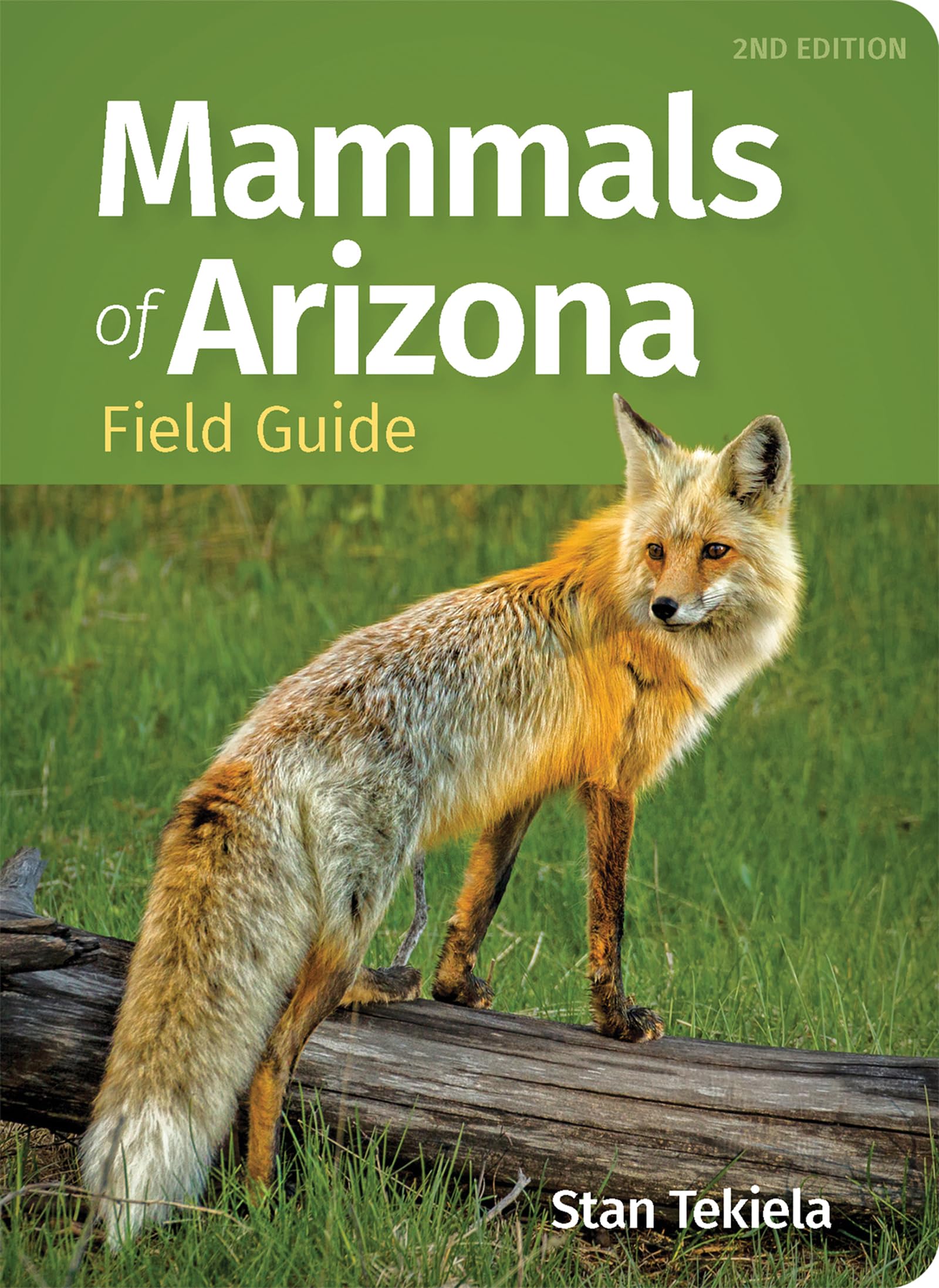



Identify Arizona mammals with this easy-to-use field guide, organized by family and featuring full-color photographs and helpful information. Whether you happen upon an animal track or actually see wildlife in nature, interacting with mammals is a thrill. Learn to identify mammals in Arizona. With Stan Tekiela’s famous field guide, mammal identification is simple and informative. The Mammals of Arizona Field Guide features all 144 species found in the state, organized by family and then by size. When you see a mammal, you can determine its family by common visual characteristics and then turn to the corresponding section to find out what it is! Fact-filled information contains the particulars that you want to know, while full-color photographs provide the visual detail needed for accurate identification. Inside you’ll find: All 144 of Arizona’s mammals, from mice to mountain lions - Facts about size, habitat, food, young, and more - Times each animal is most likely to be active and signs it might leave behind - Professional photos, range maps, and track patterns - Stan’s naturalist notes and fascinating facts Grab this second edition of the Mammals of Arizona Field Guide for your next outing to help ensure that you positively identify the wildlife you see. Naturalist, wildlife photographer, and writer Stan Tekiela is the author of more than 190 field guides, nature books, children’s books, and playing cards, presenting many species of birds, mammals, reptiles, amphibians, trees, wildflowers, and cacti in the United States. With a Bachelor of Science degree in Natural History from the University of Minnesota and as an active professional naturalist for more than 30 years, Stan studies and photographs wildlife throughout the United States and Canada. He has received various national and regional awards for his books and photographs. Also a well-known columnist and radio personality, his syndicated column appears in more than 25 newspapers and his wildlife programs are broadcast on a number of Midwest radio stations. White-tailed Deer Odocoileus virginianus couesi Family: Deer (Cervidae) Size: L 3–6' (0.9–1.8 m); T 6–12" (15–30 cm); H 3–4' (0.9–1.2 m) Weight: M 70–120 lb. (32–54 kg); F 50–75 lb. (23–34 kg) Description: Reddish brown during summer, grayish brown during winter. Large ears, white inside with black edges. A white eye-ring, nose band, chin, throat, and belly. Brown tail with a black tip and white underside. Male has antlers with many tines and an antler spread of 12–36" (30–91 cm). Female has a thinner neck than male and lacks antlers. Origin/Age: native; 5–10 years Compare: Smaller and less common than the Mule Deer (pg. 323), which has a small, thin white tail with a black tip. Elk (pg. 327) has a dark mane and is much larger and heavier than White-tailed Deer. Habitat: all habitats, all elevations Home: no den or nest; sleeps in a different spot every night, beds may be concentrated in one area, does not use a shelter in bad weather or winter, will move to a semisheltered area (yard) with a good supply of food in winter Food: herbivore; grasses and other green plants, acorns and nuts in summer, twigs and buds in winter Sounds: loud whistle-like snorts, male grunts, fawn bleats Breeding late Oct–Nov mating; 6–7 months gestation Young: 1–2 fawns once per year in May or June; covered with white spots, walks within hours of birth Signs: browsed twigs that are ripped or torn (due to the lack of upper incisor teeth), tree rubs (saplings scraped or stripped of bark) made by male while polishing antlers during the rut, oval depressions in grass or leaves are evidence of beds; round, hard brown pellets during winter, segmented cylindrical masses of scat in spring and summer Activity: nocturnal, crepuscular; often moves along same trails to visit feeding areas Tracks: front hoof 2–3" (5–7.5 cm) long, hind hoof slightly smaller, both with a split heart shape with the point in the front; neat line of single tracks; hind hooves fall near or directly onto fore prints (direct register) when walking Stan’s Notes: Almost extirpated in the 1920s. It has recovered well and is now found in most river bottoms in southeastern Arizona. In Arizona the White-tailed Deer is actually a subspecies known as Coues White-tailed Deer. Coues Whitetails look the same as White-tailed Deer ( O. virginianus ), their eastern counterpart, except that they are smaller and weigh less. Also called Virginia Deer or just Whitetail. Much longer guard hairs in winter give the animal a larger appearance than in summer. Individual hairs of the winter coat are thick and hollow and provide excellent insulation. In summer, antlers are covered with a furry skin called velvet. Velvet contains a network of blood vessels that supplies nutrients to the growing antlers. New antler growth begins after the male (buck) drops his antlers in January or February. Some females (does) have been known to grow antlers. Deer are dependen