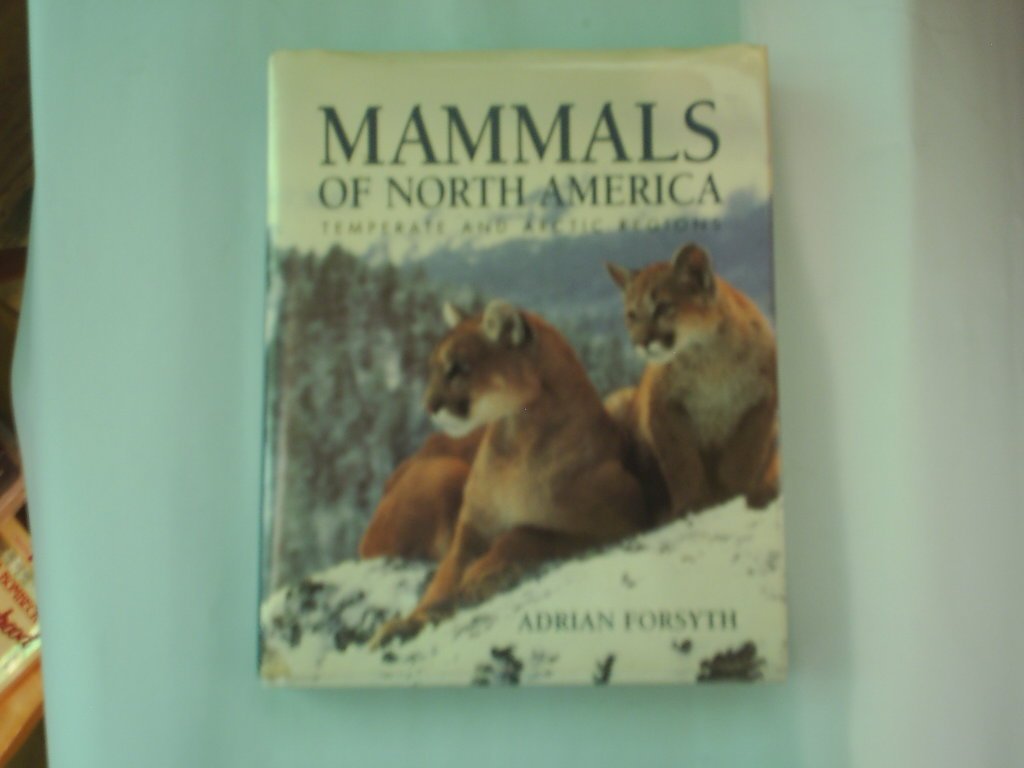



This landmark reference by award-winning science writer Adrian Forsyth is completely up-to-date with the latest scientific names and behavioral data on the wild mammals of North America. Much more than a field guide, Mammals of North America goes beyond simple identification and description, and delves into the reasons wild mammals live and act the way they do: Why are some predators highly social, while others live alone? Why must shrews no bigger than a thimble eat more than their body weight each day or face certain starvation? How can a bat pick a small insect off the surface of a leaf in total darkness? How did a squat prehistoric pig-like animal evolve into one of the world's fastest creatures, the pronghorn antelope? Blessed with vast areas of wilderness, the United States and Canada support the largest and healthiest populations of native mammals on Earth. Even residents of urban centers are seldom more than a morning's drive from the splendors of wild-mammal life. Whether you enjoy wildlife firsthand or from the comfort of your armchair, Adrian Forsyth's Mammals of North America will prove an essential and fascinating resource. Field guides help naturalists identify animals, but understanding their behavior is much more difficult. That's why this hefty reference work is so welcome. Mammals of North America is an excellent introduction to the behavior, ecology, and evolution of temperate and arctic mammals. Adrian Forsyth, a scientist and author of several other books on natural history, provides more than 100 species accounts, complete with excellent color photographs, range maps, basic life-history data, and concise summaries of behavior and ecology. From bighorn sheep to pygmy shrew, blue whale to black bear, Forsyth always finds something interesting to say. But Forsyth's best writing shines in the mini-essays that occur throughout the text. What good are antlers? At less than a 10th of an ounce, how do shrews stay warm? Why do mammals produce milk? (From modified sweat glands, no less!) Why are seals such excellent divers? These topics allow him to address the big issues raised by recent advances in ecology and evolution, but always in the context of the mammal at hand, hoof, or flipper. The geographical coverage is not truly North American. Forsyth provides accounts for only one-third of the North American species in some families. Most of the species omitted are from California, the arid Southwest, and Mexico. Is a companion volume for the arid regions of North America planned? Even with these omissions, Mammals of North America provides rich rewards for armchair naturalists as well as those who follow Louis Agassiz's advice to "study Nature, not books." --Pete Holloran This book provides information on over 150 species of mammals organized by taxonomic classification. Although the focus is on Canada and the northern United States, many species have ranges extending far to the south. Forsyth, a biologist with the W. Alton Jones Foundation and the Smithsonian Institution, furnishes the usual details about anatomy, habitat, diet, gestation, and range for each species, but the emphasis is on animal behavior--particularly why animals behave the way they do. He also covers some subjects that usually fall outside the realm of field guides, such as animal welfare, pollution, and the effects of human interaction. Whereas The Smithsonian Book of North American Mammals (LJ 11/15/99) covers twice as many species, it is geared toward a more scholarly audience. Forsyth's book, with its accessible style of writing and useful index, is more easily approachable for the lay reader who may not know the scientific classification of a species. The currency of the material is questionable, however, as this work duplicates to a large extent Forsyth's earlier Mammals of the American North (1985. o.p.), the primary differences being the reversed order of the chapters and new photographs. Libraries should therefore choose the more comprehensive and authoritative Smithsonian book over Forsyth's. -Teresa Berry, Univ. of Tennessee Libs., Knoxville Copyright 2000 Reed Business Information, Inc. In the introduction, Forsyth, a science writer and biodiversity expert who serves as a researcher at the Smithsonian, states that one of this book's goals is to interest readers in the wild mammals that currently flourish in North America. As modern society encroaches upon their habitats and threatened ecosystems, many of these animals may become endangered. The author has limited his work to approximately 150 species that inhabit some of the same territory as humans. He hopes that readers will come to appreciate these creatures and work to save them from extinction. Each chapter follows the same format: the common name of the species followed by the Latin name; a color photograph; a sidebar consisting of a map with the habitat shaded, a description, and vital statistics, including life span, diet, habitat, pred