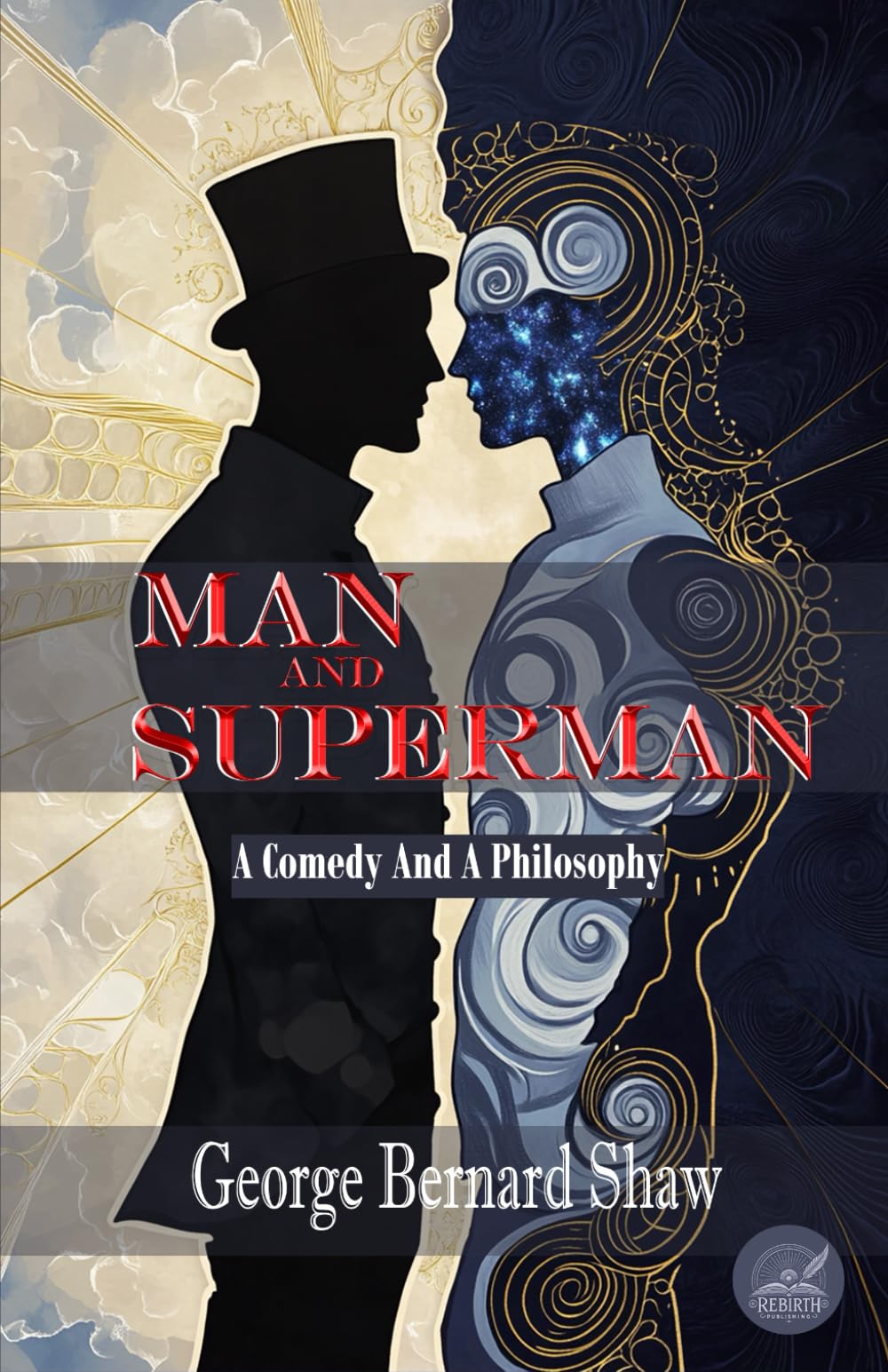
Man And Superman - A Comedy And A Philosophy: Rebirth Special Edition | Annotated
$10.95
by George Bernard Shaw



MAN AND SUPERMAN by G. Bernard Shaw A Revolutionary Philosophical Comedy with New Critical Commentary George Bernard Shaw's masterpiece "Man and Superman" is one of the most intellectually daring twentieth century's dramatic works. This definitive edition includes Shaw's complete text—including the rarely performed "Don Juan in Hell" sequence—alongside illuminating new critical commentary that guides readers through the playwright's revolutionary vision. More than a century after its first publication in 1903, "Man and Superman" continues to challenge and provoke with its fusion of Nietzschean philosophy, evolutionary theory, and romantic comedy. Shaw transforms the legendary Don Juan into John Tanner, a reluctant revolutionary pursued by Ann Whitefield, the embodiment of what Shaw called the "Life Force"—the evolutionary energy driving humanity toward higher consciousness. Key Philosophical Themes Explored: The Life Force : Shaw's revolutionary concept of purposeful evolution working through human desire and consciousness - Superman Philosophy : How Shaw adapted Nietzsche's Übermensch into a vision of evolved moral and intellectual capacity - Gender Revolution : Shaw's subversion of traditional romantic narratives by portraying women as evolutionary agents - Socialist Vision : The connection between political revolution and human evolutionary advancement - Conscious Evolution : Humanity's potential to direct its own development through expanded awareness Theatrical Significance Illuminated: Shaw's reinvention of the Don Juan legend as a vehicle for modern philosophical exploration - The playwright's linguistic revolution transformed the dramatic dialogue - The challenge of staging philosophy and how directors have approached this unique theatrical work - Shaw's comedic technique makes revolutionary ideas accessible and entertaining - The play's influence on subsequent dramatists from Brecht to Stoppard This edition places "Man and Superman" in its intellectual context while revealing its remarkable contemporary relevance. Shaw's insights into gender dynamics, evolutionary purpose, and the relationship between individual will and biological imperative speak directly to twenty-first-century concerns about genetic engineering, reproductive technology, and humanity's evolutionary future. The included foreword traces the genesis of Shaw's revolutionary vision through his "Epistle Dedicatory to Arthur Bingham Walkley," revealing how the play emerged from Shaw's determination to use theater as a forum for ideas rather than mere entertainment. The afterword examines the play's production history and enduring influence, demonstrating how each generation discovers new significance in Shaw's prophetic work. Whether approaching "Man and Superman" as a literary masterpiece, philosophical treatise, or theatrical landmark, readers will find a comprehensive guide to one of the most intellectually stimulating works in the dramatic canon in this edition. Shaw's vision of human potential—simultaneously optimistic and demanding—continues to challenge us to participate consciously in our evolution, making this play not merely a historical artifact but an ongoing provocation to expanded consciousness. Enter Shaw's revolutionary world where comedy reveals the evolutionary purpose and human consciousness knowingly participates in its advancement. This world remains as challenging, inspiring, and necessary today as when it first appeared.