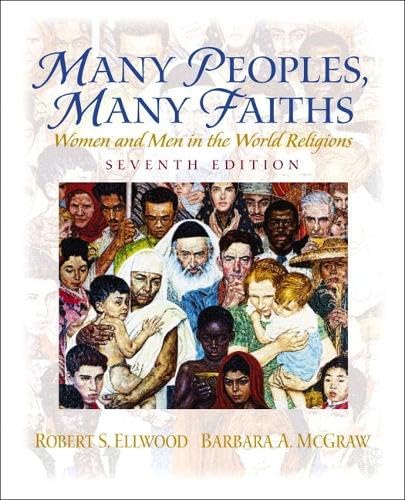
Many Peoples, Many Faiths: Women and Men in the World Religions (7th Edition)
$40.46
by Robert S. Ellwood



For more than three decades this introduction to the world's religions, Many Peoples, Many Faiths has combined factual information with empathic writing that seeks to convey the flavor of our planet's diverse religions and cultures. This classic work helps students gain a sense of each religion's unique characteristics while tackling some of today's most critical religious issues. It is written in an engaging style and has been fully updated--with fresh insights and information on each of the world’s major religions, along with new religious movements. Understanding the many faiths of the many peoples of the earth requires a balance of knowledge and empathy. For twenty-five years, Many Peoples, Many Faiths has successfully explored the diverse religions and cultures comprising our world by presenting factual information in a sensitive and engaging style. In this Seventh Edition, Robert Ellwood and Barbara McGraw describe the conceptual, sacred, and social elements of various religions, incorporating recent methods in religious studies. This widely-used text portrays religious life as an intriguing and important dimension of human existence. Especially new to this edition are expanded discussions of: The role of women in world religions - Diverse religious practices within the mufti-cultural United States - Contemporary religious movements throughout the world (e.g., an entire chapter is devoted to such emerging religions as China's Falun Gong) - Practical outlines for writing papers on religious visits and world religions - Updated topics on social problems and how religions respond The authors have added new books to the Suggested Reading list and have expanded the Glossary as a true teaching aid. The text's illustrations and maps are improved to bring to life the colorful world of religion and its geography. For nearly three decades this introduction to the world's religions, Many Peoples, Many Faiths, has endeavored in various ways to combine factual information with empathetic writing that tries to convey something of the flavor of our planet's diverse religions and cultures. While striving for accuracy and depth, it is neither an encyclopedic compilation of data nor a survey of alternative philosophies. Instead, it seeks to present something of the total human experience, made up as it is of an inseparable mingling of conceptual, worship, and social factors, of religious life from past to present. The authors hope that their efforts will implant in many readers a sense of the richness and fascination of the areas of scholarship that lie behind the presentation of this experience, and that it will inspire at least some to explore these areas more deeply. Barbara McGraw, Associate Professor, St. Mary's College of California, joined with the original writer, Robert Ellwood, Emeritus Professor, University of Southern California, as coauthor for the sixth edition of Many Peoples, Many Faiths, and continues to have a large part in the rewriting of all sections of the seventh edition of the book. In particular, Professor McGraw has contributed nearly all of the material that was added in the sixth edition on women in the world religions. The growing interest in this issue and its own intrinsic importance have led both of us to believe that world religions textbooks must now give substantial amounts of space and detail to the role and experience of women in religion. And we hope that the effort to combine factual information with empathetic writing has been carried over into the material on women in the world's faiths, while recognizing at the same time that sometimes shedding light on a subject at all may call its basic tenets into question. In general, this seventh edition of Many Peoples, Many Faiths seeks to continue the balanced and empathetic approach to the religions of the world toward which previous versions have striven. Additions made to earlier editions have been maintained and, where appropriate, updated. For example, in the sixth edition new material was added throughout on the presence of the world religions in the United States. Further, it was previously recognized that in a world increasingly faced with very difficult choices and with a growing awareness of current injustices, no human institution, religion included, can avoid challenge and criticism. New material was previously added to the introductory chapter on critical approaches to religion, and a new final chapter was then appended on religion in the context of present and future crises, which has been substantially revised for the seventh edition. Readers will be challenged to think about how religion has responded to present developments in ecology, technology, globalization and other trends, and what possible futures for religion there may be in light of them. Further, this seventh edition has been substantially edited in many places and additional headings have been added as "pointers" to make the material