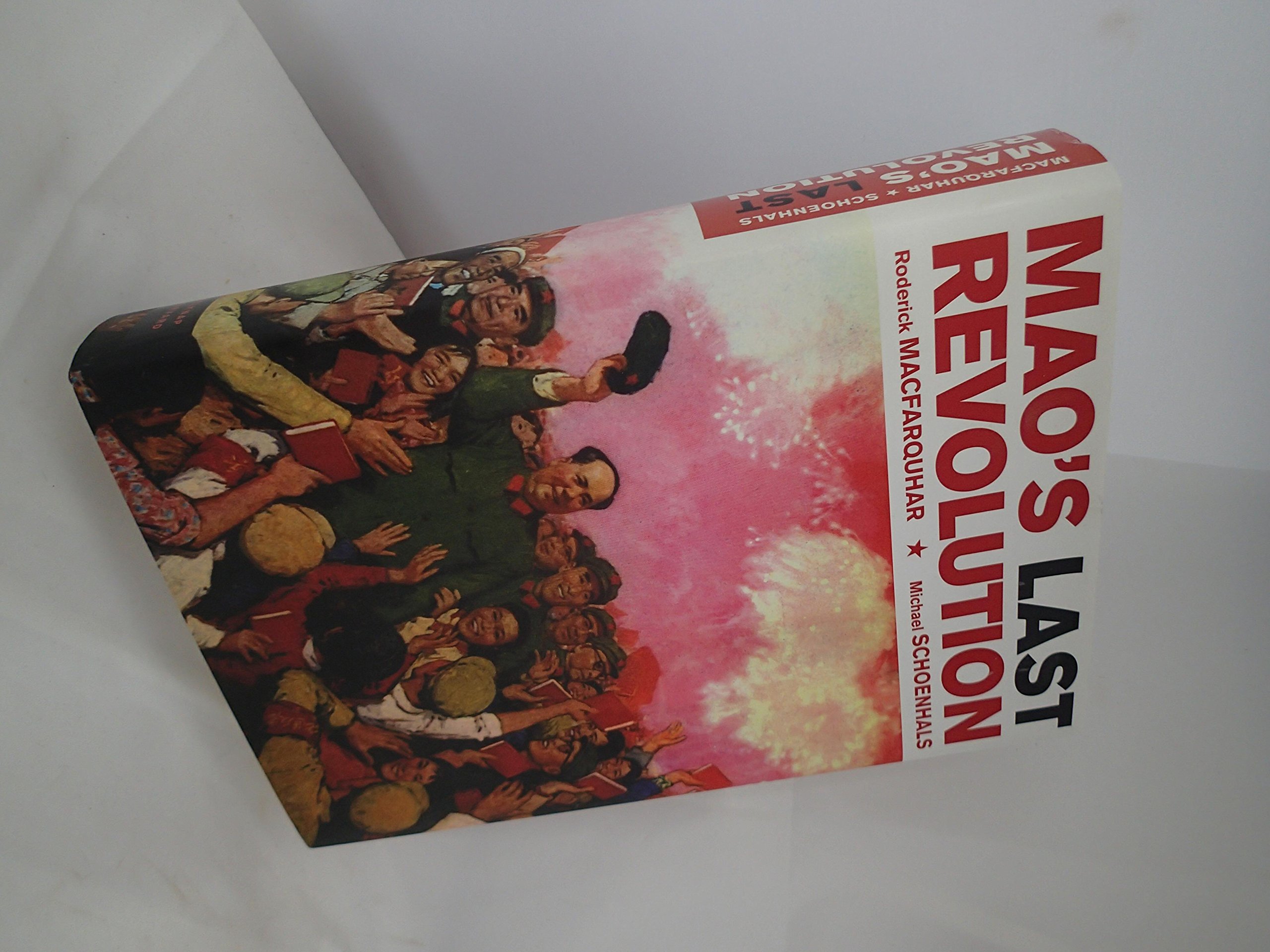



The Cultural Revolution was a watershed event in the history of the People’s Republic of China, the defining decade of half a century of communist rule. Before 1966, China was a typical communist state, with a command economy and a powerful party able to keep the population under control. But during the Cultural Revolution, in a move unprecedented in any communist country, Mao unleashed the Red Guards against the party. Tens of thousands of officials were humiliated, tortured, and even killed. Order had to be restored by the military, whose methods were often equally brutal. In a masterly book, Roderick MacFarquhar and Michael Schoenhals explain why Mao launched the Cultural Revolution, and show his Machiavellian role in masterminding it (which Chinese publications conceal). In often horrifying detail, they document the Hobbesian state that ensued. The movement veered out of control and terror paralyzed the country. Power struggles raged among Lin Biao, Zhou Enlai, Deng Xiaoping, and Jiang Qing—Mao’s wife and leader of the Gang of Four—while Mao often played one against the other. After Mao’s death, in reaction to the killing and the chaos, Deng Xiaoping led China into a reform era in which capitalism flourishes and the party has lost its former authority. In its invaluable critical analysis of Chairman Mao and its brilliant portrait of a culture in turmoil, Mao’s Last Revolution offers the most authoritative and compelling account to date of this seminal event in the history of China. MacFarquhar and Schoenhals successfully synthesize the many plotlines of the Cultural Revolution in a narrative that shuttles from the endless micro-maneuvers of the Party elite to the marauding teens of the Red Guard; and from the Revolution's macro-economic fallout to such bizarre manifestations as the cannibalizing of counter-revolutionaries in Guangxi. Carefully orchestrating the pandemonium and fuelling it with his "deliberate opaqueness" is the figure of Mao Zedong. Utterly unfazed by violence"China is such a populous nation, it is not as if we cannot do without a few people," he remarkedhe hoped the Revolution would perpetuate his legacy. But the arbitrary brutality of the regime insured the opposite. One weary subject recalled that when Mao died, in 1976, "the news filled me with such euphoria that for an instant I was numb." Copyright © 2006 Click here to subscribe to The New Yorker The two leading experts in the West on the Cultural Revolution offer a powerful--and awful--tale, tackled on a grand scale. One can see the corrosive effect of Mao Zedong on just about everyone with whom he came in contact at this time. This perceptive study of the Cultural Revolution is a strong achievement. --Jonathan Spence Given the hostile biographies and debunking histories that have recently appeared, it's safe to say that Mao's overlong honeymoon is over. In this exhaustive critique of the terrifying Great Proletarian Cultural Revolution between 1966 and 1976, when Mao unleashed the Red Guards on his people, MacFarquhar and Schoenhals deliver the divorce papers. [They] cover the unceasing, pointless intrigues between Mao and his chief henchmen as the violence and denunciations, the staged humiliations and mass executions raged out of control, and the country lurched into turmoil. ( Publishers Weekly (starred review) 2006-06-26) Supple prose, impeccable scholarship, and a Great Wall of bibliography...MacFarquhar and Schoenhals confirm our suspicions that without the disaster of the Cultural Revolution, China would not have been so eager to motor down the 'capitalist road,' and that Mao himself, purging comrades with 'deliberate opaqueness,' called every bloody shot. --John Leonard ( Harper's 2006-09-01) An exhaustive history of China's Cultural Revolution. --Benjamin Healy and Benjamin Schwarz ( The Atlantic 2006-07-01) [A] detailed, important book...For anyone interested in the period it contains real insights into the Cultural Revolution, when hundreds of thousands were killed, many dying without knowing what they had done wrong. The book communicates an amazing sense of escalation as Mao's 'Red Terror' spread through the campuses and schools of Beijing and then into factories, the countryside and people's homes. Intent on preserving power, Mao constructed elaborate intrigues around himself and the book captures the hysteria of the era in its descriptions of Red Guards, leftist students and schoolchildren roaming the streets attacking intellectuals, screaming denunciations of 'rightists' and 'revisionists,' forcing their elders to wear dunce hats, beating them up and exiling them to the country... Mao's Last Revolution leaves the reader in no doubt that Mao was a monster, but its dispassionate tone points a way towards understanding the genesis of that evil. Showing how Mao conceived and carried out the Cultural Revolution is crucial to building a broader understanding of that tumultuous period in Chinese hi