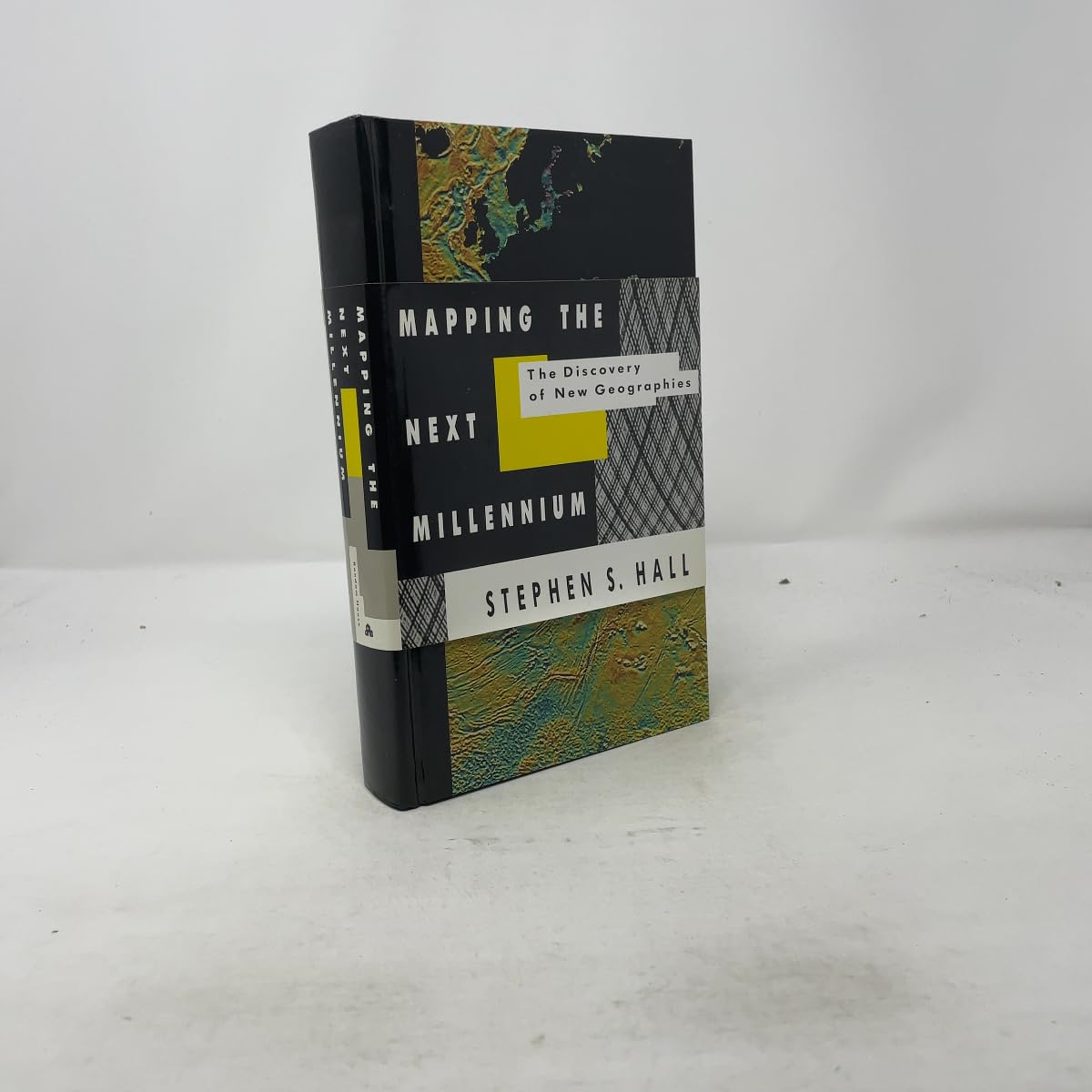



Discusses the use of innovative new technologies to map diverse areas of the universe, from the mathmatical constant pi, to human chromosomes, to the ocean floor In the spirit of John Noble Wilford's The Mapmakers ( LJ 4/15/81) in which he writes "an unmapped discovery is of little value to succeeding generations," this book celebrates the science of high - tech cartography. From maps of the ocean floor to the human genome, science writer Hall discusses, in 18 essays, how the frontiers of science are revealed in their graphic representations. The essays are arranged into four broad categories: "Planetary Landscapes, Ours and Others" "The Animate Landscape," "Probalistic Landscapes, Atomic and Mathematical" and "Astronomical and Cosmological Landscapes." While the individual topics vary, the focus on maps gives the collection a thematic continuity. Despite an occasional tendency to ramble, Hall conveys a genuine enthusiasm for maps of all kinds. Recommended for any library. - Gregg Sapp, Montana State Univ. Libs., Bozeman Copyright 1992 Reed Business Information, Inc. In beautiful and sometimes moving prose, Hall (Invisible Frontiers, 1987) argues here that the common ground of space exploration, medical tomography, cosmology, greenhouse-effect modeling, and biotechnology is the map--and then offers a Grand Tour of the charting of these realms. It's a common story, but never better told, how the two Voyager spacecraft almost never made it off the ground because of wrangles deep within NASA; how a graduate student named Gary Flandro helped save the project when he stumbled onto the gravity- assist method of boosting trajectories, and saw how the planets lined up in the 1980's so that they could be visited in one mission. With a sort of inspired doodling, Flandro had produced a primitive navigational chart; the Voyagers plunged into the almost- unknown, and when they got there, Neptune wasn't where it was supposed to be. That's what maps are for, Hall says: To condense what we've said to be true into graphic, comprehensible form--and then, if necessary, we can change the map. Hall reflects passionately on the way exploration has generated maps that are then lost to imperial interests, or to the military (the US Navy, for example, resisted satellite mapping of the ocean floor because it feared it would make submarine routes obvious). Maps of genes, Hall says, point toward a sort of de facto eugenics, and there is precious little debate on the matter. And a new map of titanium deposits on the moon may only foster the sorts of abuses that Lewis and Clark inadvertently brought to the West. ``Maps inspire action,'' Hall says. It may even be, in a sick world, that better maps mean more sickness. Hall quotes the philosopher Sandra Harding: ``More science in a socially regressive society...will increase the movement of the resources from the many to the few.'' For the generalist striving mightily to keep up, this is a godsend. (Sixteen pages of color and 75 b&w illustrations--not seen.) -- Copyright ©1991, Kirkus Associates, LP. All rights reserved.