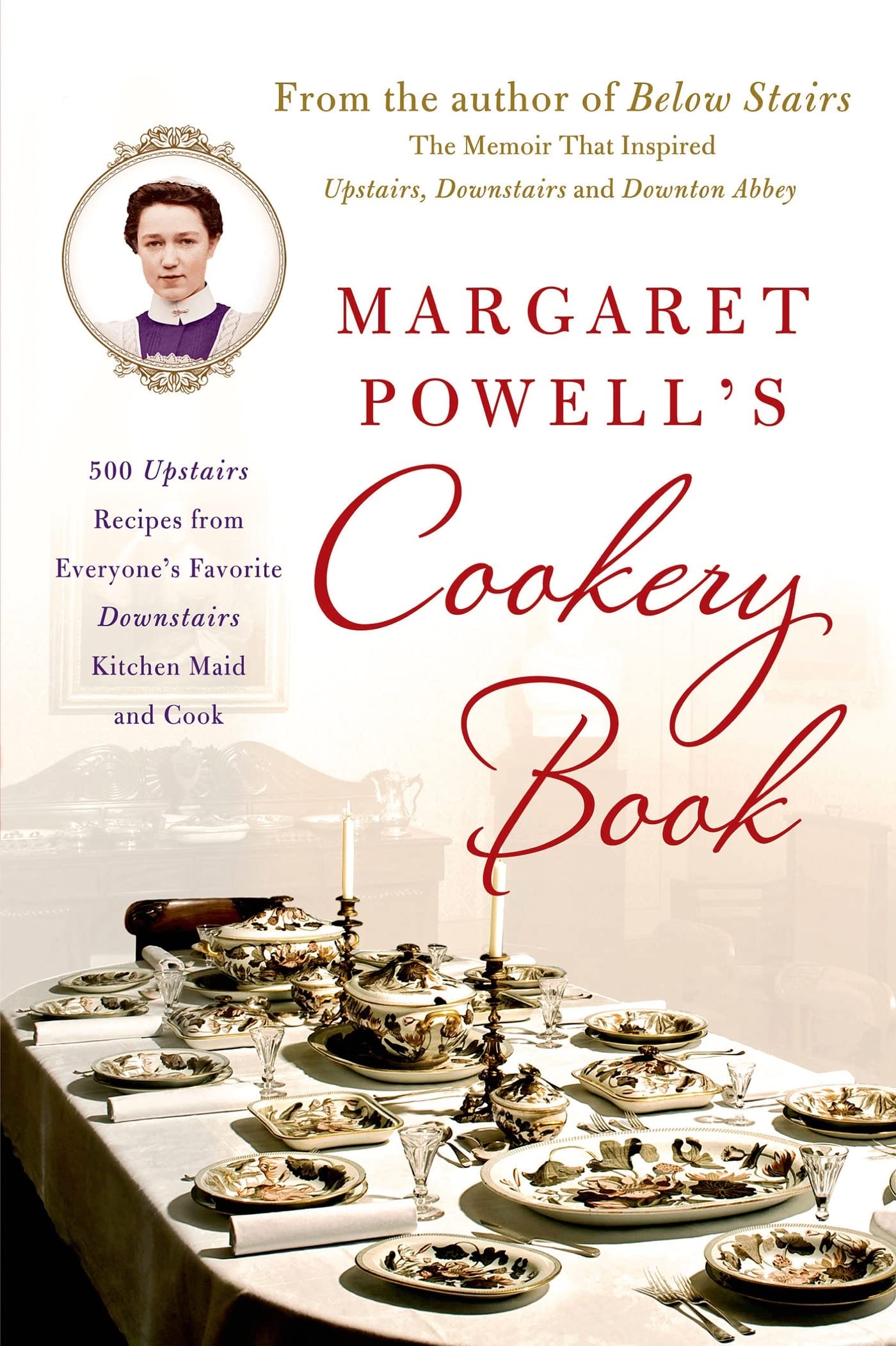



In the national bestseller Below Stairs , Margaret Powell told readers what it was really like to work in the great houses of England. In Margaret Powell's Cookery Book , she gives readers a closer look at the world inside the vast kitchens of these great houses. It's an eye-opening and mouthwatering snapshot of that world. The upstairs dining room always demanded the best of Continental cuisine and, cooking downstairs, Margaret Powell obliged. Her cookery book is a firsthand account of the way English people cooked and dined in the early twentieth century when houses like those in "Upstairs, Downstairs" and "Downton Abbey" were fully staffed and running like clockwork. Describing kitchen equipment such as the black ranges that had to be shined daily, the fancy moulds that needed screen covers to keep out the flies and tubs of ice that were used instead of refrigerators, she tells readers just how big a job it was to keep the upstairs dining table abundantly filled. Giving away the secrets of the manor, she presents more than 500 recipes, from the simple to the sophisticated. Divided into chapters such as Hors d'oeuvre, Soups, Fish, Entrees, Roasts and Meat Dishes , Savouries, Puddings and others, she shows readers today what it was like to eat well, if you were a member of England's upper class. Classic, but simple, dishes such as Shepherd's Pie and Roast Chicken Stuffed with Herbs alternate with sophisticated fare and long-lost recipes like Potatoes a la Florence, Rabbit Pilau, Compote of Snipe, Sardines a la Bombay and Queen Mab Pudding. With her trademark wit and gimlet eye, she tells readers what it was like to cook for her "betters" but she also states one thing proudly--"Food is more than just food. I like it be prepared and cooked well, and I like trouble taken over it." Behind every well-fed family like the Crawleys of "Downton Abbey" or the Bellamys of "Upstairs, Downstairs" was a cook like Margaret Powell and, now, she invites readers everywhere to the feast. “...I suspect the real story of the relationship of servants to their masters is more accurately told by Margaret Powell in her simple and quite brilliant "Below Stairs"..."What makes Powell such a credible narrator is the fact that she's never reflexively bitter or nasty. When she worked for a family that treated her with kindness... she was deeply grateful... Below Stairs retains its peculiar fascination.” ― The New York Times on Below Stairs “An irresistible inside account of life "in service" and a fascinating document of a vanished time and place.” ― Kirkus Reviews on Below Stairs “[A] sharply observed memoir… stands out in the tradition of literature about servants for being a true account…although the incidents are as vividly entertaining and disturbing as anything found in fiction.” ― Wall Street Journal on Below Stairs “Powell was the first person outside my family to introduce me to that world …I certainly owe her a great debt.” ― Julian Fellowes, creator of Downton Abbey on Below Stairs MARGARET POWELL was born in 1907 in Hove, and left school at the age of 13 to start working. At 14, she got a job in a hotel laundry room, and a year later went into service as a kitchen maid, eventually progressing to the position of cook, before marrying a milkman called Albert. In 1968 the first volume of her memoirs, Below Stairs , was published to instant success and turned her into a celebrity. She died in 1984. Margaret Powell's Cookery Book 500 Upstairs Recipes from Everyone's Favorite Downstairs Kitchen Maid and Cook By Margaret Powell St. Martin's Griffin Copyright © 2013 Margaret Powell All right reserved. ISBN: 9781250038562 Margaret Powell's Cookery Book 1 LEARNING TO COOK Lots of girls nowadays by the time that they get married know a great deal about cooking, because their mothers have let them learn it at home. Today people have got more money and can experiment, but when I was a girl money was so tight and food was so precious that my mother couldn't possibly let me practise at cooking. I used to peel the vegetables and do other odd jobs for her, but that was all. I'd get upset about it because I would have loved to make pastries and cakes. I was always anxious to learn. I knew that other mothers let their daughters cook and I thought Mum was being unkind. When you're young you don't really understand about the shortage of money.So it was that when I went into domestic service as a kitchen maid at the age of fifteen, I knew nothing about cooking at all. This surprised the cook. She was a Scot, and she told me that up there no mother would dream of bringing up a daughter without instructing her in the rudiments of cooking from a very early age, but she was quite kindly. 'Well, gal,' she said when I joined her, 'you're going to have to begin at the beginning. It may be no bad thing at that. At least you'll learn to do things my way. Just keep your eyes and ears open and do as I do or as I tell you.'Th