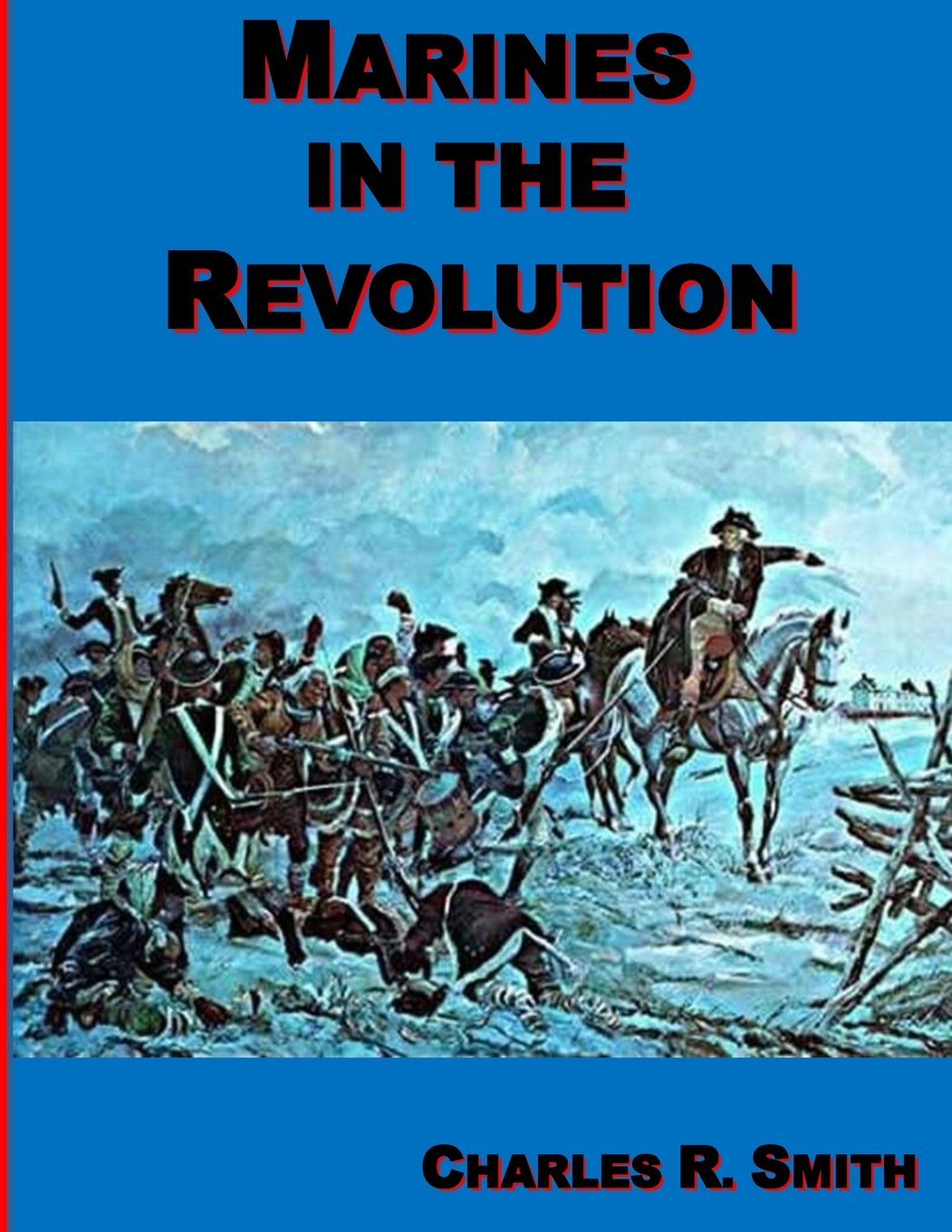
Marines in the Revolution: A History of the Continental Marines in the American Revolution 1775-1783
$24.95
by Charles R. Smith



Note: This is a rare work on the early history of the Marine Corps. Since it originally was published a number of years ago in a much larger format, we had to reduce it to a reasonable 8.5x11 inches. Readers may note some darkening of several page edges from the reduction process. Also several paintings have been reduced in size. All information has been retained and none of these minor appearance changes impact readability. Please enjoy this wealth if information.(SJP) Marines are as old as naval warfare itself. WhenThemistocles mobilized Athenian sea power againstthe invading Persians ¡n 480 B.C., one of his firstdecrees was to order the enlistment of Marinesfor the fleet. These men, called Epibatae, or "heavyarmed sea soldiers," fought in the Greek triremes at Salamis which turned back Xerxes and saved Athens. Later, Rome had what Polybius describedas milites classiarii (soldiers of the fleet), a categoryof Roman soldier organized and specially armed forduty on board warships, usually quinqueremes of the line. During the middle ages, ordinary soldiers werefrequently embarked on board ship to provide afighting backbone, but it was not until the navalwars of the 17th century that the distinct andorganized role of Marines was almost simultaneouslyrediscovered by the British and Dutch, whoraised the first two modern corps of Marines ¡n1664 and 1665, respectively.Americans of the 17th and 18th centuries werenotably a maritime people. The British colonies wereclose to the sea, but scattered along a coast lineof more than a thousand miles, so that, in theabsence of good roads, intercommunication wasalmost completely by water. Ocean trade also,chiefly with England and the West Indies, was extensive.Fishing was one of the most importantindustries, especially of the northeastern colonies,and the handling of small vessels on the NewfoundlandBanks during all seasons of the year trainedlarge numbers of men in seamanship. The whale fisherieslikewise furnished an unsurpassed schoolfor mariners.A considerable number of colonists, therefore,were at home upon the sea and, more than this,they were to some extent practiced in maritimewarfare. England, during the 17th and 18th centuries,was at war with various European powers agreat part of the time, and almost from the beginningof the colonial period American privateers andletters of marque scoured the ocean in search ofFrench and Spanish prizes. Large fleets were alsofitted out and manned by provincials for variousexpeditions against foreign-held territories. The firstof these expeditions to employ Americans in acapacity as Marines was that launched by AdmiralEdward Vernon against the Spaniards in the Warof the Austrian Succession.British Marines, after the Peace of Utrecht in 1713,were practically disbanded; only four invalid companiesremained. However, with the outbreak ofhostilities with Spain in 1739, King George Il tookmeasures to re-establish the Marines. On 15 November,in his address to the House of Commons whichopened Parliament, the King stated that the prosecutionof the war would require "a number of soldiersto serve on board the fleet," and he "judged itproper, that a body of Marines should be raised."The following month, an Order ¡n Council decreedthe formation of six regiments of Marines, eachwith an authorized strength of 1,100. Increases soonfollowed among them were three regiments organizedin the colonies and placed under the commandof Colonel Alexander Spotswood of Virginia.'