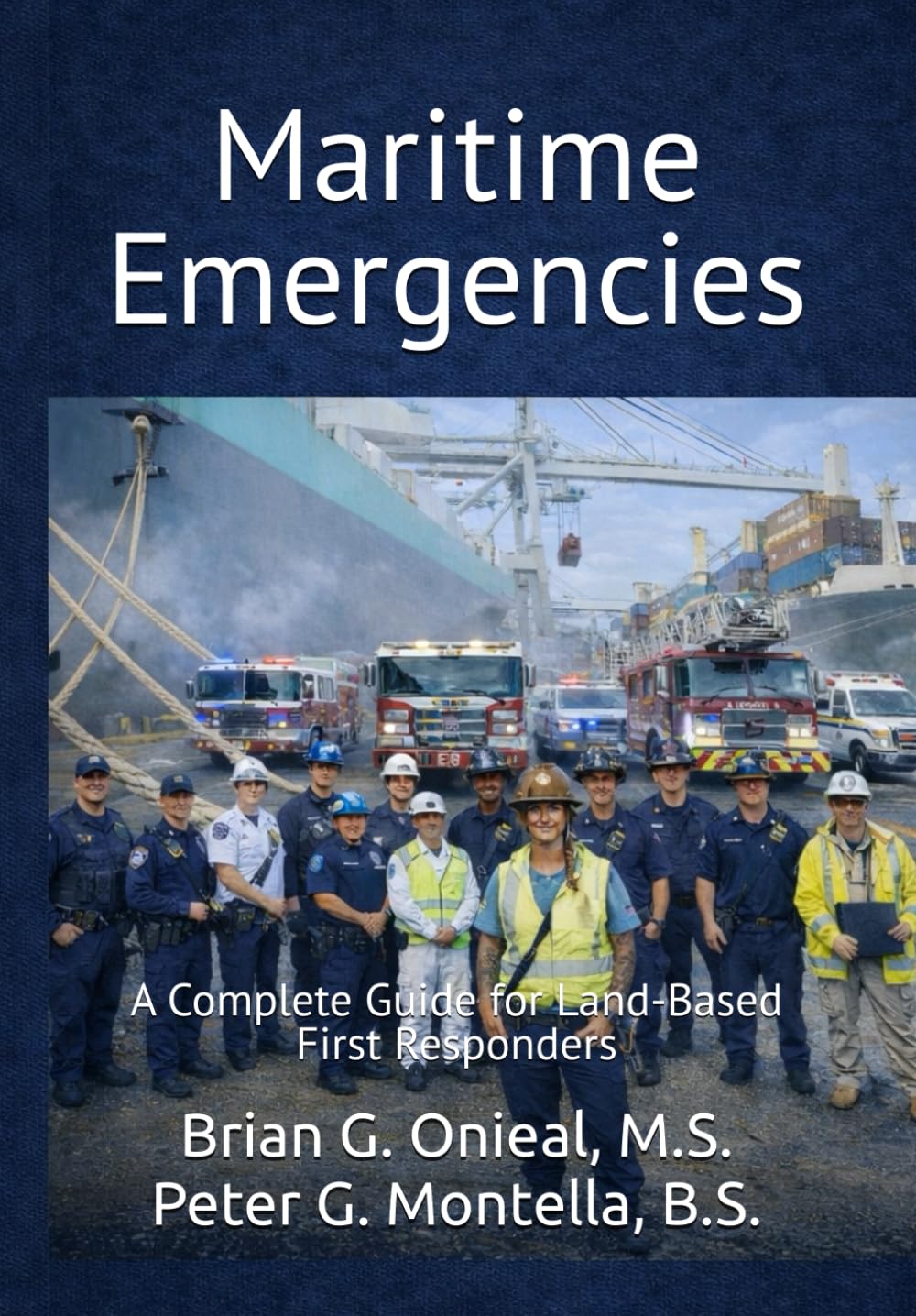
Maritime Emergencies: A Complete Guide for Land-Based First Responders
$17.99
by Brian G Onieal M.S



Maritime Emergency: A Complete Guide for Land-Based First Responders Everything feels familiar— until the vessel reminds you it operates under a completely different design logic. You move toward what seems like a routine emergency, and suddenly the environment shifts around you. Heat rises through the deck… ventilation changes… alarms activate… and you realize the openings in the steel aren’t damage—they’re engineered systems responding to the incident. On land, no one trains fire, EMS, police, or emergency managers to ask, “Is this surface, compartment, or atmosphere part of a system already in operation?” Yet aboard a vessel, that question can determine everyone’s safety. Maritime incidents—whether fire, medical, hazmat, security, or mechanical—unfold inside an engineered, multilingual, all-hazards environment. This book bridges the gap between land-based instincts and maritime reality. A vessel is not a building—and not a street - but with the right understanding, every responder can operate safely within it. When an emergency happens on the water, land-based response instincts can become liabilities. Maritime Emergency: A Complete Guide for Land-Based First Responders is the first practical, field-oriented reference written specifically for firefighters, law enforcement officers, EMS, emergency managers, and public safety leaders who may be called to respond to incidents involving vessels, ports, and waterfront infrastructure—often with little warning and no maritime background. Drawing on decades of real-world experience in ports, vessel incidents, and multi-agency emergency operations, this guide bridges the critical knowledge gap between land-based response doctrine and the realities of the maritime environment. Inside this book, readers will learn: Why vessels behave differently than buildings during fires, flooding, and structural failures - How ship design, cargo configuration, stability, and suppression systems affect responder safety - When not to board a vessel—and why restraint can save lives - How Incident Command, Unified Command, and Vessel Response Plans (VRPs) intersect during maritime emergencies - The roles of vessel masters, crews, Qualified Individuals, salvage teams, and marine firefighters - Key considerations for lithium-ion battery hazards, vehicle decks, container ships, ferries, terminals, and special events - How suspicious small-vessel activity, security zones, and maritime access control affect response posture - Practical checklists, operational considerations, and coordination principles aligned with ICS and HSEEP This is not a marine firefighting manual and not a replacement for specialized maritime training. Instead, it is an awareness and decision-support guide —designed to help land-based responders recognize hazards early, ask the right questions, establish appropriate command structures, and avoid preventable mistakes in low-frequency, high-consequence incidents. Written in clear, operational language and supported by real incident lessons, this book is ideal for: Firefighters and officers - Law enforcement and port police - EMS and rescue personnel - Emergency managers and planners - Port authorities and terminal operators - Training officers and exercise planners If your response area includes rivers, ports, terminals, ferries, or commercial vessels—this book belongs on your shelf before the call comes in. Preparedness begins with understanding.