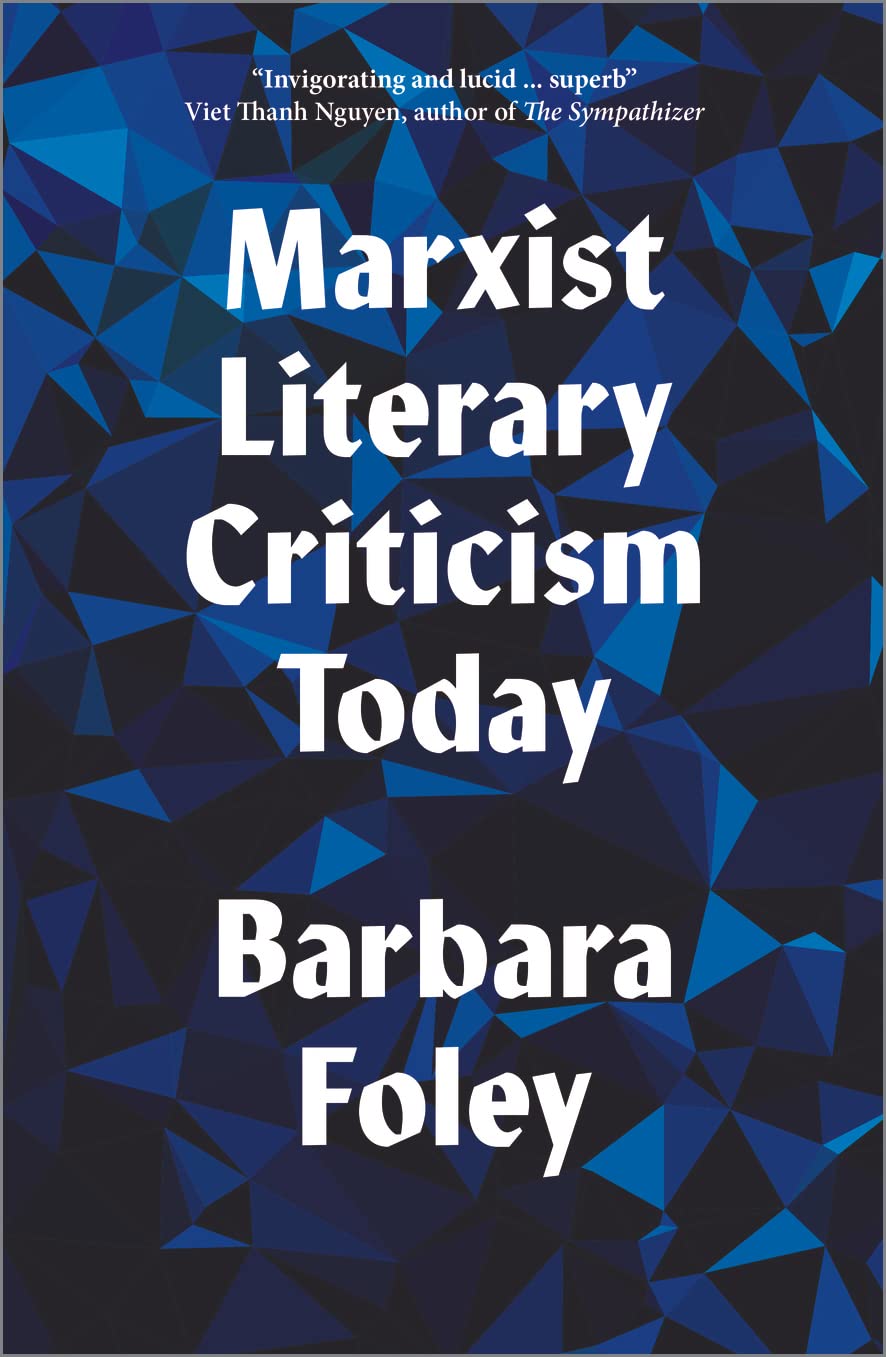



In the first introduction to Marxist literary criticism in decades, Barbara Foley argues that Marxism continues to offer the best framework for exploring the relationship between literature and society. She lays out in clear terms the principal aspects of Marxist methodology—historical materialism, political economy, and ideology critique—as well as key debates about the nature of literature and the goals of literary criticism and pedagogy. Examining a wide range of texts through the empowering lens of Marxism—from Jane Austen’s Pride and Prejudice to E. L. James’s Fifty Shades of Grey , from Frederick Douglass’s ‘What to the Slave Is the Fourth of July?’ to Annie Proulx’s ‘Brokeback Mountain’—Foley provides a clear and compelling textbook of Marxist literary criticism. 'A book many have longed for. Readers of literature will find Foley's lucid exposition of Marxist criticism an invaluable guide, even as the book's broad scope speaks to a wide audience' --Rosemary Hennessy, Rice University 'Widely surveying contemporary critical theory and practice, this magisterial book will be a valuable resource for students, critics, and activists for years to come' --Robert T. Tally Jr., Texas State University 'I warmly recommend this book especially for those who want to change the world as well as interpret it' --Richard Ohmann, Wesleyan University 'Invigorating and lucid - a fine introduction to Marxism in general and to Marxist literary criticism. Foley has done a superb job writing a book that is useful both for novices and for teachers who wish to show how literature is inescapably connected to the material world' 'Widely surveying contemporary critical theory and practice, Barbara Foley's magisterial book demonstrates the crucial significance of Marxism to our historical moment, and it will be a valuable resource for students, critics, and activists for years to come' 'Foley deftly sketches the lineaments of traditional Marxism, then some main interests of traditional criticism, and then shows in readings of literary texts what depth of insight comes from conjoining the two traditions. I warmly recommend this book especially for those who want to change the world as well as interpret it' 'This is a book many have longed for. Readers of literature will find Foley's lucid exposition of Marxist criticism an invaluable guide.' 'Invigorating and lucid. Foley has done a superb job writing a book that is useful both for novices and for teachers who wish to show how literature is inescapably connected to the material world' --Viet Thanh Nguyen, winner of the Pulitzer Prize for Fiction and University Professor, University of Southern California Barbara Foley is Distinguished Professor of English at Rutgers University, Newark. She has published widely in the fields of Marxist criticism, US literary radicalism, and African American literature. Her books include Wrestling with the Left: The Making of Ralph Ellison's Invisible Man and Spectres of 1919: Class and Nation in the Making of the New Negro . Marxist Literary Criticism Today By Barbara Foley Pluto Press Copyright © 2019 Barbara Foley All rights reserved. ISBN: 978-0-7453-3883-5 Contents Acknowledgements, vii, Prologue, x, PART I: MARXISM, 1. Historical Materialism, 3, 2. Political Economy, 33, 3. Ideology, 57, PART II: LITERATURE, 4. Literature and Literary Criticism, 87, 5. Marxist Literary Criticism, 122, 6. Marxist Pedagogy, 157, Notes, 226, Bibliography, 228, Index, 248, CHAPTER 1 Historical Materialism It is not the consciousness of men that determines their being, but, on the contrary, their social being that determines their consciousness. — Karl Marx, Preface to A Contribution to the Critique of Political Economy Associated with the writings of Karl Marx (1818–83) and his close collaborator Friedrich Engels (1820–95), Marxism is at once a philosophy, a method of analysis, and a guide to revolutionary social change. Although, as Engels recalled, Marx himself once famously declared, "I am not a Marxist" (FE to Schmidt, 5 August 1890, MEC ), since the publication of The Communist Manifesto in 1848 Marx's writings have probably had a more significant effect on revolutionary movements around the world, from Europe to Asia to Africa to the Americas, than have those of any other writer. His ideas have also had a widespread impact upon scholarship in the social sciences and the humanities. As the most cursory library or internet search will reveal, a tremendous amount has been written about Marx and Marxism. In addition, there have been many offshoots from the original texts by Marx and Engels that have claimed the heritage of Marxism, some of these in quite emphatic opposition to one another. The brief discussion of Marxism supplied in this chapter and the two that follow will not pretend to cover these debates, let alone resolve any of them; parenthetical citations will guide interested readers to