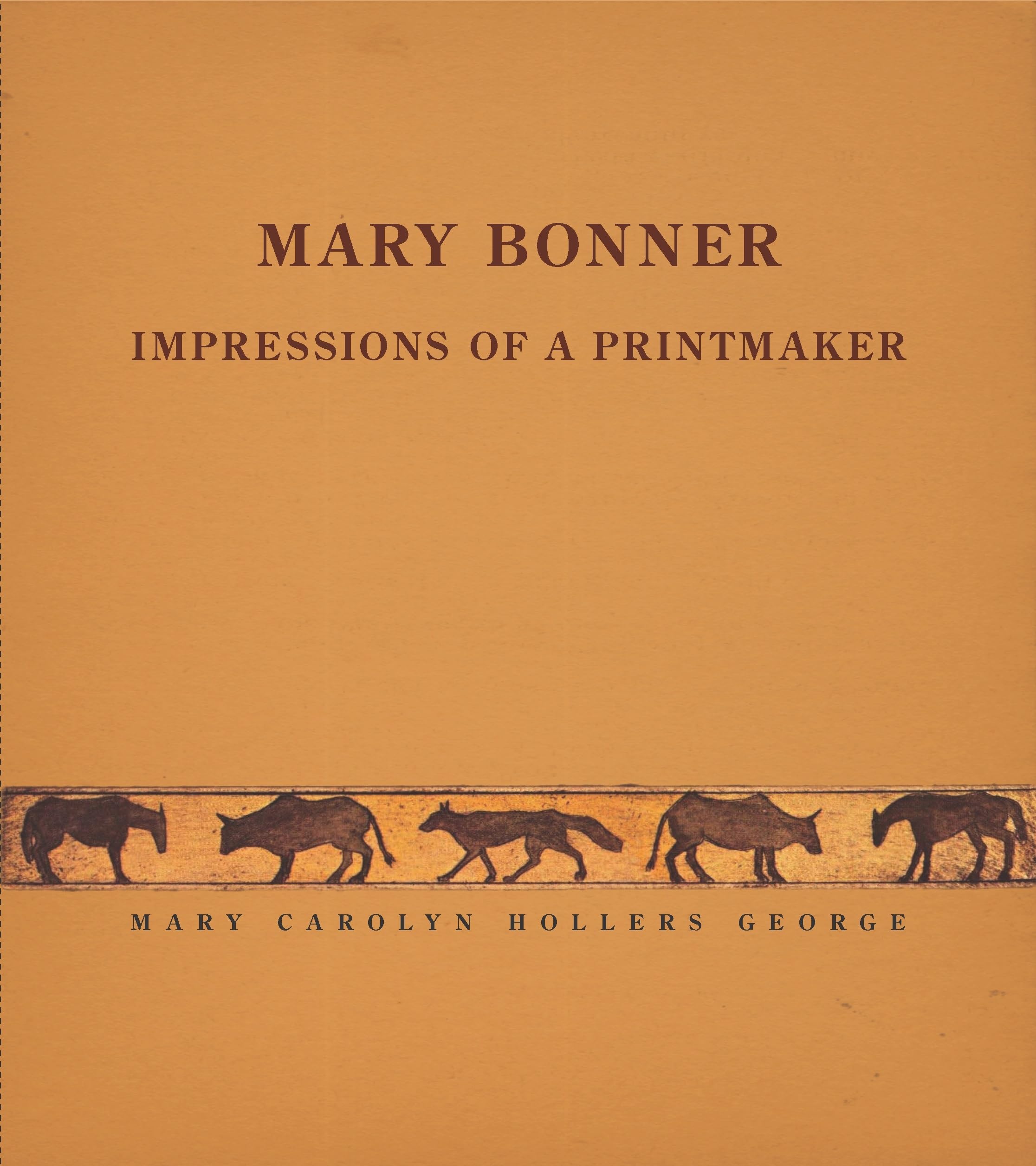



Mary Bonner: Impressions of a Printmaker is the definitive account of the life of an iconic Texas artist known for her delicate etchings and prints of the places and people that make South Texas unique. Mary Bonner begins with the artist’s early years in San Antonio and continues through her awakening as an artist at the Woodstock colony in upstate New York in summer 1922 to her years in France under the instruction of master printmaker Édouard Henri Léon. In Paris, Bonner began entering her work in juried exhibitions, and these early Paris prints were met with some acclaim. She came into her own when she began experimenting with a more innovative and modern style, exemplified by Les cowboys , a three-part frieze inspired by memories of her family’s ranch in Texas. After several years of dedicated study in Paris, Bonner began splitting her time between San Antonio and Paris. By 1928 she had begun to take on the causes of art and conservation in San Antonio, devoting less time to her own work. She spent the last years of her life at the family residence in San Antonio and died in 1935 at age forty-eight. Bonner’s legacy, both as an accomplished artist and as a steadfast advocate for the arts, lives on, especially in San Antonio. Mary Bonner is copublished with the National Trust for Historic Preservation and Villa Finale. The book will accompany a retrospective of Bonner’s work at the McNay Art Museum in San Antonio. This edition includes a new preface, an introduction by McNay curator Lyle Williams, and an afterword by Jane Lewis, director of Villa Finale. Mary Carolyn Hollers George , a native-born San Antonian, is a cultural historian whose work has largely focused on the architectural history of Texas and Mexico. She is the author of The Architectural Legacy of Alfred Giles and Mary Bonner: Impressions of a Printmaker , both published by Trinity University Press, and Alfred Giles: An English Architect in Texas and Mexico and O’Neil Ford, Architect . Her late husband, architect W. Eugene George, was her collaborator on many projects as photographer, designer, and wise counsel. Lyle Williams is the curator of prints and drawings at the McNay Art Museum in San Antonio, Texas. Jane Lewis is the executive director of Villa Finale in San Antonio, Texas. Introduction Mary Bonner in Context, by Lyle Williams Texas has a long printmaking tradition dating back to the days of the Republic in the 1840s. Most of the prints made back then, however, were of a commercial nature: mastheads for newspapers, topographic views, currency, and images used primarily to illustrate advertisements. Perhaps the most famous and sophisticated prints by an artist working in Texas in the nineteenth century were those by the German immigrant Hermann Lungkwitz. His views of the growing towns of Fredericksburg and San Antonio were not printed in Texas. Rather the artist sent his drawings back home to Dresden to be made into lithographs. This is all to say that while printmaking technology existed in Texas and San Antonio in the 1840s and 50s, there were no artists---and no presses---producing what could be called original fine art prints. It was not until Mary Bonner installed an etching press in the basement of her family’s home on East Agarita in San Antonio’s Monte Vista neighborhood in the summer of 1926 that San Antonio could claim to have its first fine art printmaker. This is why Bonner holds such an important place in our city’s art history. Some interesting insights into Bonner’s development as one of the state’s early, important printmakers arise from a comparison of Bonner’s life and career with that of another Mary who is arguably the most famous of all women printmakers, Mary Cassatt (1844-1926). Both artists were born to privilege and both must have had strong independent natures. Despite being women born in the highly patristic nineteenth century, they overcame significant hurdles to become artists. For Cassatt, that meant leaving the Pennsylvania Academy of Fine Arts because the faculty didn’t allow women to draw from nude models. It also meant overcoming French chauvinism regarding her nationality and her gender after her move to Paris. One is reminded of Edgar Degas’ comment upon admiring one of Cassatt’s drawings: “I don’t admit that a woman draws that well!” Bonner faced similar hurdles. While visiting the artists’ colony at Woodstock in upstate New York in the summer of 1922, she approached the man in charge of the lithography shop about learning the process. She was told that she “was not strong enough to handle the material and implements required” and encouraged to “try something light and easy, like etching.” Bonner took the advice in good humor but a careful reader can easily understand the not-so-subtle sexism inherent in it. Bonner, like Cassatt, also felt that the opportunities afforded her as a woman and a woman living in Texas, where the state university would not even have an art pro