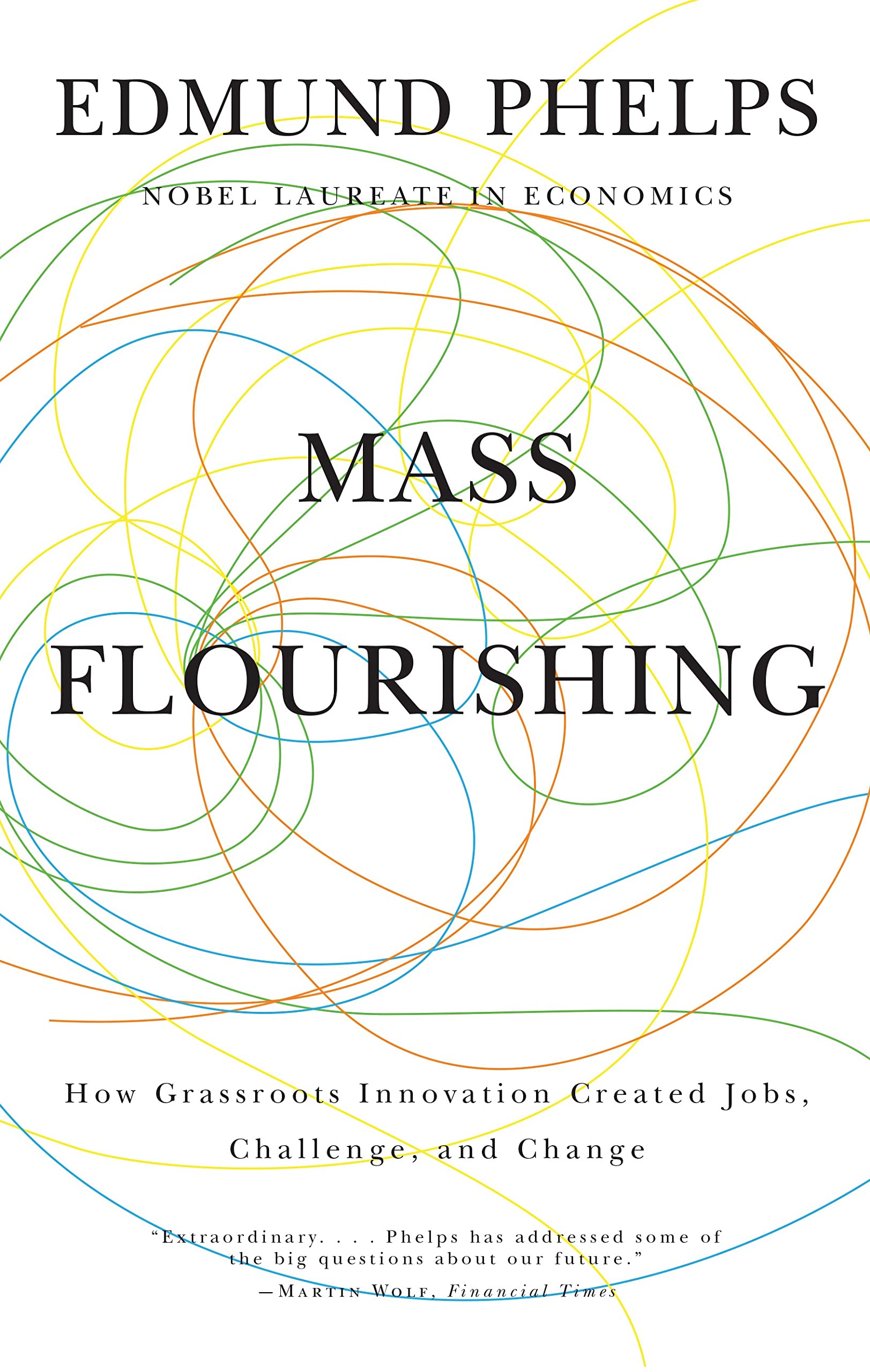
Mass Flourishing: How Grassroots Innovation Created Jobs, Challenge, and Change
$19.38
by Edmund S. Phelps



In this book, Nobel Prize-winning economist Edmund Phelps draws on a lifetime of thinking to make a sweeping new argument about what makes nations prosper--and why the sources of that prosperity are under threat today. Why did prosperity explode in some nations between the 1820s and 1960s, creating not just unprecedented material wealth but "flourishing"--meaningful work, self-expression, and personal growth for more people than ever before? Phelps makes the case that the wellspring of this flourishing was modern values such as the desire to create, explore, and meet challenges. These values fueled the grassroots dynamism that was necessary for widespread, indigenous innovation. Most innovation wasn't driven by a few isolated visionaries like Henry Ford and Steve Jobs; rather, it was driven by millions of people empowered to think of, develop, and market innumerable new products and processes, and improvements to existing ones. Mass flourishing--a combination of material well-being and the "good life" in a broader sense--was created by this mass innovation. Yet indigenous innovation and flourishing weakened decades ago. In America, evidence indicates that innovation and job satisfaction have decreased since the late 1960s, while postwar Europe has never recaptured its former dynamism. The reason, Phelps argues, is that the modern values underlying the modern economy are under threat by a resurgence of traditional, corporatist values that put the community and state over the individual. The ultimate fate of modern values is now the most pressing question for the West: will Western nations recommit themselves to modernity, grassroots dynamism, indigenous innovation, and widespread personal fulfillment, or will we go on with a narrowed innovation that limits flourishing to a few? A book of immense practical and intellectual importance, Mass Flourishing is essential reading for anyone who cares about the sources of prosperity and the future of the West. "Winner of the 2014 Gold Medal in Economics, Axiom Business Book Awards" "One of Choice's Outstanding Academic Titles for 2014" "One of Bloomberg Businessweek’s Best Books of 2014, chosen by chosen by Bjorn Wahlroos" "One of Financial Times (FT.com) Best Economics Books of 2013" "A "Best Business Book of the Year for 2013" selected on LinkedIn by Matthew Bishop, Economics Editor of The Economist" "[W]ide-ranging." ---Benjamin Friedman, New York Review of Books "The book eloquently discusses the culture of innovation, which can refer to both an entrepreneurial mind-set and the cultural achievements during an age of change. . . . The dismal science becomes a little brighter when Mr. Phelps draws the connections between the economic ferment of the industrial age and the art of Beethoven, Verdi and Rodin." ---Edward Glaeser, Wall Street Journal "[I]nquiring readers, not just academics and social scientists, will enjoy the vast learning in Phelps's sophisticated, sometimes sardonic, look at homo economicus." ― Publishers Weekly "Phelps, a Nobel laureate in economics, defies categorisation. In this extraordinary book--part history, part economics and part philosophy--he proclaims individual enterprise as the defining characteristic of modernity. But he fears this dynamism is lost. One does not have to agree to recognise that Phelps has addressed some of the big questions about our future." ---Martin Wolf, Financial Times "Phelps has written a book that transcends the materialist walls of standard economics. . . . It is a book J.M. Keynes would have admired." ---Paul DeRosa, American Interest "[F]ascinating, versatile and profound." ---Felix Martin, New Statesman "A great book that will annoy big business and absolutely infuriate the left. I loved it." ---Diana Hunter, Financial World "Nobel laureate Edmund Phelps' latest book should be read by those seeking a broader context to the challenges currently facing the global economies. In his wide-ranging and insightful book, Professor Phelps draws on historical trends and cultural shifts to present his hypothesis that a lack of dynamism in modern economies lies at the root of the current malaise. . . . Indeed, this remarkable book addresses the central economic question of why some economies thrive while others languish." ---Declan Jordan, London School of Economics Review of Books "Few leading economists . . . have tried to develop Marx's contention that there is an ineluctable relationship between human psychology and market participation. This relationship is what Phelps describes as human 'flourishing.'" ---Andrew Godley, International Journal of the Economics of Business "Phelps has produced an insightful work that bridges gaps among economics, sociology, and philosophy to identify countries that have the capabilities to prosper and flourish. This book is an essential read for individuals interested in better assessing countries' economies and competitive advantages." ― Librar