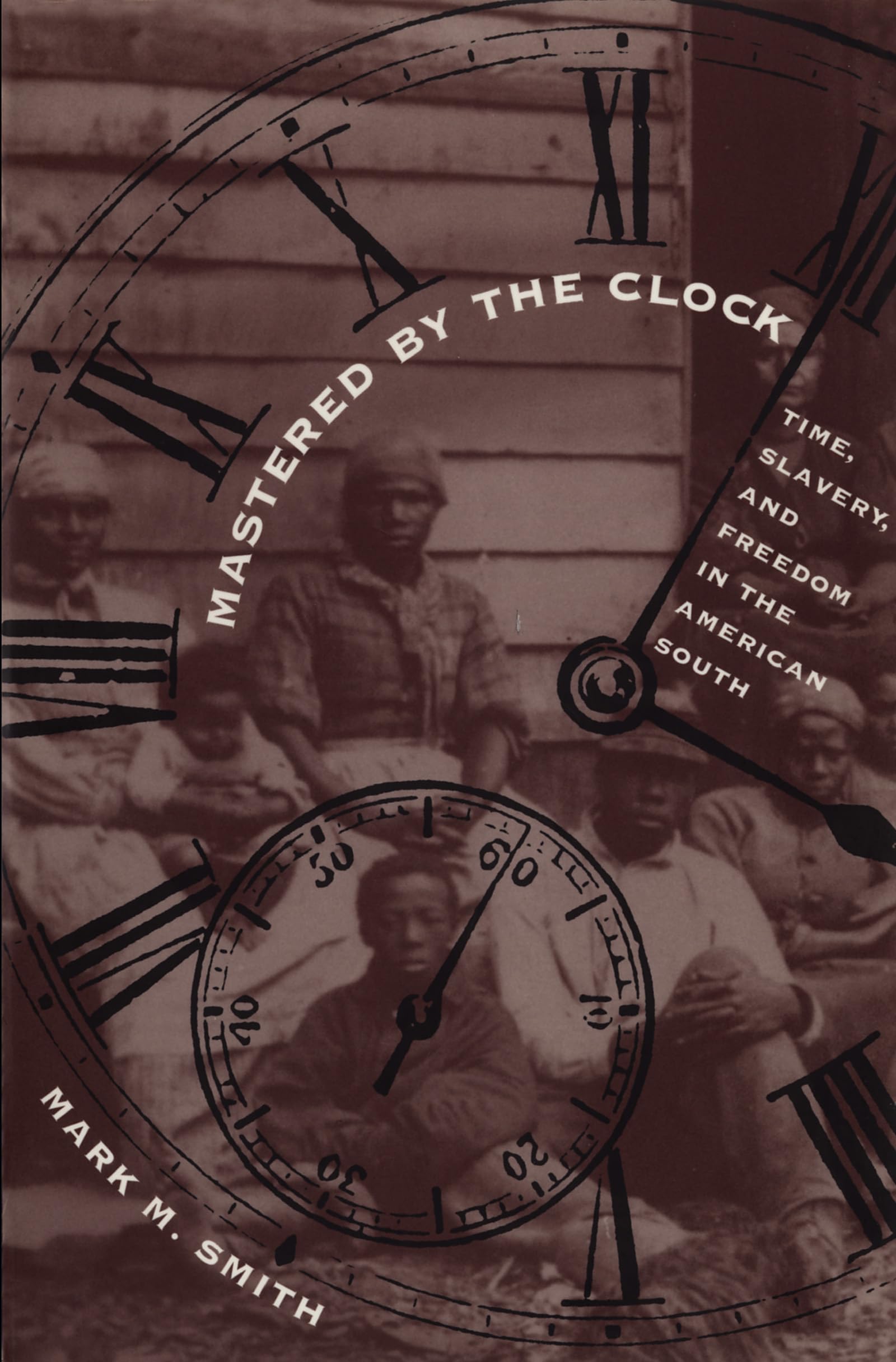
Mastered by the Clock: Time, Slavery, and Freedom in the American South (Fred W. Morrison Series in Southern Studies)
$28.99
by Mark M. Smith



Mastered by the Clock is the first work to explore the evolution of clock-based time consciousness in the American South. Challenging traditional assumptions about the plantation economy’s reliance on a premodern, nature-based conception of time, Mark M. Smith shows how and why southerners — particularly masters and their slaves — came to view the clock as a legitimate arbiter of time. Drawing on an extraordinary range of eighteenth- and nineteenth-century archival sources, Smith demonstrates that white southern slaveholders began to incorporate this new sense of time in the 1830s. Influenced by colonial merchants' fascination with time thrift, by a long-held familiarity with urban, public time, by the transport and market revolution in the South, and by their own qualified embrace of modernity, slaveowners began to purchase timepieces in growing numbers, adopting a clock-based conception of time and attempting in turn to instill a similar consciousness in their slaves. But, forbidden to own watches themselves, slaves did not internalize this idea to the same degree as their masters, and slaveholders found themselves dependent as much on the whip as on the clock when enforcing slaves' obedience to time. Ironically, Smith shows, freedom largely consolidated the dependence of masters as well as freedpeople on the clock. “Delightfully original. . . . A sophisticated, imaginative addition to our understanding of the nineteenth-century South.” — Journal of Interdisciplinary History “Fascinating. . . . An engaging work that should draw the serious attention of scholars and laymen interested in the history of technology as well as general history. It provides yet another reminder that in very basic ways colonists trekking across the Atlantic had much in common in spite of their different destinations.” — Technology & Culture “Its elegant argument and its deft use of evidence, brought to bear on a genuinely new topic, seem certain to make Mastered by the Clock a central contributor to debates on the nature of the antebellum South.” Georgia Historical Quarterly “Readable, imaginative, and innovative, this study casts the Old South and its plantations in a new light. Scholars will be debating the extent of Smith’s findings for some time.” American Historical Review “If the measure of a significant book is that it is read, discussed, debated, reread, and not forgotten, then Mark Smith’s first book exceeds the standards. It is an engaging book by a young scholar whose work certainly justifies his own time spent in producing it.” — Register of the Kentucky Historical Society “[Smith] offers an intriguing take on a familiar problem — whether slavery is primarily capitalist of precapitalist — by looking at something that previous historians have never considered important. This originality makes Smith’s conclusions important and thoughtprovoking. Mastered by the Clock deserves close attention and is a worthy achievement.” — - Australasian Journal of American Studies “Strikingly original. . . . This impressive book merits serious attention.” — Agricultural History “Mark M. Smith’s Mastered by the Clock is an interesting, lively study that suggests how (mostly antebellum) southern whites’ appreciation of clock-segmented time reveals their claim on the modern temperament.” — Journal of American History “An imaginative, pioneering study of the culture of time, time measurement and management in the slave South from the eighteenth century through the Reconstruction era, with particular emphasis on the middle decades of the nineteenth century. . . . Mastered by the Clock is an impressive study. Set within a sophisticated historiographical frame, it contributes to the cultural history of eighteenth- and nineteenth-century American on several planes.” — Journal of the Early Republic “Excellent. . . . This original and very stimulating study is well researched and nicely presented.” — South Carolina Historical Magazine Excellent. . . . This original and very stimulating study is well researched and nicely presented.-- South Carolina Historical Magazine How the plantation South came to be run by the clock Mark M. Smith is Carolina Distinguished Professor of History at the University of South Carolina. Used Book in Good Condition