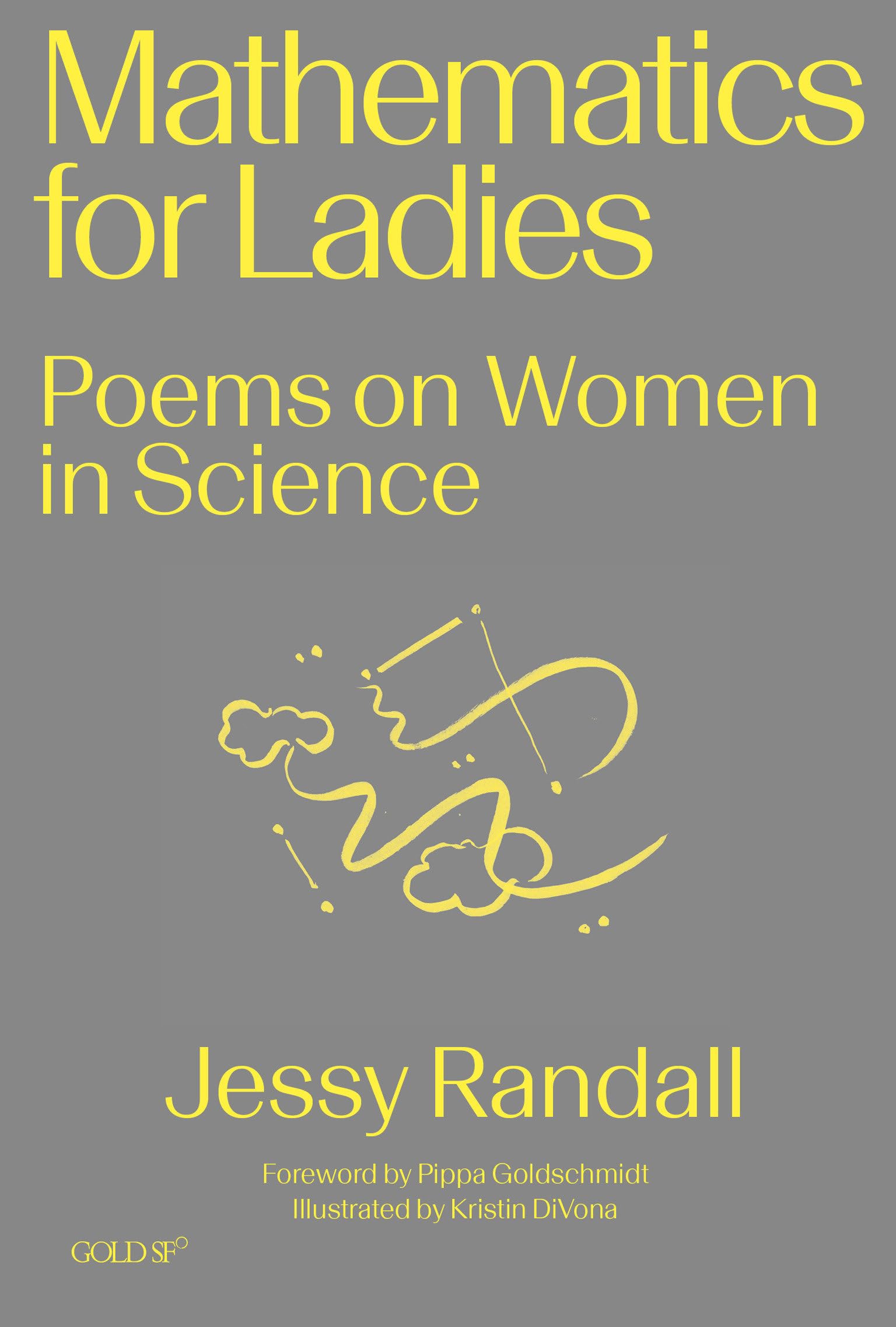
Mathematics for Ladies: Poems on Women in Science (Goldsmiths Press / Gold SF)
$20.00
by Jessy Randall



Poems about historical women in STEM fields. Hilarious, heart-breaking, and perfectly pitched, these carefully researched poems about historical women in science, technology, engineering, mathematics, and medicine will bring you to both laughter and outrage in just a few lines. A wickedly funny, feminist take on the lives and work of women who resisted their parents, their governments, the rules and conventions of their times, and sometimes situations as insidious as a lack of a women’s bathroom in a college science building. Discover seashells by the seashore alongside Mary Anning and learn how Elizabeth Blackwell lost her eye. Read about Bertha Pallan’s side hustle in the circus, Honor Fell bringing a ferret to her sister’s wedding, Annie Jump Cannon cataloguing stars, Mary G. Ross stumping the panel on “What’s My Line?,” Alice Ball’s cure for leprosy, and Roberta Eike stowing away on a research vessel. Some of these poems celebrate women who triumphed spectacularly. Others remember women who barely survived. Explore the stories of women you may have heard of (Marie Curie, Jane Goodall, Émilie du Châtelet) alongside those of others you may not (Virginia Apgar, Maryam Mirzakhani, Ynes Mexia, Susan La Flesche Picotte, Chien-Shiung Wu). If you have come across Randall’s poems in Scientific American , Analog , or Asimov’s , you will have already opened the door to these tales, all the more extraordinary because they are true. Illustrated with Kristin DiVona’s portraits for NASA’s “Reaching Across the Stars” project, this is a book to share with scientists, feminists, and poets, young and old and of any gender. Gr 7 Up—Beginning with an explanatory foreword, this book of short, free verse poems introduces a wide array of remarkable women. The featured females are introduced chronologically, starting with an unknown prehistoric woman curious about the composition of rocks and nature of minerals, and concluding with Maryam Mirzakhani, the first woman to receive the prestigious Fields Medal in mathematics. Seventy poems range from short anecdotal snippets to deeper reflections, all intriguing and serving as invitations to discover more about the featured scientist, engineer, mathematician, or physician. Some of the poems include recognizable names such as Elizabeth Blackwell, Marie Curie, and Jane Goodall. However, most are lesser known, such as Roberta Eike, Bertha Parker Pallan, and Joan Beauchamp Procter: these are the poems that are the most intriguing and require further investigation. In a note concerning her choice for the collections' title, Randall shares that the phrase "mathematics for ladies" was a derogatory term used in the Soviet Union in the 1920s for the study of pure math; a strong feminist theme appears in many of the poems. This well-researched book includes a helpful table of contents, author notes, and works cited. Simple ink portraits are disbursed throughout the text. VERDICT Secondary schools where there is interest in STEM projects, poetry studies, and women's issues will benefit by adding this multifaceted title to their library or classroom collection.—Lynne Stover "Seventy poems range from short anecdotal snippets to deeper reflections, all intriguing and serving as invitations to discover more about the featured scientist, engineer, mathematician, or physician." — School Library Journal "The poems weave professional and biographical details into exasperated, mischievous and easy-to-read verse." —Hindustan Times "The only good science fiction poems ever written are by Jessy Randall." —Annalee Newitz, author of The Future of Another Timeline and Autonomous "I never get tired of learning about women who achieved great things despite obstacles. There are so many of them—and so many of them did not get their due." —Katha Pollitt, Women’s Review of Books Jessy Randall is the author of the poetry collections How to Tell If You Are Human (2018), Suicide Hotline Hold Music (2016), There Was an Old Woman (2015), Injecting Dreams into Cows (2012), and A Day in Boyland (2007), a finalist for the Colorado Book Award. Her poems and stories have appeared in Poetry , McSweeney’s , Nature , and Scientific American . Pippa Goldschmidt is a writer based in Edinburgh, UK and Frankfurt, Germany. Much of her writing explores the hidden lives of scientists and their work. She is co-editor of I Am Because You Are , a specially commissioned anthology of fiction celebrating general relativity, and Uncanny Bodies , an anthology of fiction, poetry and academic writing inspired by the uncanny. Her short stories, poetry and non-fiction have been published in a variety of magazines and anthologies, most recently in Mslexia , Litro , Scottish Review of Books , New Writing Scotland, and the New York Times , and broadcast on Radio 4. Working at the intersection of science and design, Kristin DiVona is the Visual Information Specialist for NASA's Chandra X-Ray Observato