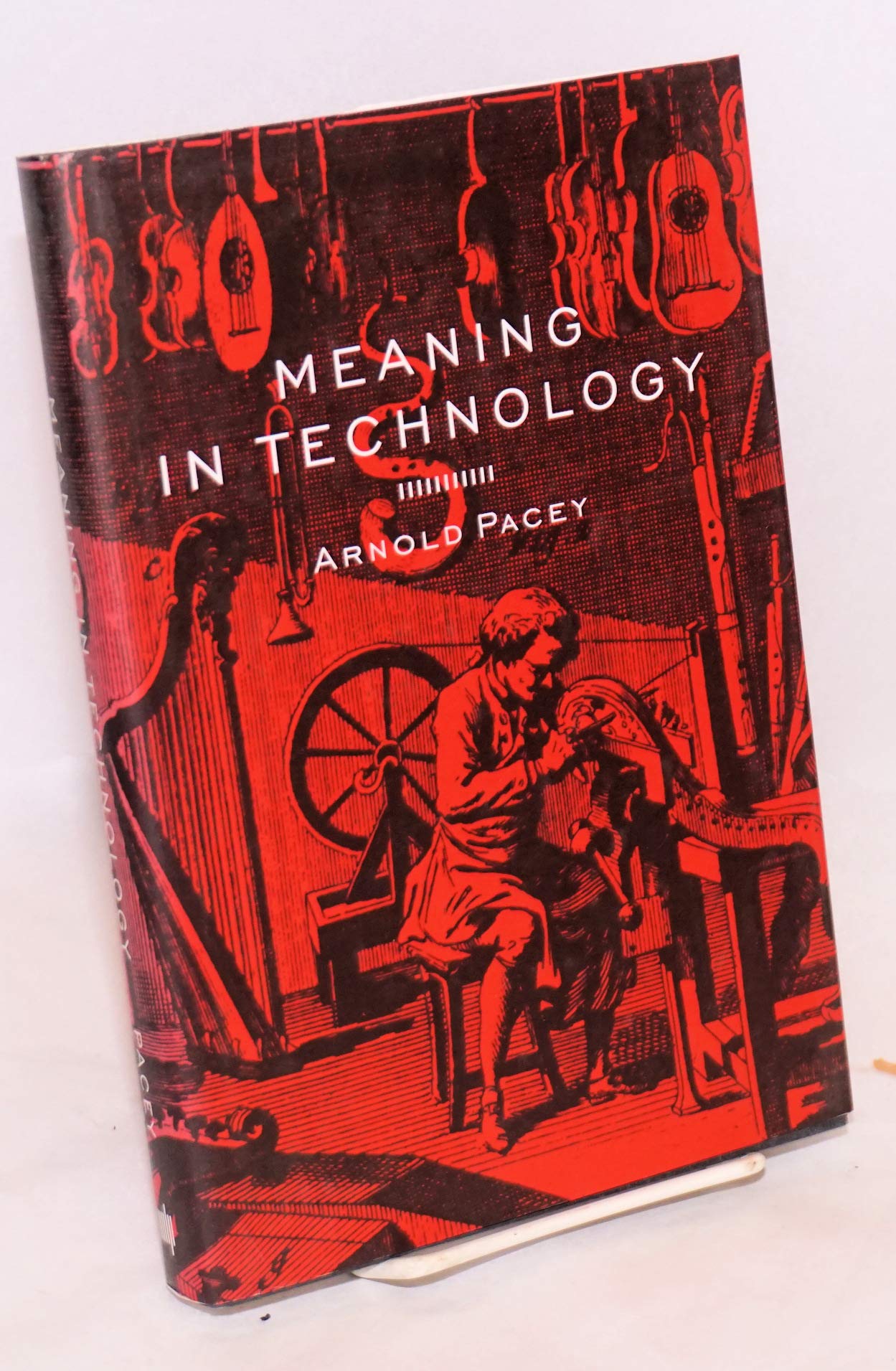



In previous books Arnold Pacey has written about the role of ideas and ideals in the creation of technology, about the global history of technology, and about how the complex interaction of political, cultural, economic, and scientific influences determines the course of technological practice. In Meaning in Technology , he explores how an individual's sense of purpose and meaning in life can affect the shape and use of technology. Stressing that there is no hierarchy of meaning in technology, he argues against reductionism in interpreting technology in a human context, and for acknowledgment of the role of the human experience of purpose when it helps to express meaning in technology. In the first part of the book, Pacey analyzes the direct experience of technology by individuals—engineers, mathematicians, craft workers, and consumers. He looks at music as a source of technology, at visual thinking, at tactile knowledge, and at the generation of social meaning. In the second part, he examines the contexts in which technology is used, relating technology to nature and society. He explores our sense of place and of our relationship with nature, environmental concerns, gender, and creativity. He concludes with a discussion of the possibilities of a more people-centered technology—a participatory, ethical experience of technology that values people as well as their environment. Most of us associate technology with science and objectivity. Writing in a conversational style, Pacey refreshingly advocates the personal experience of technology as an essential part of the larger public meaning. Thus, he focuses on the affective side and on how technology "feels" to individuals who use it. Pacey examines music as a source of technology and relates visual thinking, tactile knowledge, and social meaning (especially play) to the development of technology. He also analyzes contexts, such as landscape and place, and frames ethical concerns related to gender bias and stimulating creativity. With many examples, Pacey makes a convincing case for technology that values people as well as their environment. This work extends and complements the concepts developed in Pacey's previous books, The Culture of Technology (LJ 2/15/84), Technology in World Civilization (LJ 3/1/91) and The Maze of Ingenuity (MIT, 1992). With extensive references; recommended for academic and public libraries.ALaverna Saunders, Salem State Coll. Lib., MA Copyright 1999 Reed Business Information, Inc. Pacey is a lecturer for Britain's Open University and the author of The Culture of Technology and Technology and World Civilization . In those books Pacey investigated the role of nations and geography in shaping technology and the impact of technology on societies and cultures. He argued that technology transfer is a dynamic process, not a one-way process, and that the technologies of Asia, Europe, and Africa interacted with and influenced one another. Now he looks at the relationship between technology and the individual. He considers how members of groups such as engineers, craft workers, and consumers experience technology, and he explores various creative sources of technology, including visual thinking, tactile knowledge, and music. To help understand the connections between technology and nature and between technology and society, Pacey also studies the contexts in which technology is used. His analysis is neither a paean to nor a diatribe against technology; instead, it is a thoughtful call for a more "people-centered" technology. David Rouse Arnold Pacey is an Associate Lecturer at The Open University, Britain. He is the author of The Culture of Technology (MIT Press, 1983), Technology and World Civilization (MIT Press, 1991), and The Maze of Ingenuity , second edition (MIT Press, 1992).