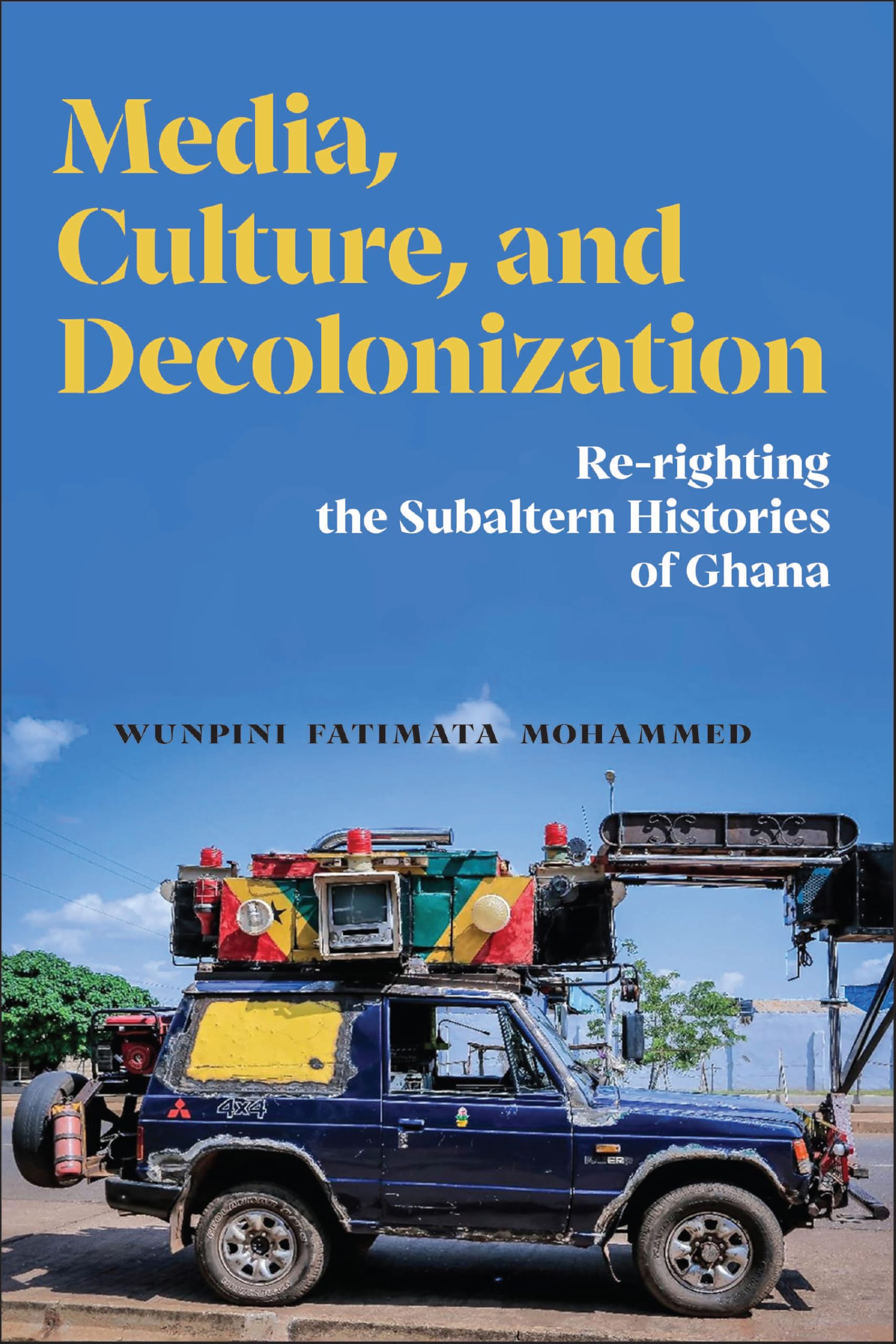
Media, Culture, and Decolonization: Re-righting the Subaltern Histories of Ghana
$31.63
by Wunpini Fatimata Mohammed



Media, Culture, and Decolonization: Re-righting the Subaltern Histories of Ghana invites us to look at media and culture from a decolonial perspective. Through Dagbaŋ epistemologies and knowledge systems, this book examines media by highlighting how African languages, cultures, and traditions can shift how we think of knowledge. It is an offering to anyone curious about the relationship between culture, language, and media. By focusing on African language media in Ghana such as film, television, and radio, the book emphasizes the importance of espousing a decolonial politic and praxis in the process of co-creating knowledge with Indigenous communities. It connects the struggles of global majority countries and demonstrates the ways in which (neo)colonialism and imperialism impede the work toward liberatory futures. This book demonstrates the potential that African language media hold as tools of cultural and epistemological decolonization. "A significant contribution to media studies, African studies, and decolonial scholarship. Its strengths lie in the analytical and conceptual depth of its theory and method, in its empirical material from Northern Ghana, and in its methodological contribution." ― Journalism & Mass Communication Quarterly "Richly researched. . . . For a world that has been left to its own devices for a long time, the lives and occupations of the book's subjects and this book itself are acts of resistance. Mohammed's writing shines when she delves into the film industry, from its history to its modern distribution. There’s so much to learn here." ― The Massachusetts Review "Not simply a study of Ghanaian media; it is a manifesto for epistemic decolonisation with implications for global media scholarship. . . . Essential reading for researchers working on African media, Indigenous knowledge systems, oral traditions, language politics, postcolonial media industries and decolonial methodologies. . . . A landmark text." ― Canadian Journal of African Studies/Revue canadienne des études africaines "This book is part of an unstoppable tidal shift in the center of knowledge production's gravity from Eurocentrism. Mohammed convincingly illustrates that the world takes on intricate hues and shapes when processed from the lens of indigeneity―a powerful tool to transform Africa(ns)." -- Sylvia Tamale ― author of Decolonization and Afro-Feminism "Drawing from lived experience in Northern Ghana, collectively coproduced knowledge, attention to the materiality of language, and a radical feminist subaltern analysis, Mohammed offers a bold intervention in how we should theorize mediated culture in the global capitalist and colonial present." -- Paula Chakravartty ― James Weldon Johnson Associate Professor of Media, Culture, and Communication at New York University "In this truly foundational contribution to scholarship on decolonizing African media studies, Mohammed combines innovative methodological approaches into excavating local agencies in African media productions grounded in indigenous epistemologies within the emerged digital mediascape. Her focus on Indigenous language media practices in Northern Ghana, an area often ignored by researchers, enables her to bring to media scholarship a historical view of subaltern media practices to theorize the political economy of media practice and consumption within the local, the national, and the global. I strongly recommend this book to all cultural studies and postcolonial media scholars." -- Amin Alhassan ― Director-General of the Ghana Broadcasting Corporation WUNPINI FATIMATA MOHAMMED is an assistant professor in the Department of Communication at Cornell University. She is coeditor of African Women in Digital Spaces: Redefining Social Movements on the Continent and in the Diaspora.