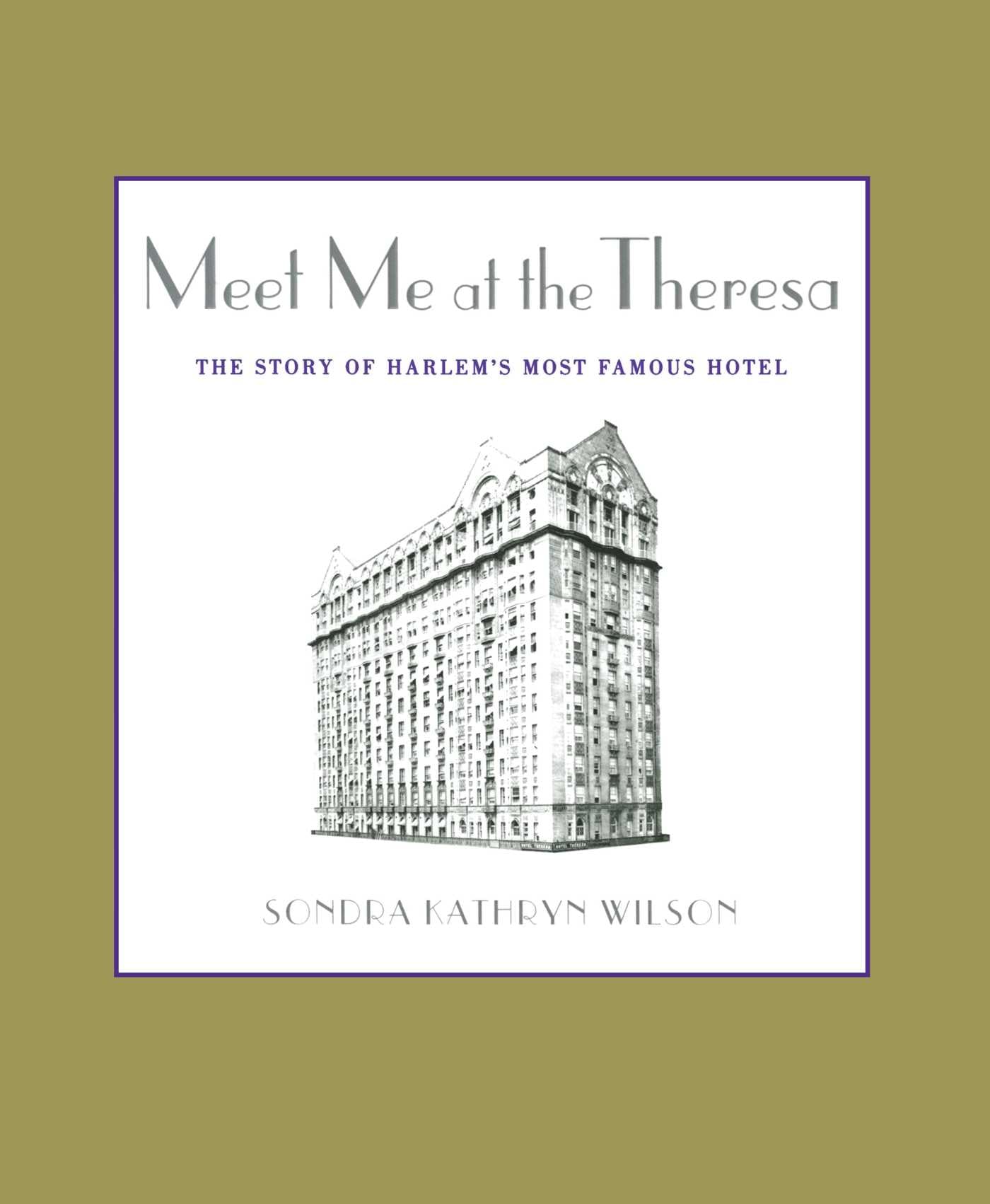
Meet Me at the Theresa: The Story of Harlem's Most Famous Hotel
$16.99
by Sondra Kathryn Wilson



A “brassy yet deeply respectful book” ( Publishers Weekly ), this is a lively social history based on first-hand accounts of the legendary Hotel Theresa—one of the New York landmarks that established Harlem as a mecca of black culture. In mid-twentieth century America, Harlem was the cultural capital of African America, and the Theresa was the place for black people to see and be seen. The hotel was known to have the hottest nightlife in the world and to be the only grand hotel in Manhattan that welcomed nonwhites. The thirteen-story building still stands on the historic corner of Seventh Avenue (or Adam Clayton Powell Jr. Boulevard) and 125th Street, but few of the legions that pass it day after day know that, as Sondra Wilson writes, “For thirty years life in and outside the hotel was an exhilarating social experience that has yet to be duplicated.” The Theresa was situated among a cluster of famous nightspots of the day. Locals and out-of-towners could stroll from the hotel to take in jam sessions at Minton’s Playhouse, see floorshows at the Baby Grand, admire chorus girls at Club Baron, do the jitterbug at the Savoy Ballroom, and watch showbiz heavyweights at the Apollo Theater. Black America’s biggest and brightest—Josephine Baker, Dorothy Dandridge, Duke Ellington, Malcolm X, Muhammad Ali, and so many more—made the hotel their New York stay-over. The book reveals little known facts and stories about the celebrities and the regulars: the owners, the gangsters, the showgirls, the politicians, entertainers, intellectuals, the fast crowd, and even the hangers-on. The Hotel Theresa is the stuff of legend, and though it closed its doors in 1970, there are still many who live to tell the tales. Meet Me at the Theresa is the first book devoted to the fabulous and continually fascinating story of the Hotel Theresa. Dr. Sondra Kathryn Wilson is a senior associate at the W.E.B. Du Bois Institute at Harvard University, founder and president of the James Weldon Johnson Foundation, Inc., and executor of James Weldon Johnson’s literary estate. She has worked as director of research in the national office of the National Association for the Advancement of Colored People (NAACP). Dr. Wilson has written numerous books on the NAACP and James Weldon Johnson. She received her doctorate from Columbia University, and lives in New York City. Chapter One: The Neighborhood The Hotel Theresa was located on the southwest corner of Seventh Avenue and 125th Street. Called the Great Black Way, Seventh Avenue has always been Harlem's most beautiful boulevard. This two-way artery, sectioned for uptown and downtown traffic, was divided by a narrow strip of beautiful trees and manicured grass and gardens. It was Harlem's principal business boulevard. Seventh Avenue mirrored Harlem's life. It had a number of beautiful brownstones, theaters, and apartment buildings that made it the grandest avenue uptown. The writer Wallace Thurman called the avenue Harlem's most representative boulevard, "a grand thoroughfare into which every element of Harlem's population ventures either for reasons of pleasure or of business. It reflects both the sordid chaos and the rhythmic splendor of Harlem." Pastored by Frederick Cullen, Salem Methodist Church at the corner of 127th Street was the largest and best-known church on Seventh Avenue. Near 134th Street was the popular Smalls' Paradise, one of the oldest nightclubs on Seventh Avenue. James Van Der Zee, Harlem's most famous photographer, who documented so many famous Harlemites, had a studio on Seventh Avenue. Across the street from the Hotel Theresa on the northwest corner was African Memorial National Bookstore. Owners Willis Huggins and Lewis Micheaux were left-wing ideologues and their voluminous stock reflected their philosophy. W. E. B. Du Bois, Paul Robeson, A. Philip Randolph, and Thurgood Marshall were among the bookstore's regular customers. "If we couldn't find a book anywhere else," a customer of the National Bookstore said, "we always knew that Micheaux had a copy on hand; but perhaps more important than the availability of books was the kind of books he had -- books on Africa now out of print; books on the history of us." The Diamond Jewelry Store was next to the bookstore. "It was a front for the Mafia," recalled a former hotel resident. "It was the biggest numbers drop in Harlem. There was dope there. They sold jewelry as a cover. Lots of us from the hotel used to buy jewelry there. They never got raided. The police had to know what was going on. On Saturday nights, all these black cars would be lined up outside -- nothing but white men going inside." Billy Rowe, the Pittsburgh Courier columnist, was talking about the gangsters who ran the Diamond Jewelry Store when he said, "The boys who electrify the corner are reduced to shiveling cowards whenever the Eastside torpedoes resplendent in their Brooks business suits descend upon Harlem to make their collections." "You didn'