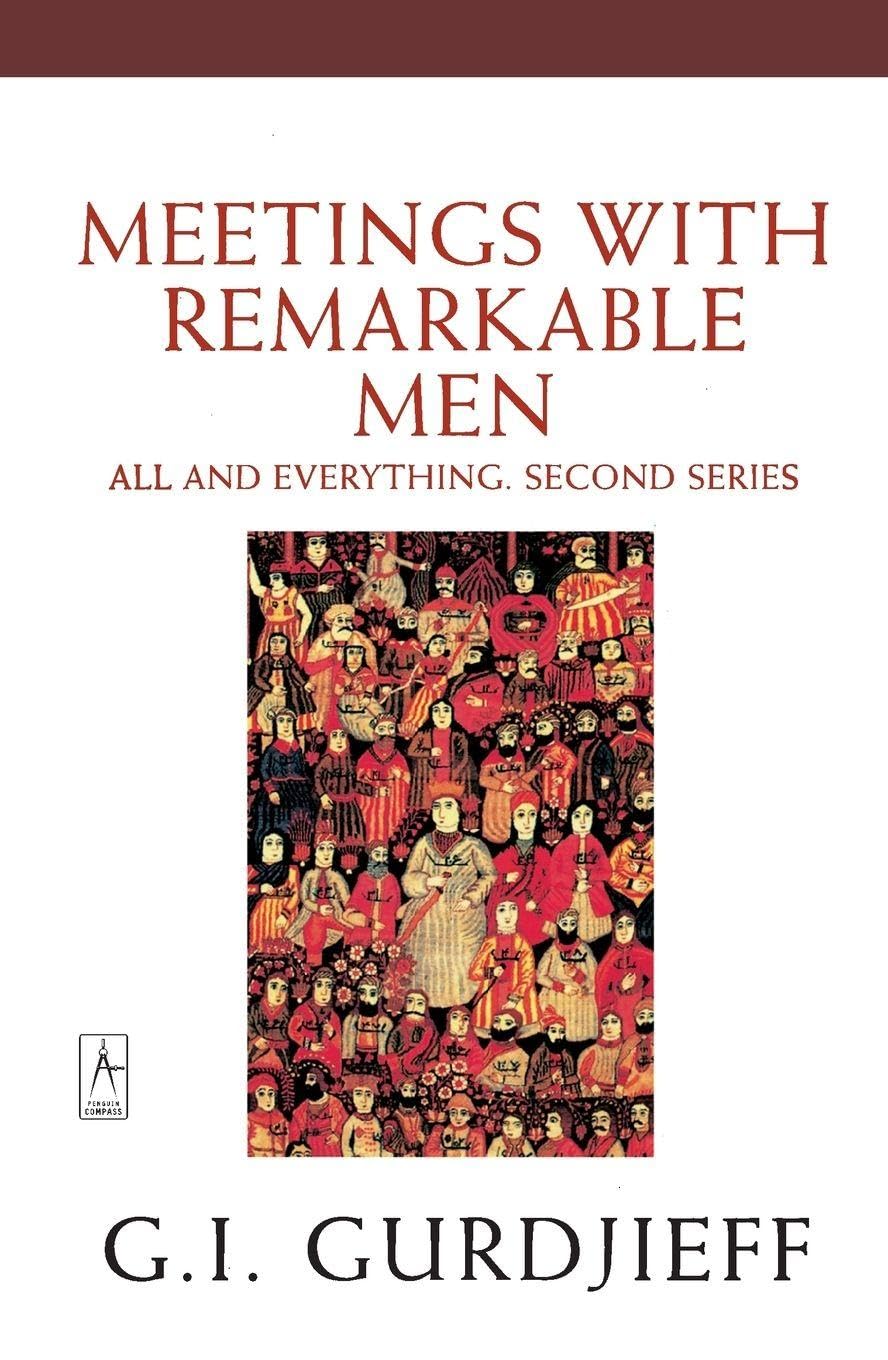



Meetings with Remarkable Men , G. I. Gurdjieff’s autobiographical account of his youth and early travels, has become something of a legend since it was first published in 1963. A compulsive “read” in the tradition of adventure narratives, but suffused with Gurdjieff’s unique perspective on life, it is organized around portraits of remarkable men and women who aided Gurdjieff’s search for hidden knowledge or accompanied him on his journeys in remote parts of the Near East and Central Asia. This is a book of lives, not doctrines, although readers will long value Gurdjieff’s accounts of conversations with sages. Meetings conveys a haunting sense of what it means to live fully—with conscience, with purpose, and with heart. Among the remarkable individuals whom the reader will come to know are Gurdjieff’s father (a traditional bard), a Russian prince dedicated to the search for Truth, a Christian missionary who entered a World Brotherhood deep in Asia, and a woman who escaped white slavery to become a trusted member of Gurdjieff’s group of fellow seekers. Gurdjieff’s account of their attitudes in the face of external challenges and in the search to understand the mysteries of life is the real substance of this classic work. Right around the turn of the 20th century, G.I. Gurdjieff initiated a group of spiritual adventurers called the "Seekers of Truth." These intrepid intellectuals of every stripe crisscrossed Africa and Asia in search of the hidden mysteries of antiquity. In Meetings with Remarkable Men , Gurdjieff narrates their exploits while drawing portraits of these extraordinary figures (including one woman and a dog). Half travel journal, half autobiography, Meetings with Remarkable Men begins with Gurdieff's childhood, when he finds his book learning at odds with paranormal events that were self-evident but inexplicable through modern science. Later he discovers a map of "pre-sands Egypt" and evidence of the Sarmound Brotherhood, alleged keepers of ancient wisdom dating back four and a half millennia. He climbs the Himalayas, follows the Nile, and is led blindfolded to a mysterious monastery. In his encounters with dervishes, monks, and fakirs, Gurdjieff recovers the wisdom he seeks; by comparison, European understanding, he says, is backwards and barbaric. A controversial figure in his time, Gurdjieff inspired deep love and loyalty in his pupils and ridicule from skeptics. At the bookends of Meetings with Remarkable Men , Gurdjieff suggests the value of blurring the line between allegory and straight reporting. But then what exactly is Meetings with Remarkable Men ? You be the judge. --Brian Bruya G. I. Gurdjieff was born in 1887 in Alexandropol. After studying with spiritual masters in the Near East and Asia, he founded the Institute for the Harmonious Development of Man in France.