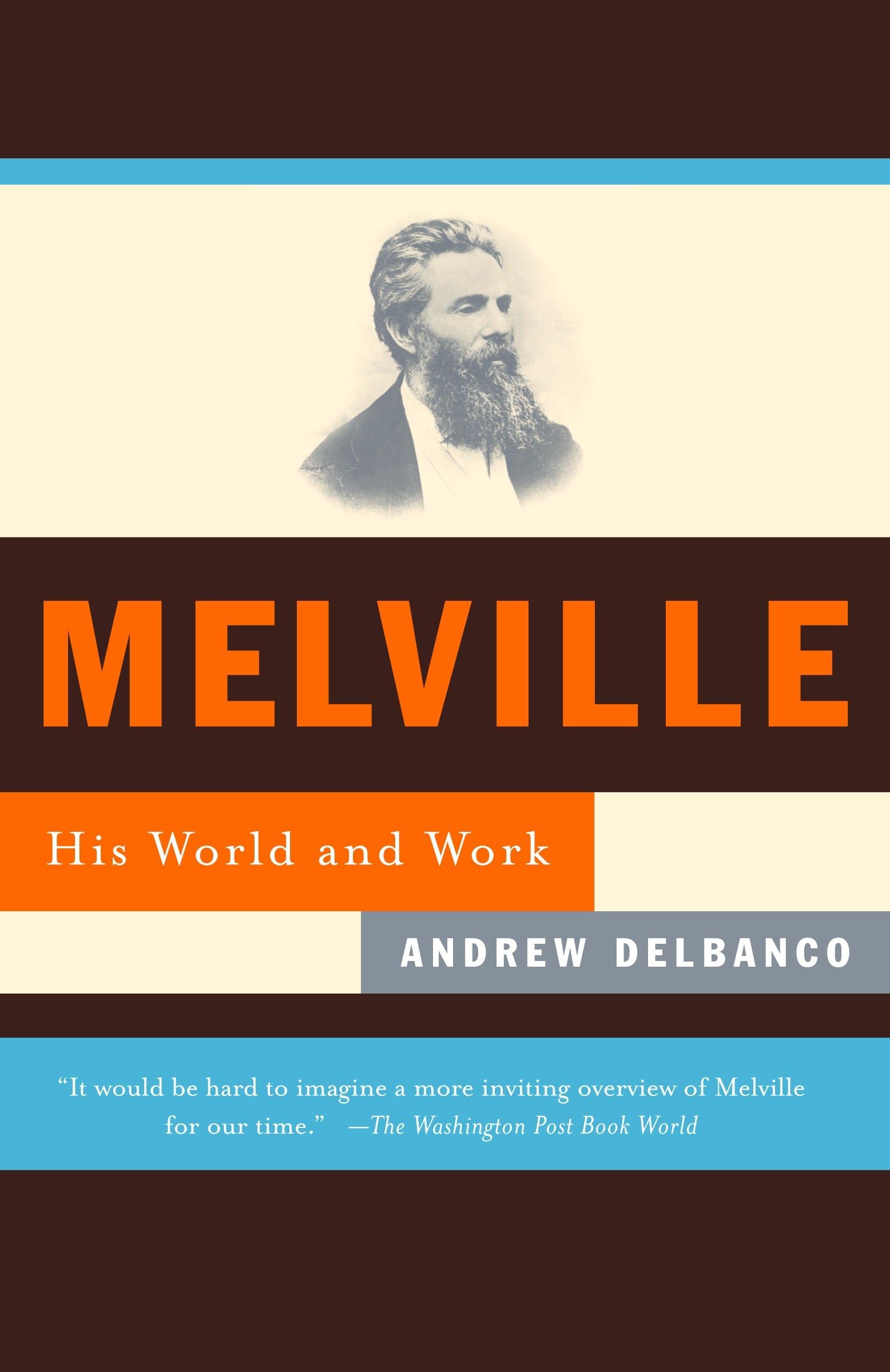



If Dickens was nineteenth-century London personified, Herman Melville was the quintessential American. With a historian’s perspective and a critic’s insight, award-winning author Andrew Delbanco marvelously demonstrates that Melville was very much a man of his era and that he recorded — in his books, letters, and marginalia; and in conversations with friends like Nathaniel Hawthorne and with his literary cronies in Manhattan — an incomparable chapter of American history. From the bawdy storytelling of Typee to the spiritual preoccupations building up to and beyond Moby Dick , Delbanco brilliantly illuminates Melville’s life and work, and his crucial role as a man of American letters. “Masterful. . . Delbanco is a fine historian as well as a fine critic”– The New Republic “An eclectic, humane, historically grounded tribute to Melville’s best achievements and a moving account of the troubles that closed in on him. . . . Among recent lives of Melville, this one has no peer for grace of style, vividness of historical evocation, and sympathy for a subject whose flaws and prejudices are nevertheless kept in view.” – The New York Review of Books "In Andrew Delbanco, Melville has found the perfect combination of biographer and critic [skilled] at re-creating the circumstances — the historical moment, the physical setting, the emotional state, the spiritual frenzy, that attended Melville's art.” – The Wall Street Journal "Andrew Delbanco places the enigmatic Herman Melville in a light that is remarkably sustained and often brilliant. His acute sense of the man, his wide-angled literary insight, and the range and strength of his grasp of Melville's world enable Delbanco to deliver full-scale the strangest of our literary giants. He also has placed himself in the company of Edmund Wilson, Alfred Kazin and Richard Chase as a trustee of our literature who writes as well as he reads." -Ted Solotaroff“ Delbanco’s Melville is a reward, a brilliant and nourishing narrative that reaches beyond literary biography to an exuberant cultural history. His voice is strong–at times personal in his fresh reading of Melville’s life and work.” –Maureen Howard Andrew Delbanco is the author of The Death of Satan (1995), Required Reading: Why Our American Classics Matter Now (1997), and The Real American Dream (1999), all of which were NYTBR notable books. The Puritan Ordeal (1989) won the Lionel Trilling Award from Columbia University. He has edited Writing New England (2001), The Portable Abraham Lincoln (1992), volume two of The Sermons of Ralph Waldo Emerson (with Teresa Toulouse), and, with Alan Heimert, The Puritans in America (1985). His essays appear regularly in The New York Review of Books , The New Republic , The New York Times Book Review , Granta , Partisan Review , Raritan , and other journals. In 2001 he was named a Fellow of the American Academy of Arts and Sciences and in 2003 named New York State Scholar of the Year by the New York Council for the Humanities. He is a trustee of the National Humanities Center and the Library of America, and has served as Vice President of PEN American Center. Since 1995 he has held the Julian Clarence Levi Professor Chair in the Humanities at Columbia University. CHILDHOOD AND YOUTH 1. He was born on August 1, 1819, into good circumstances. But his parents lacked the money to stay there, and so they turned, at no small cost to their dignity, to their elders for help. On his mother’s side, the benefactor was Maria’s father, Peter Gansevoort, a towering man (six foot three in an age when six-footers were rare) famous for having commanded the defense of Fort Stanwix, an outpost guarding the trade route from the Great Lakes, during the British siege of 1777. There is a tendency today to think of the Revolutionary War as a dispute among bewigged gentlemen who sent men into battle with inaccurate guns to the martial music of fife and drum; in fact, it was a brutal war whose combatants literally tasted sweat and blood flung from the bodies of their enemies as they slashed at each other with bayonets. It was not uncommon for wounded soldiers to be stabbed through and left to bleed to death “like sieves,” or to have their brains dashed out with “barbarity to the utmost” by the musket butts of the advancing enemy. Melville was to write about this war in the novel Israel Potter, in which he described the Yankee defenders at Bunker Hill gripping their muskets by the barrel and beating back the British assault by “wielding the stock right and left, as seal-hunters on the beach, knock down with their clubs the Shetland seal.” Melville’s Gansevoort grandfather was known for his valor in the face of superior numbers of enemy troops. At Fort Stanwix, having refused to receive a verbal message from the officer in charge of the British assault, he was presented with a written ultimatum to surrender “exhibiting in magnificent terms . . . the strength of the [Brit