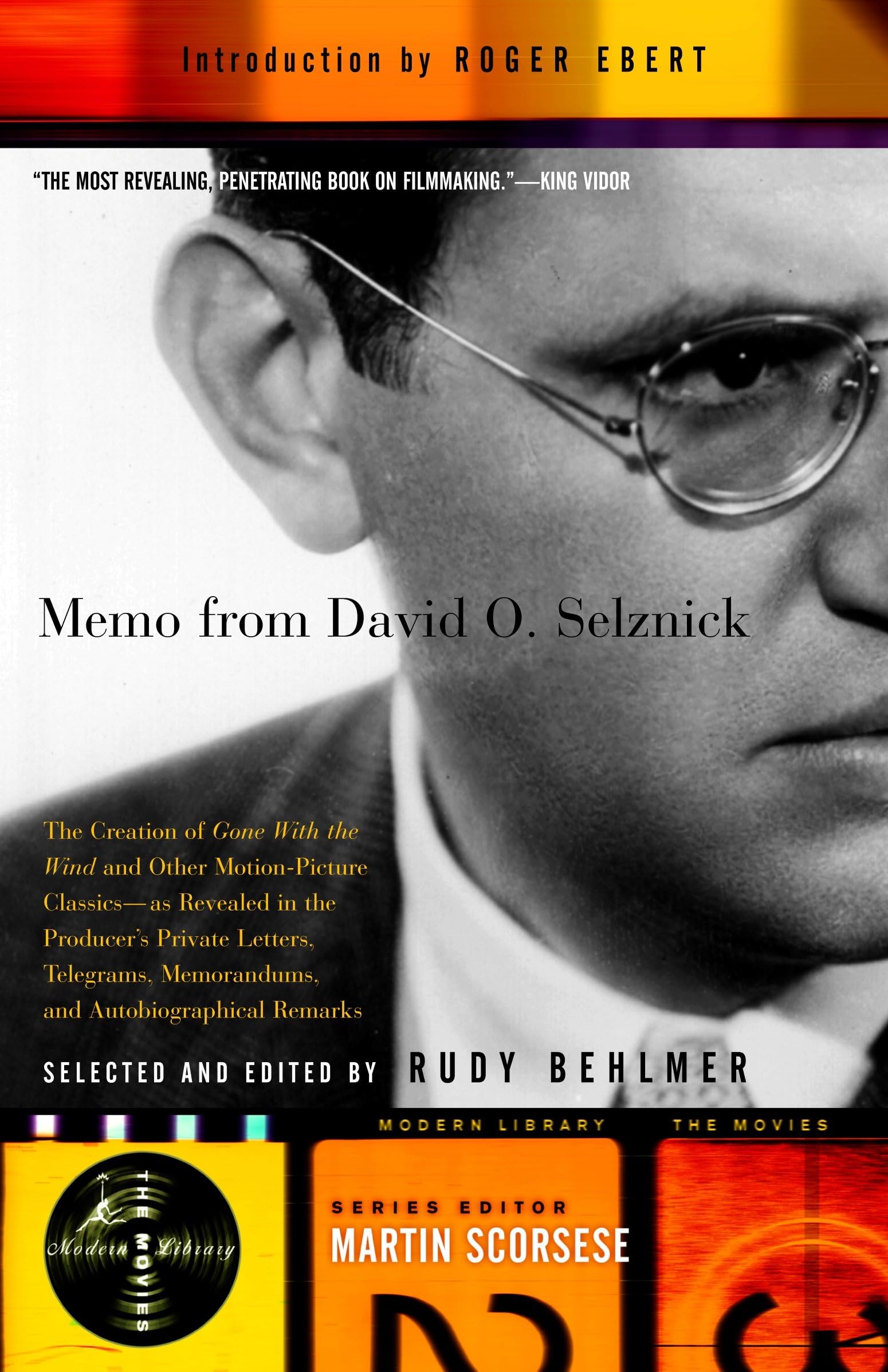
Memo from David O. Selznick : The Creation of "Gone with the Wind" and Other Motion Picture Classics, as Revealed in the Producer's Private Letters,
$20.53
by David O. Selznick



"The most revealing, penetrating book on filmmaking I know of . . ."--King Vidor David O. Selznick was a unique figure in the golden Hollywood studio era. He produced some of the greatest and most memorable American films ever made--notably, Rebecca, A Star Is Born, Anna Karenina, A Farewell to Arms, and, above all, Gone With the Wind. Selznick's absolute power and artistic control are evidenced in his impassioned, eloquent, witty, and sometimes rageful memos to directors, writers, stars and studio executives, writings that have become almost as famous as his films. Newsweek wrote,"I can't imagine how a book on the American movie business could be more illuminating, more riveting or more fun to read than this collection of David Selznick's memos. As Roger Ebert observes in his smart introduction to the collected memos of the legendary producer Selznick, this is no ordinary book. Buzzed on Benzedrine, Selznick dictated his every thought to secretaries from 1916-1965, 2,000 file boxes' worth of priceless, absolutely unique inside information. "What we're given is a seat in his office," Ebert says, "the Nixon tapes of Hollywood's golden age." It's a privilege to see Selznick tussle with Hitchcock (who evidently had a notion about a vaguely Psycho -like grandma in the first draft of Rebecca ), Ingrid Bergman (to whom he dictated an amazing tantrum), and Tallulah Bankhead ("Would you care to brave the lioness' den?" he asks his secretary, suggesting that she contact Bankhead about a bit part after spurning her for the Scarlett part in Gone with the Wind ). The gestation of Scarlett's flick is especially fascinating. At first, Selznick cautions director George Cukor about "not going overboard on size and expensive production scenes of the civil war," but with Selznick, things always tend to get bigger. To battle bigotry, he cuts the Ku Klux Klan from the film ("Of course we might have shown a couple of Catholic Klansmen, but it would be rather comic to have a Jewish Kleagle.") By the end, he's pulling out the stops--he urges the composer to "go mad with schmaltz in the last three reels." Selznick blows it sometimes: he nixes newcomers Gregory Peck and Burt Lancaster , and John Ford's Stagecoach , which created John Wayne. But by reading his memos, you can't fail to see what made him a true auteur. All hail Martin Scorsese for editing the classic film-books series of which this is a part, Modern Library: The Movies. Even if he'd never directed, Scorsese would be God's gift to film history. --Tim Appelo st revealing, penetrating book on filmmaking I know of . . ."--King Vidor David O. Selznick was a unique figure in the golden Hollywood studio era. He produced some of the greatest and most memorable American films ever made--notably, Rebecca, A Star Is Born, Anna Karenina, A Farewell to Arms, and, above all, Gone With the Wind. Selznick's absolute power and artistic control are evidenced in his impassioned, eloquent, witty, and sometimes rageful memos to directors, writers, stars and studio executives, writings that have become almost as famous as his films. Newsweek wrote,"I can't imagine how a book on the American movie business could be more illuminating, more riveting or more fun to read than this collection of David Selznick's memos. st revealing, penetrating book on filmmaking I know of . . ."--King Vidor David O. Selznick was a unique figure in the golden Hollywood studio era. He produced some of the greatest and most memorable American films ever made--notably, Rebecca, A Star Is Born, Anna Karenina, A Farewell to Arms, and, above all, Gone With the Wind. Selznick's absolute power and artistic control are evidenced in his impassioned, eloquent, witty, and sometimes rageful memos to directors, writers, stars and studio executives, writings that have become almost as famous as his films. Newsweek wrote,"I can't imagine how a book on the American movie business could be more illuminating, more riveting or more fun to read than this collection of David Selznick's memos. Rudy Behlmer is the author of seven books including Inside Warner Bros. and The Complete Films of Errol Flynn. Gone With the Wind (1936-1941) WHEN I HESITATED about paying $50,000 for a novel about the Civil War--the largest price ever paid for a book that was not even established as a success--Jock Whitney wired me that if I didn't buy it for Selznick International, he would buy it, and hold it for the company if I wanted it. This was all the encouragement I needed, and rather than have Jock have the last laugh on me, we went ahead and bought Gone With the Wind. I then went to Hawaii on vacation and read the novel on board ship. Much later, Metro demanded half the film, and secured it, for a loan of Clark Gable. They put up $1,250,000-and we took all the gamble. (The picture cost $4,250,000.) The risk money was entirely ours, secured from the banks, due to the great support I had from Jock Whitney, who approved enthusiastic