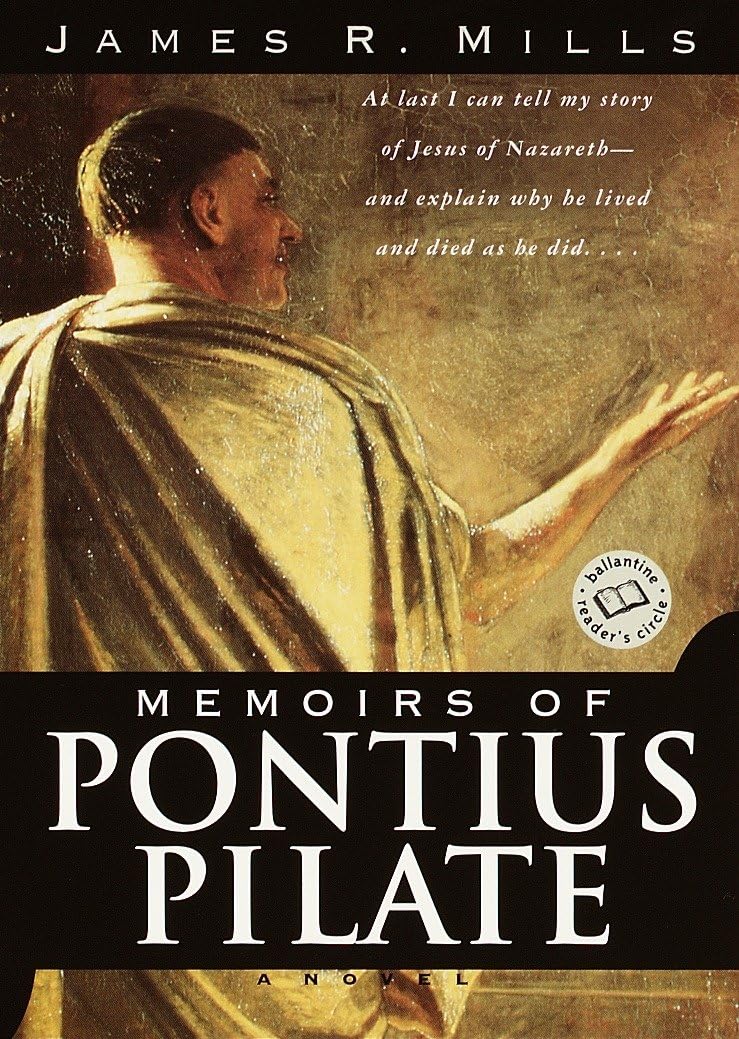
Memoirs of Pontius Pilate: A Novel (Ballantine Reader's Circle)
$15.00
by James R. R. Mills



It's been thirty years since he sentenced the troublemaker to die, but Pontius Pilate can't get Jesus out of his mind. . . . Forced to live out his life in exile, Pontius Pilate, the former governor of Judea, is now haunted by the executions that were carried out on his orders. The life and death of a particular carpenter from Nazareth lay heavily on his mind. With years of solitude stretched out before him, Pilate sets out to uncover all he can about Jesus—his birth, boyhood, ministry, and the struggles that led to his crucifixion. With unexpected wit and candor, Pilate reveals a unique, compelling picture of Jesus that only one of his enemies could give. In a vibrant, inventive, completely engaging novel that places Jesus and his teachings in a wonderfully accurate historical setting, James R. Mills has created nothing less than a new gospel that illuminates the beginnings of Christianity from an astonishing and unexpected point of view. "OUTSTANDINGLY ORIGINAL, SUPERBLY WRITTEN, FASCINATING AND ENGAGING." --Midwest Book Review It's been thirty years since he sentenced the troublemaker to die, but Pontius Pilate can't get Jesus out of his mind. . . . Forced to live out his life in exile, Pontius Pilate, the former governor of Judea, is now haunted by the executions that were carried out on his orders. The life and death of a particular carpenter from Nazareth lay heavily on his mind. With years of solitude stretched out before him, Pilate sets out to uncover all he can about Jesus?his birth, boyhood, ministry, and the struggles that led to his crucifixion. With unexpected wit and candor, Pilate reveals a unique, compelling picture of Jesus that only one of his enemies could give. In a vibrant, inventive, completely engaging novel that places Jesus and his teachings in a wonderfully accurate historical setting, James R. Mills has created nothing less than a new gospel that illuminates the beginnings of Christianity from an astonishing and unexpected point of view. It's been thirty years since he sentenced the troublemaker to die, but Pontius Pilate can't get Jesus out of his mind. . . . Forced to live out his life in exile, Pontius Pilate, the former governor of Judea, is now haunted by the executions that were carried out on his orders. The life and death of a particular carpenter from Nazareth lay heavily on his mind. With years of solitude stretched out before him, Pilate sets out to uncover all he can about Jesus--his birth, boyhood, ministry, and the struggles that led to his crucifixion. With unexpected wit and candor, Pilate reveals a unique, compelling picture of Jesus that only one of his enemies could give. In a vibrant, inventive, completely engaging novel that places Jesus and his teachings in a wonderfully accurate historical setting, James R. Mills has created nothing less than a new gospel that illuminates the beginnings of Christianity from an astonishing and unexpected point of view. Prologue The time has come for me when I, like Julius Caesar, can say, "I have lived long enough, whether for fame or fortune." My wife is dead, and I have no friends here in my place of exile, so I spend my days reflecting upon the past, as old men do for lack of better ways to occupy their time. As I reflect upon my experiences of long ago, I find that they are fading in my memory, losing their colors and details, growing as muzzy as wall paintings exposed to the elements in some ancient ruin. However, one action of mine is still as vivid in my mind as it ever was. I refer to my ordering of the crucifixion of that now famous Jewish carpenter called Jesus of Nazareth, while I was governor of Judea, Samaria, and Idumea. Three years after I was exiled to Gaul by Caligula, that mad young emperor banished Herod Antipas to Lugdunum, just a few miles up the river that flows outside my window as I sit here writing this. Herod did not deserve to be disgraced, even as I did not, but we both had powerful enemies, and we both became the victims of those enemies. Herod had been, like his father, Herod the Great, a loyal ally of Rome and a pragmatic ruler of his people. However, his youthful nephew Herod Agrippa was a close boyhood friend of Caligula's, and he wanted to be king of all the Jews, so the realm of Herod Antipas was added to his own, and Herod Antipas was banished to Gaul in his old age to die. I had dinner with Herod Antipas once in the last year of his life, and we talked for over an hour about that strange carpenter. His wife was present, and she tried to turn our conversation to another odd Jewish mystic, one called John the Baptist, a fellow she had snared her husband into beheading. Herod muttered through his beard that it had been a mistake to kill John, which it clearly had been, and he spoke again of the carpenter, expressing a belief that the man's miracles had been genuine. During the long years I have been in exile here, I have had few other occasions to talk about Jesus of Nazar