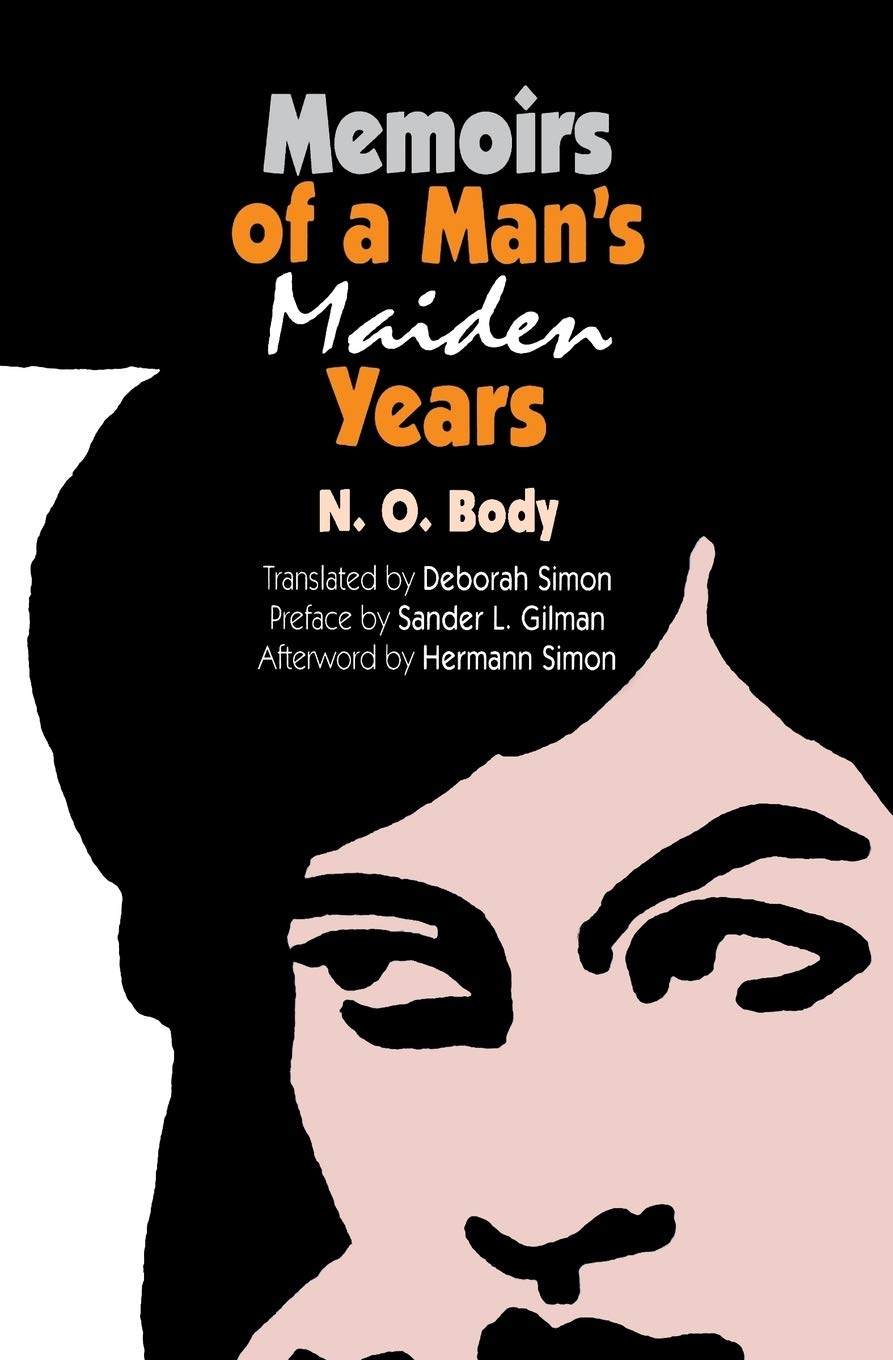



"I was born a boy, raised as a girl. . . . One may raise a healthy boy in as womanish a manner as one wishes, and a female creature in as mannish; never will this cause their senses to remain forever reversed." So writes the pseudonymous N. O. Body, born in 1884 with ambiguous genitalia and assigned a female identity in early infancy. Brought up as a girl, "she" nevertheless asserted stereotypical male behavior from early on. In the end, it was a passionate love affair with a married woman that brought matters to a head. Desperately confused, suicidally depressed, and in consultation with Magnus Hirschfeld, one of the most eminent and controversial sexologists of the day, "she" decided to become "he." Originally published in 1907 and now available for the first time in English, Memoirs of a Man's Maiden Years describes a childhood and youth in Kaiser Wilhelm's Germany that is shaped by bourgeois attitudes and stifled by convention. It is, at the same time, a book startlingly charged with sexuality. Yet, however frank the memoirist may be about matters physical or emotional, Hermann Simon reveals in his afterword the full extent of the lengths to which N. O. Body went to hide not just his true name but a second secret, his Jewish identity. And here, Sander L. Gilman suggests in his brilliant preface, may lie the crucial hint to solving the real riddle of the ambiguously gendered N. O. Body. "This is a very interesting and beautifully written memoir by somebody who would have been called a hermaphrodite in the nineteenth century. The work gives a fascinating picture of the childhood experiences of the anonymous author and is full of sensitive and often moving observations on the plights of sexual ambiguity in childhood. The style, apparently so simple and relatively dispassionate, is extremely effective in pulling the reader into the story." ― Chandak Sengoopta N. O. Body was the pseudonym of Karl M. Baer, the director of the Berlin B'nai B'rith until his emigration from Germany in 1938. He died in Israel in 1956. Sander L. Gilman is Distinguished Professor of the Arts and Sciences at Emory University. He is the author or editor of more than seventy books, including Jewish Self-Hatred and Smoke: A Global History of Smoking (coedited with Zhou Xun). Dr. Hermann Simon is the director of the Neue Synagoge Berlin-Centrum Judaicum Foundation and is the coauthor and coeditor of Jews in Berlin. Deborah Simon is a teacher of English and translation studies at Humboldt University, Berlin. Whose Body is it anyway? Hermaphrodites, Gays, and Jews in N. O. Body's Germany Sander L. Gilman "N.O. Body" is a most appropriate pseudonym for Karl M. Baer (1885-1956) to have used when he sat down to pen his autobiography, which appeared in 1907. For being "nobody" was his way of seeing his body: it was neither male nor female. It was doubly foreign ("nobody" is English rather than German) as it was Jewish as well as German. This is how he imagined his past life raised as a woman, Martha Baer, in a Jewish family in Imperial Germany. But it is "nobody" that Odysseus tricks the Cyclops to answering when asked who has harmed him—"Who has hurt you?" "Nobody," the blinded giant responds. In his autobiography Baer is simultaneously the clever trickster but also the damaged giant. On its surface Baer's autobiography is a remarkable fin-de-siècle document of "hermaphrodism," as the Berlin sexologist Magnus Hirschfeld (1868-1935) notes in his afterword. Its subject suffered from false gender assignment because of the apparent ambiguity of his genitalia as an infant. He was registered and treated as a "female" child rather than a "male" child, an error of assignment that became evident only with puberty. He was a "pseudohermaphrodite," to use the terminology of the day, as his body was hormonally and psychologically gendered male, even though his genitalia seemed at first glance ambiguous. Sex was defined by the appearance of the body and was dimorphic—there were men and women. Any one who was neither or both was seen as pathological. The central argue of the autobiography is expressed on its opening page: "one may raise a healthy boy in as womanish manner as one wishes and a female creature in as mannish; never will this cause their senses to remain forever reversed." No confusion about gender can exist except, as is the case here, through the fuzzy ineptitude of the physician who at Baer's birth in 1885 (not 1884 as in the text) stated that "on superficial inspection the shape makes a feminine appearance, ergo we have a girl before us." But the autobiography shows that this was never the case. Baer was always a male, even when treated as a female. As Hirschfeld notes in his afterward: "the sex of a person lies more in his mind than in his body." For Baer there was no ambiguity in his sense of discomfort as a woman caused by the outward appearance of his genitalia. His desires were "male"—from the games he wished to play to the wom