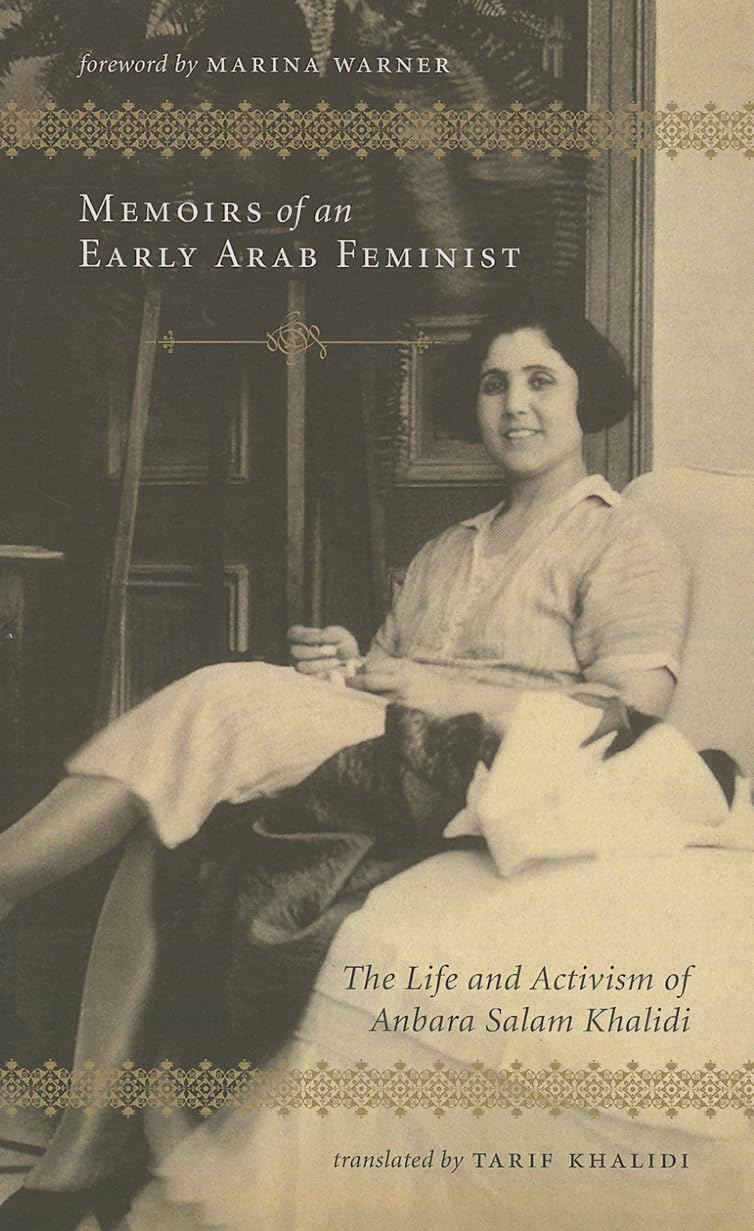
Memoirs of an Early Arab Feminist: The Life and Activism of Anbara Salam Khalidi
$19.68
by Anbara Salam Khalidi



Memoirs of an Early Arab Feminist is the first English translation of the memoirs of Anbara Salam Khalidi, the iconic Arab feminist. At a time when women are playing a leading role in the Arab Spring, this book brings to life an earlier period of social turmoil and women's activism through one remarkable life. Anbara Salam was born in 1897 to a notable Sunni Muslim family of Beirut. She grew up in 'Greater Syria', in which unhindered travel between Beirut, Jerusalem and Damascus was possible, and wrote a series of newspaper articles calling on women to fight for their rights within the Ottoman Empire. In 1927 she caused a public scandal by removing her veil during a lecture at the American University of Beirut. Later she translated Homer and Virgil into Arabic and fled from Jerusalem to Beirut following the establishment of Israel in 1948. She died in Beirut in 1986. These memoirs have long been acclaimed by Middle East historians as an essential resource for the social history of Beirut and the larger Arab world in the 19th and 20th centuries. "These memoirs are a fascinating record of experiences witnessed by a pioneer feminist in Beirut whose name is rightly synonymous with the feminist, social and literary renaissance of the Arab East. ... From now on [neither] the history of Beirut in the modern period nor the history of the modern feminist movement in the Arab world [can] be written without reference to these very memoirs." - Kamal Salibi, prominent Lebanese historian and former Professor of History at the American University of Beirut, Lebanon. 'A truly exceptional woman. Her book stands witness to a momentous period; throughout, she was in the vanguard of reform' 'A fascinating record of experiences witnessed by a pioneer feminist in Beirut whose name is rightly synonymous with the feminist, social and literary renaissance of the Arab East' Anbara Salam Khalidi (1897 - 1986) was a feminist, activist, writer and translator of classic literary works into Arabic. Marina Warner is an award-winning writer of fiction, criticism and history; her works include novels and short stories as well as studies of art, myths, symbols, and fairytales. Memoirs of an Early Arab Feminist The Life and Activism of Anbara Salam Khalidi By Anbara Salam Khalidi, Tarif Khalidi Pluto Press Copyright © 2013 Pluto Press All rights reserved. ISBN: 978-0-7453-3356-4 Contents List of Illustrations, vii, Foreword by Marina Warner, viii, Translator's Acknowledgments, xiii, Prologue, 1, 1. Upbringing and Family, 4, 2. Political Events Before the First World War, 34, 3. An Engagement that was Not Completed, 60, 4. The War's End, 91, 5. Society for Women's Renaissance, 104, 6. Back to the Literary Scene of the 1920s and Beyond, 124, 7. The Story of My Marriage, 129, 8. Exile, 160, Index, 163, CHAPTER 1 Upbringing and Family My earliest memories go back to the early years of the twentieth century, but I first need to sketch our family life, socially and politically, at that moment in time. I was born in 1897 into a family that was typical of traditional families in our social class, where I first sensed the amity that bound my two parents, although final authority rested with my father. My parents were connected also by a deep piety that made them follow the dictates of religion and adhere to its principles. We would wake up in the morning to the sound of Qur'anic verses being recited by one of my parents before my father left for his office and my mother commenced the heavy household duties of a large family. This took place after they had performed the dawn prayers and before the sun had risen. The house would echo with Qur'anic verses, softly and piously recited, followed by prayers to God for forgiveness and guidance. The atmosphere was one of deep faith, characterized by turning to God in all circumstances. I owe my memorization by heart of many Qur'anic verses to those recitations, in addition to studying the Qur'an at school later on. My father would often lead us in prayer if prayer time found him at home. My father, Salim 'Ali Salam (1868–1938), familiarly known as "Abu 'Ali," was a tall man of darkish complexion with a trimmed beard, well-dressed, and a man of courage and determination. He had a powerful personality and was a well-respected and prominent figure in his community, with friends of every religious sect. In all major local events his opinions counted for much; indeed this was true for all events in the Arab territories of the Ottoman Empire. He was in the first rank of merchants in his city and at the very heart of its charitable and social organizations. He held several public offices during Ottoman rule such as president of the Beirut Municipality, membership in the Council of the Province (the equivalent of a Council of Ministers), headed by the Ottoman Governor of Beirut, and membership in the Tribunal of Commerce, headed by a Turk appointed by the s