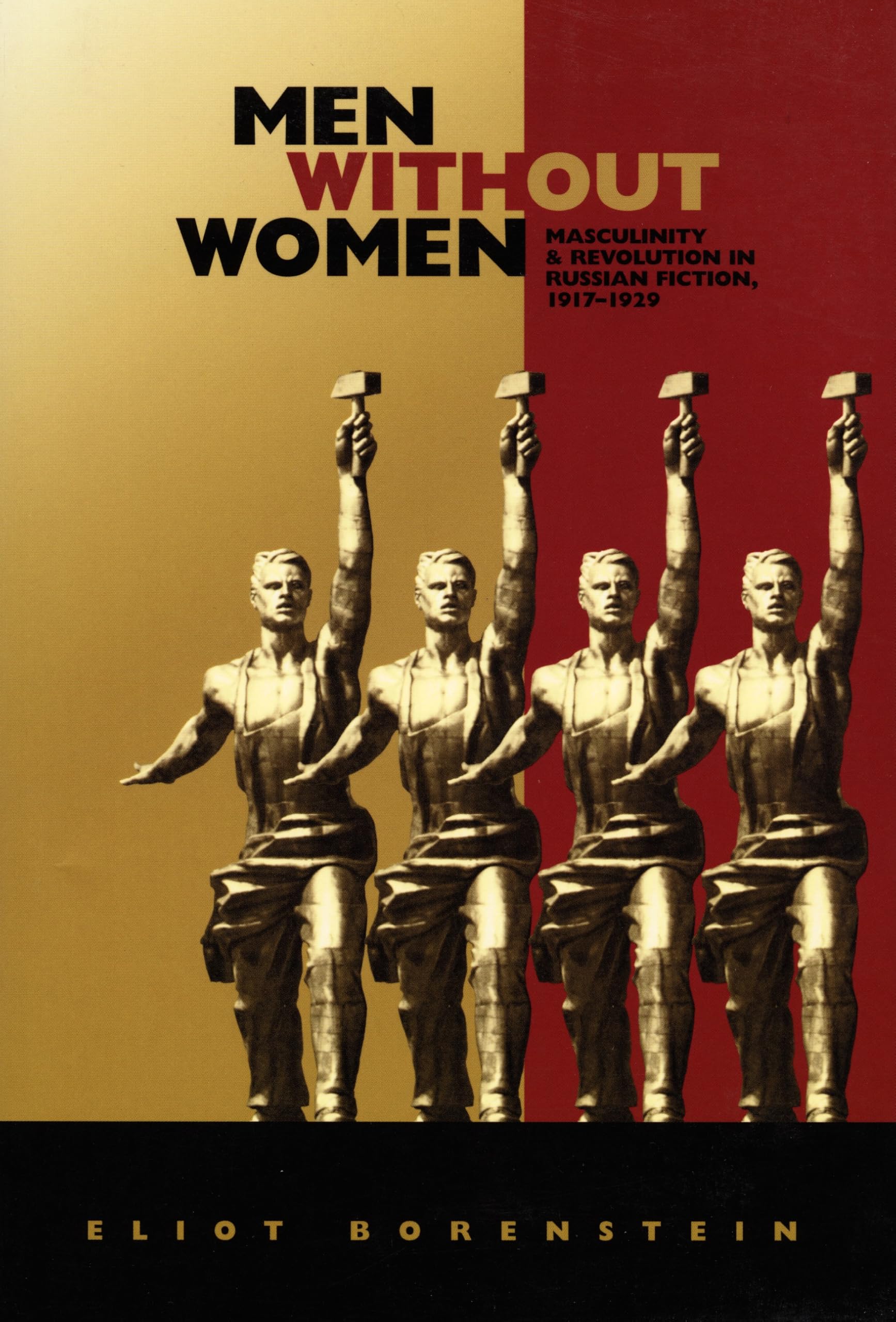
Men without Women: Masculinity and Revolution in Russian Fiction, 1917–1929
$39.95
by Eliot Borenstein



In Men without Women Eliot Borenstein examines the literature of the early Soviet period to shed new light on the iconic Russian concept of comradeship. By analyzing a variety of Russian writers who span the ideological spectrum, Borenstein provides an illuminating reading of the construction of masculinity in Soviet culture. In each example he identifies the replacement of blood ties with ideology and the creation of a social order in which the family has been supplanted by the collective. In such works as Red Cavalry by Isaac Babel, Envy by Yuri Olesha, and Chevengur by Andrei Platonov women are either absent or transformed into bodiless abstractions. Their absence, claims Borenstein, reflects the masculine values that are hallmarks of the post-revolutionary era: production rather than reproduction, participation in history rather than domestic ahistoricity, heavy industry, construction, and struggle. He identifies in this literature groups of “men without women” replacing the family, even while the metaphor of family is used as an organizing feature of their recurring revolutionary missions. With the passage of time, these characters’ relationships—just as those in the Soviet culture of the time—begin to resemble the family structure that was originally rejected and destroyed, with one important exception: the new “families” had no place for women. According to Borenstein, this masculinist myth found its most congenial audience during the early period of communism, but its hostility to women and family ties could not survive into the Stalinist era when women, home, and family were no longer seen as antithetical to socialism. Drawing on the theory and writings of Levi-Strauss, Girard, Sedgwick, and others, Men Without Women will be of interest to students and scholars of Slavic literature and history as well as specialists in literary theory and gender studies. “Teeming with insights, tightly argued, and written with stylish verve, MEN WITHOUT WOMEN is a splendid study of three key figures in the context of early Soviet prose: Platonov, Babel, and Olesha. By taking gender into meaningful account Borenstein deftly constructs a nuanced and original perspective, nicely grounded in the era’s history and ideology, from which to read Russian fiction and society of the 1920s. In addition to being a ‘must’ for Slavists, this seductive volume abounds in pleasures of the text.”—Helena Goscilo, University of Pittsburgh “Well versed in theory and thoroughly knowledgeable about Russian political and cultural life, Borenstein provides an excellent contribution to the burgeoning field of gender studies in Russian and Soviet literatures.”—Adele Barker, University of Arizona "Well versed in theory and thoroughly knowledgeable about Russian political and cultural life, Borenstein provides an excellent contribution to the burgeoning field of gender studies in Russian and Soviet literatures."--Adele Barker, University of Arizona Eliot Borenstein is Assistant Professor of Russian and Slavic Studies at New York University. Men Without Women Masculinity and Revolution in Russian Fiction, 1917-1929 By Eliot Borenstein Duke University Press Copyright © 2000 Duke University Press All rights reserved. ISBN: 978-0-8223-2592-5 Contents Acknowledgments, Note on Translations and Transliteration, Introduction Brothers and Comrades, Chapter One The Ladykillers: Bolshevik Chivalry, Female Sacrifice, and the End of the Marriage Plot, Chapter Two Isaak Babel: Dead Fathers and Sons, Chapter Three The Family Men of Yuri Olesha, Chapter Four The Object of Envy: Androgyny, Love Triangles, and the Uses of Women, Chapter Five Puritans and Proletarians: Andrei Platonov's Asexual Revolution, 1919-1923, Chapter Six Chevengur: Buried in the Family Plot, Conclusion Fathers and Furies, Notes, Works Cited, Index, CHAPTER 1 THE LADYKILLERS Bolshevik Chivalry, Female Sacrifice, and the End of the Marriage Plot Then the Cossacks entered the room. They laughed, and grabbed Sashka by the arm and threw her onto a mountain of materials and books. Sashka's body, blooming and stinking, like the meat of a freshly slaughtered cow, exposed itself, her raised skirts uncovered the legs of the squadron's lady, wrought-iron, firm legs, and Kurdyukov, a moronic lad, mounted Sashka and shook as though in the saddle, pretending to be carried away by passion. She threw him off and ran to the door. And only then, passing by the altar, did we proceed into the church. — Isaac Babel, "At Saint Valentine's" (1920/1924) Among the tramps there was one girl, her eyes currant-colored and timid, as if someone had waved his arm over them, her hair flowed like a downpour onto her shoulders. She was silent throughout the trip, was silent when the tramps fought and she didn't look at Ivan; she silently followed them. "You've seen the tsaritsa," said the guide to Ivan. 'We brought her from the Caspian itself and watch over