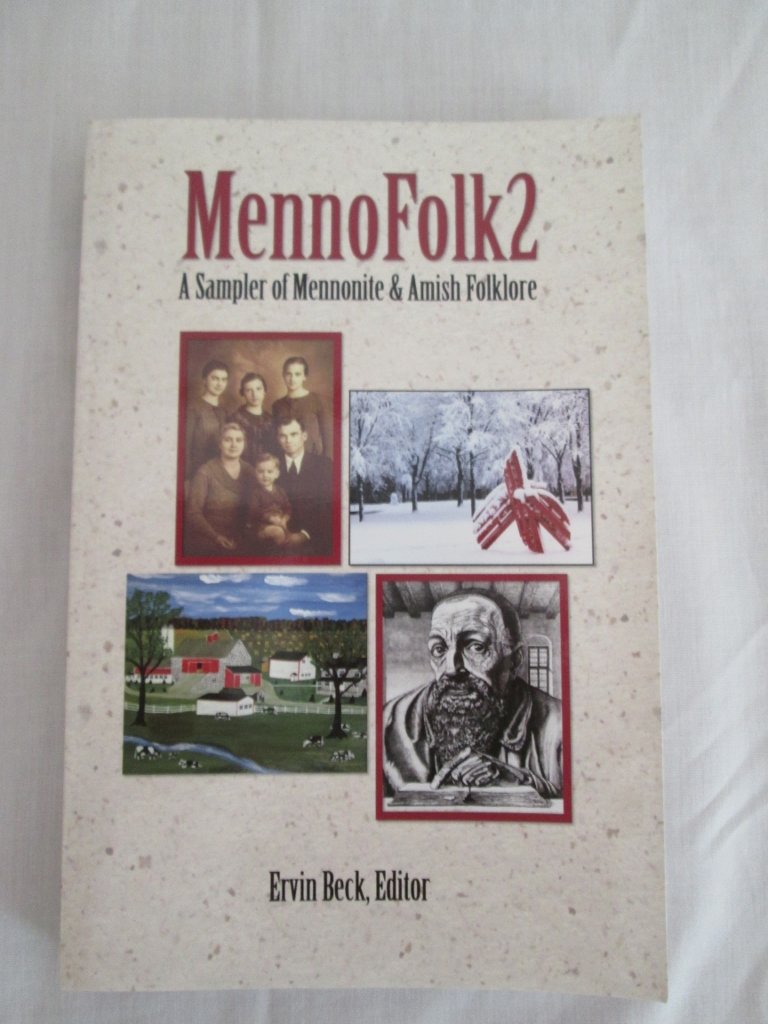



MennoFolk2 follows Ervin Becks popular and critically welcomed MennoFolk. This second book offers 17 new studies of folklore that represents small subgroups of Mennonites and Amish, rather than their culture at large. Here you will find a wide range of age groups, geographic locations, religious subgroups, and folklore genres. Includes Allen Whites Bedtime Stories, Arthur Emmerts Horse-Trading Stories, and Nicknames in the Lockport Church, all of which makes interesting, revealing reading. "With MennoFolk2, Ervin Beck and his students offer an invitation to explore the informal history, culture, and traditions of Mennonite and Amish communities. So much has been written about the purely religious and social history of the Mennonites and Amish, and so little about the texture of their rich folk cultural life. Perhaps it is time to devote attention to documenting the traditional practices that reinforce community and give meaning to its members." From the Foreword by Catherine Hiebert Kerst, American Folklife Center, Library of Congress Many Mennonites would like to deny the quasi-pagan aspect of our peasant heritage, but there it is, and who is to say, among the numerous changes involved in moving from agrarian to urban lifestyles, which of our Mennonite customs and values are the crucial ones to valorize. Di Brandt, "Growing Up Among the Wild Mennonites," Christian Living (JulyAug. 2002), 17. The above quote from Mennonite poet Di Brandt reminds us that Mennonites (and Amish) are, most of the time, just ordinary people living ordinary lives. They may belong to a folk group whose identity is tied to a peculiar religious tradition. But most of the time they give no conscious attention to Anabaptist theology or Mennonite history or what the preacher said in church last Sunday. They simply go about their business while unselfconsciously creating and sustaining their folk traditions, which they either transmit orally in face-to-face encounters or learn through imitation within the community. Usually this folklore is uninformed by conscious decisions about being Mennonite. It often consists of earthy, peasant-like elements that one would be embarrassed to see as part of a church service or church-related activity. Nevertheless, it is a necessary, natural, and integrated part of being a humaneven a humaneMennonite person. MennoFolk2: A Sampler of Mennonite & Amish Folklore is a kind of sequel to the book MennoFolk: Mennonite and Amish Folk Traditions (Herald Press, 2004). MennoFolk2 differs from the first book, however, in presenting folklore from small subgroups of Mennonites rather than from Mennonite culture at large. Where MennoFolk presents "Mennonite folklore," meaning folklore that is widely distributed among Mennonite groups, MennoFolk2 presents "Mennonites folklore," meaning folklore nurtured only by some Mennonites and Amish. 1 Erblore John Liechty Here we meet a clan of Miller-Erb Mennonites. They present themselves not in their Sunday dress but in their everyday, folk culture. In fact, they seem to use the rougher, slightly irreverent edges of their culture to define and express who they are as a family, in contradistinction to their neighbors, through four generations. E. B. My family name may be Liechty, but I also have a strong sense of "being an Erb," and have had it for as long as I can remember. Being an Erb is an essential dimension to my sense of family. It is still shaping my personality and provides a sense of identity and pride. I was reminded of many of the distinguishing features of being an Erb when my two aunts, Carley June Erb (Mrs. Galen) Miller and Shirley Erb (Mrs. Roman) Gingerich, recounted some of the stories, jokes, proverbs, prejudices, and memories that contribute most to their own sense of what being an Erb means. Their lore will likely sound familiar to readers whose family identity is characterized by a sense of apartness. My Erb family genealogy looks something like this: Lewis Miller m. Sarah (Stutzman) Miller (1873 1949) ( 1874 1962) Glen Miller Erma Miller Wallace Miller (1902 1980) (1898 1978) (1904 1970) m. Jacob Erb (1898 1981) Shirley Erb Gingerich Lois Erb Liechty Carley June Erb Miller Lowell Erb (b. 1919) (1920 1974) (b. 1922) (1934 1995) John Liechty (b. 1958) Carley June and Shirley Carley is a lively, entertaining woman whose vitality always seems both enviable and therapeutic. She was born in 1922, in the rolling country north of Wellman, Iowa. Although she is in good health, Carley insists that "the brain atrophied some time ago." Her name was inspired by a Zane Grey heroine that appealed to her mother. Born into a predominantly Mennonite community, Carley attended East Union Mennonite Church with her family. She had two older sisters "I was the third girl and wasn t too welcome" and a younger brother. She graduated from Center High School and attended Goshen College in Indiana, where she met Galen Miller, whom she married in 1944. Galen s m