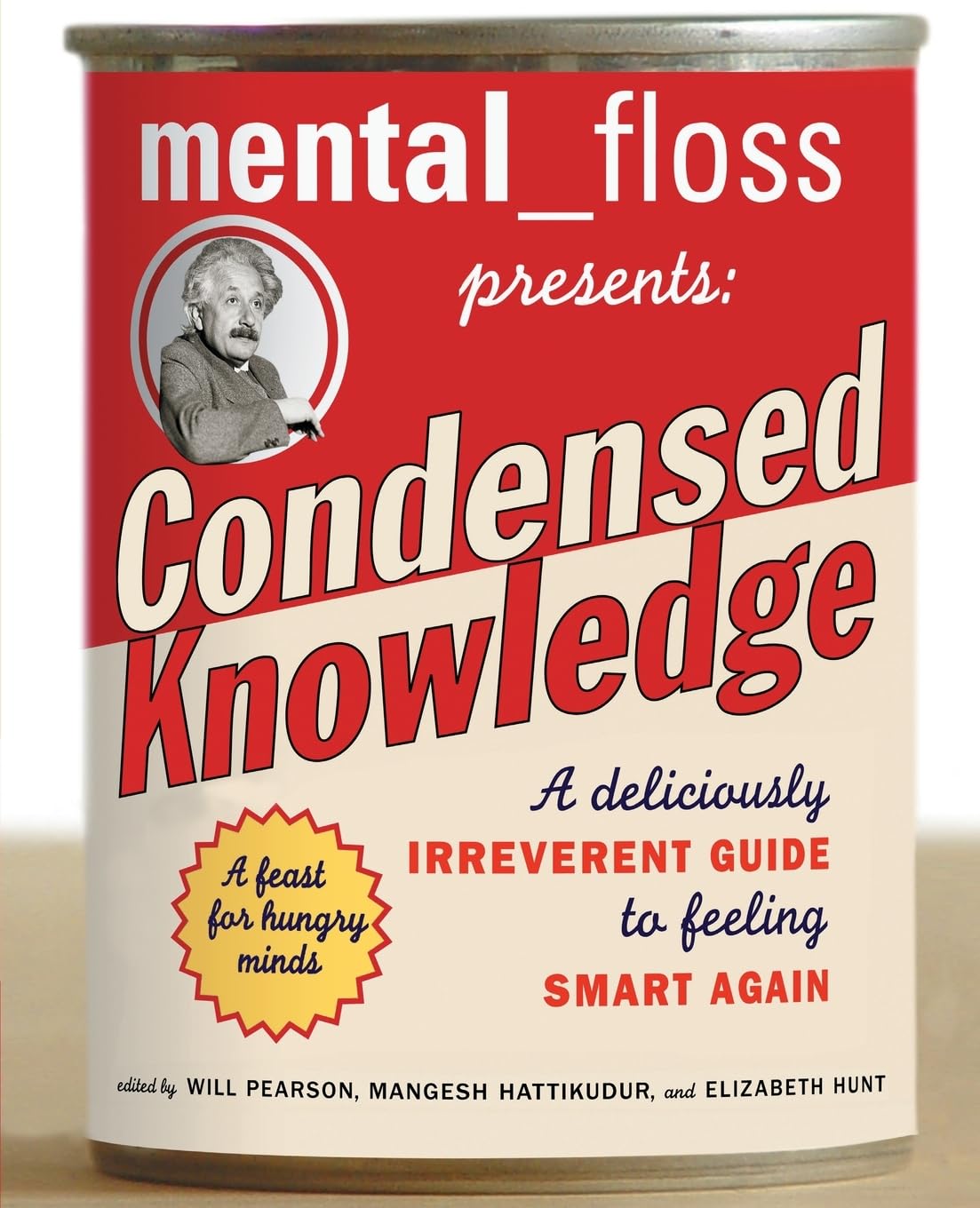
Mental Floss Presents Condensed Knowledge: A Deliciously Irreverent Guide to Feeling Smart Again
$9.98
by Will Pearson



Loaded with meaty trivia and tasty, bite-sized facts! mental_floss is proud to offer a delicious, hearty helping of brain-food that's sure to fire up your neurons and tantalize your synapses. Condensed Knowledge is a mouthwatering mix of intriguing facts, lucid explanations, and mind-blowing theories that will satisfy even the hungriest mind! Ingredients include: 5 tiny nations that get no respect • 4 civilizations nobody remembers • 5 classics written under the influence • 4 things your boss has in common with slime mold • 3 schools of thought that will impress the opposite sex • 4 things Einstein got wrong • 5 classical tunes you know from the movies • 3 famous studies that would be illegal today • 2 religious mysteries solved by chemistry • 5 scandals that rocked art, and much more ... “A lot like that professor of your who peppered his tests with raunchy jokes: it makes learning fun.” - Newsweek “A delightfully eccentric and eclectic new magazine.” - Washington Post “Part scholarly journal, part Spy magazine protégé.” - Charlotte Observer “For the discerning intellect, Mental Floss cleans out the cobwebs.” - Chicago Tribune “A single issue packs enough cocktail party ammo to make even the most intellectually detached person the kind of trivia-spouting maniac not seen since “Cheers” mailman Cliff Clavin.” - Los Angeles Times “There’s only one place I would expect to find this amazing font of knowledge and good humor, and that is Birmingham. There is also a statue of some kind of God of Iron in Birmingham. It stands on a hill, and holds a lightning bolt. I like that statue, but not as much as Mental Floss’ Condensed Knowledge, because it is Good.” - Dave Eggers Clever presentation and funny headlines aside, this book serves up a nourishing meat-and-potatoes menu of cultural information. Chances are you’ll find that reading it is “M’m! M’m! Good!” - Hartford Courant “The titans of trivia.” - Newsweek “An ideal reference to settle arguments or jog your memory.” - Calgary Herald Loaded with meaty trivia and tasty, bite-sized facts! mental_floss is proud to offer a delicious, hearty helping of brain-food that's sure to fire up your neurons and tantalize your synapses. Condensed Knowledge is a mouthwatering mix of intriguing facts, lucid explanations, and mind-blowing theories that will satisfy even the hungriest mind! Ingredients include: 5 tiny nations that get no respect • 4 civilizations nobody remembers • 5 classics written under the influence • 4 things your boss has in common with slime mold • 3 schools of thought that will impress the opposite sex • 4 things Einstein got wrong • 5 classical tunes you know from the movies • 3 famous studies that would be illegal today • 2 religious mysteries solved by chemistry • 5 scandals that rocked art, and much more ... Will Pearson and Mangesh Hattikudur met as first year students at Duke University. Ignoring the lures of law school and investment banking, the pair co-founded mental_floss and have been grinning ever since. Maggie Koerth-Baker is a freelance journalist and a former assistant editor at mental_floss magazine, where she consistently astounded Will and Mangesh with her amazingness. Mental Floss Presents Condensed Knowledge By Pearson, William HarperResource ISBN: 0060568062 Chapter One 5 Scandals That Rocked Art Forgeries, thefts, and outright vandalism? That's right. Art history's about to get a whole lot more interesting. _01:: The Vermeer Forgeries Every age sees art through its own eyes, andthe cleverest forgers play up to this. One ofthe most notorious forgeries ever occurred inthe 1930s. A Dutchman named Han vanMeegeren (1889?1947) produced forgeries ofearly works by the Dutch 17th-century masterJan Vermeer. They were technically brilliantand faultless, using old canvas and thecorrect 17th-century pigments. Cunningly,van Meegeren chose religious imagery thatsome experts believed Vermeer had painted,but very few examples of which existed. Most(though not all) of the greatest experts werecompletely taken in, but when you see thepaintings now, you'll wonder why. All thefaces look like the great film stars of the 1930s,such as Marlene Dietrich and Douglas Fairbanks. _02:: The Mona Lisa Theft It's sometimes suggested that rich criminalsarrange for famous works of art to be stolen sothat they can have them exclusively to themselvesin private. Such theories have neverbeen proven, and the truth is usually just a bitsimpler. One of the most bizarre thefts was ofthe Mona Lisa from the Louvre in 1911. AnItalian workman, Vincenzo Perugia, walkedinto the gallery, took the painting off the wall,and carried it out. Security was nonexistent. About two years later it was discovered in atrunk in his cheap lodging rooms in Florence.So, why did he take it? It was nothing to dowith money. He said that as the painting wasby an Italian, Leonardo da Vinci, it was part ofItaly's national cultural heritage, and he wassimply taking it b