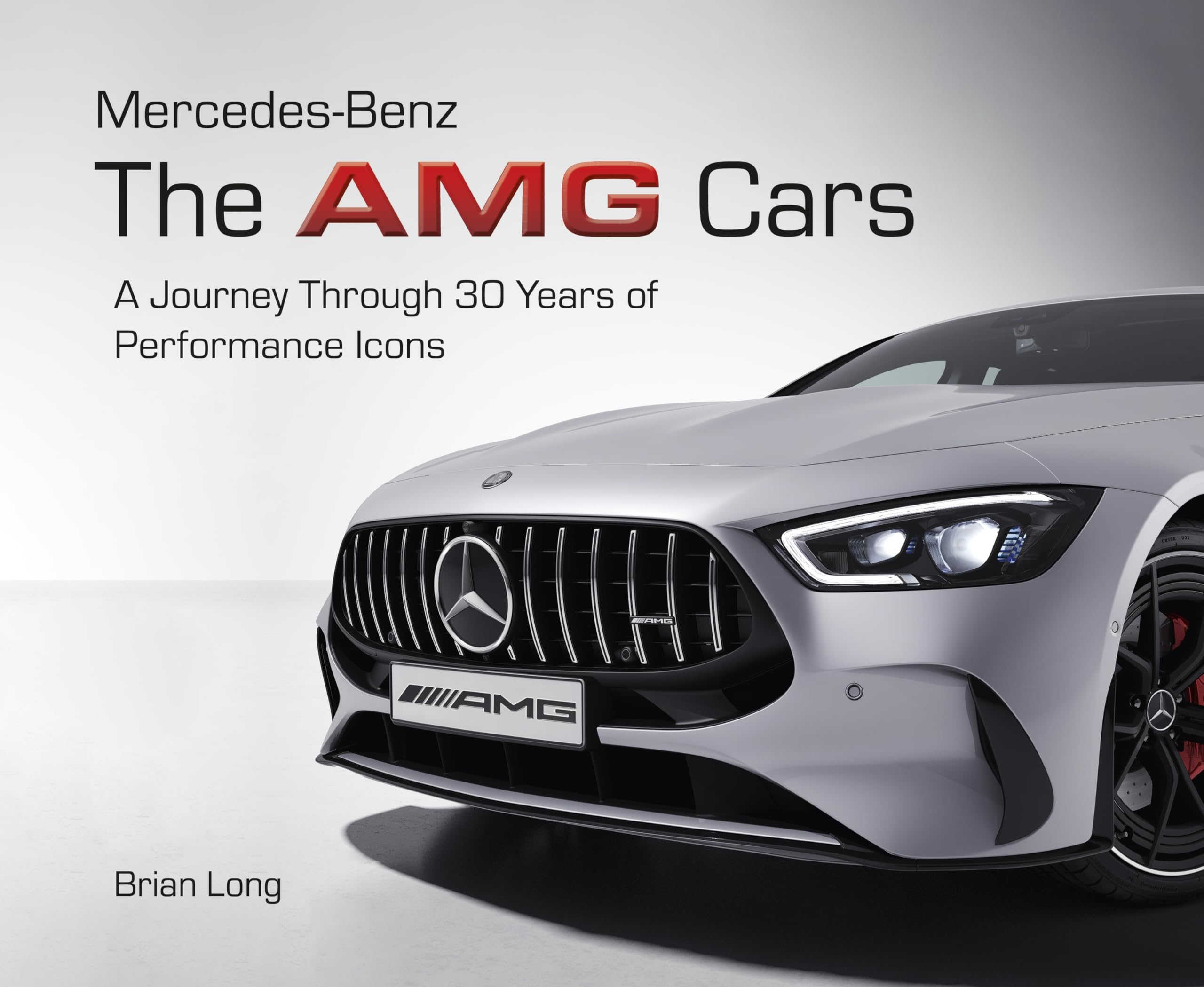
Mercedes-Benz: The AMG Cars: A Journey Through 30 Years of Performance Icons
$59.97
by Brian Long



From small-time tuner to global automotive legend – this is the ultimate guide to the Mercedes-AMG story. Explore the thrilling history of AMG, the performance brand that transformed Mercedes-Benz from a symbol of refined luxury into a fierce motorsport competitor and producer of some of the most desirable performance vehicles on the planet. Written by renowned automotive historian Brian Long, Mercedes-Benz: The AMG Cars charts the full journey from the brand’s unofficial beginnings to its modern-day status as an icon of high-performance engineering. Discover how two ex-Mercedes engineers, Hans-Werner Aufrecht and Erhard Melcher, began handcrafting race engines in a garage, and how their tiny operation became a global performance powerhouse. With deep dives into key models like the AMG Hammer , groundbreaking moments in DTM and Group C racing, and the official tie-up with Mercedes-Benz that reshaped the brand’s future, this is a comprehensive year-by-year chronicle of a unique automotive evolution. The book covers: The full story of AMG’s independent era and its 1990s transition into official Mercedes-Benz partnership - All production AMG models from 1993 to 2024, presented in chronological chapters - Legendary engines, tuning techniques, and motorsport triumphs - Rare and obscure models alongside the most celebrated icons - Hundreds of colour images, advertisements, and catalogue shots (over 660 visuals) With expert insights, rare images, and rich historical detail, this book is essential reading for Mercedes fans, collectors, and motoring enthusiasts alike. Get ready to experience the full-throttle story of the three-letter badge that changed Mercedes-Benz forever. Brian Long is one of the most respected voices in automotive publishing. Born in Coventry – the heart of the British motor industry – Brian trained as a mechanical engineer before beginning a prolific writing career. Since 1990, he has authored over 80 titles on classic and performance cars, many of which have become standard references. Now based in Chiba, Japan, he continues to write full time, often drawing on his extensive personal archive and network of international automotive contacts. His deep-rooted passion for motorsport and performance engineering shines throughout Mercedes-Benz: The AMG Cars . This book is about a famous double brand, bringing together one of the oldest names in the automotive industry and one created in the 1960s, albeit born out of the desire to keep the former in racing. The older company is Mercedes-Benz, while the relative newcomer is AMG. Put them together and the results are always interesting, often special, and sometimes downright thrilling. Over the next few pages, we will introduce you to how the Mercedes-Benz business was formed, and how AMG came about in the days before it became a household name amongst enthusiasts. We’ll then look into the earlier efforts at them working together, both on road and track vehicles, before a more formal co-operation agreement was signed. After all, while the main subject of this book is the post-1992 machines (when the first AMG cars appeared as a specific model grade in official Benz catalogues), the story leading up to then is far too appealing to dismiss lightly. The birth of Mercedes-Benz The Mercedes-Benz name can be traced back to two true pioneers of the motor industry, Gottlieb Daimler and Carl Benz. Amazingly, they actually never met, despite being based less than 60 miles (100km) from each other, and internal politics would see to it that neither headed the companies bearing their names for long. Nevertheless, their importance in the foundation of the Mercedes-Benz brand cannot be overlooked. Daimler learnt his trade as an engineer well, ultimately becoming a key figure at Gasmotoren-Fabrik Deutz AG (founded by N A Otto, the father of the four-stroke engine) before starting his own business in Cannstatt, an ancient borough of Stuttgart. Working alongside Wilhelm Maybach, who himself would rise through the ranks to create vehicles and aero-engines, Daimler built a motorcycle in 1885 and had a four-wheeled car on the road in the following year. Investors soon got wind of this new technology, with engines used to power all sorts of machines, and the Daimler Motoren Gesellschaft (or DMG) was founded at the end of 1890. However, Daimler and Maybach were disturbed by the desire for profits being put before their experimental work. This led to the pair walking away at one point, although F R Simms of Daimler in the UK (a separate entity started via the use of Daimler patents) persuaded them to return to the DMG. Sadly, Daimler died in March 1900, and while Maybach stayed on for a while longer, his attention would soon turn to power-unit production for the famous Zeppelin airships. Gottlieb Daimler’s eldest son, Paul, remained at the DMG until the early 1920s (when his Chief Engineer’s post was passed on to Ferdinand Porsche), but a marketing agreement signe