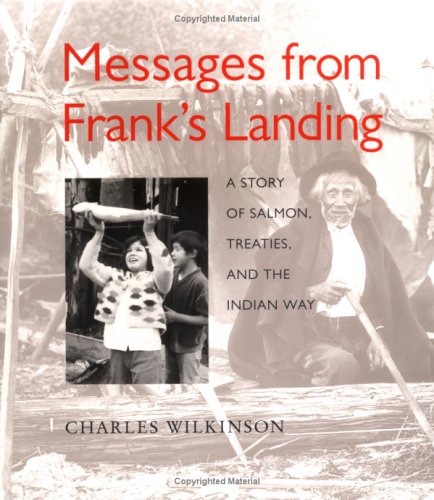
Messages from Frank's Landing: A Story of Salmon, Treaties, and the Indian Way
$99.99
by Charles F. Wilkinson



Explores the historical, legal, and social context of Indian fishing rights in the Pacific Northwest, providing a dramatic account of the people and issues involved. The story focuses on Billy Frank and the river flowing past Frank's Landing, and details Frank's life as an activist, from legal settlements over salmon habitats destroyed by hydroelectric plants, to negotiations with the US Army for environmental protection of tribal lands. Includes many b&w photos of people and the land. Wilkinson (law, U. of Colorado-Boulder) draws on decades of experience as a lawyer working with Indian people. Annotation c. Book News, Inc., Portland, OR (booknews.com) More than a quarter of a century ago, a federal judge, George H. Boldt, affirmed the tribal fishing rights of Native Americans in the Pacific Northwest, granting them 50 percent of the harvestable salmon and steelhead catch. One of the key players in the controversy surrounding that decision was Billy Frank, a Nisqually tribal leader and outspoken champion of Indian rights. Frank's Landing, where Billy Frank and his 95-year-old father lived, became the center of a battle (the famous "Fish Wars") that captivated the entire country. This account of the events leading up to Judge Boldt's decision is remarkably broad in scope, given its length (the 128 pages include 52 photographs and three maps). The authors have written a history not only of a single event but also of the fight for Native American rights in America. The combination of legal analysis and oral history (some fascinating people tell their stories) produces a balanced, thoughtful look at a subject that is as timely and important now as it was 25 years ago. David Pitt Copyright © American Library Association. All rights reserved The author tells a dramatic and complex story with clarity and insight, but his greatest triumph in Messages is that he conveys the inner peace and traditional Indian world view that carries Frank through as an activist and negotiator for Native American rights, and as the spokesperson for the salmon, the river, and the circle of life. An excellent book. ― Wildlife Activist Billy Frank Jr., has been celebrated as a visionary, but if we go deeper and truer, we learn that he is best understood as a plainspoken bearer of traditions, a messenger, passing along messages from his father, from his grandfather, from those further back, from all Indian people, really. They are messages about the natural world, about societies past, about this society, and about societies to come. When examined rigorously?-not out of any romanticism but only out of our own enlightened self?interest?-these messages can be of great practical use to us in this and future years. -- Charles Wilkinson, from the Introduction The Boldt decision profoundly changed natural resource management in the Pacific Northwest. This book clearly builds an historical base to help guide us today. The wisdom and patience of Billy Frank fill virtually every page. It is required reading for anyone interested in salmon preservation. -- Governor Daniel J. Evans Charles Wilkinson evokes the character and culture of the Nisqually people as well as their deep love for their land. From Chief Leschi to Billy Frank, we see the long thread of cultural continuity, culminating in modern times with this fight for justice. -- Ada Deer (Menominee), University of Wisconsin?Madison The authors have written a history not only of a single event but also of the fight for Native American rights in America. The combination of legal analysis and oral history (some fascinating people tell their stories) produces a balanced, thoughtful look at a subject that is as timely and important now as it was 25 years ago. ― Booklist Through the life of Billy Frank, Jr., the Nisqually Indian who led the fight for native treaty fishing rights in the Pacific Northwest, this book provides a vivid and dramatic account of the people and issues involved in this ?uncommon controversy.? Charles Wilkinson is Moses Lasky Professor of Law at the University of Colorado, Boulder. In addition to the standard law texts on Indian and Federal public land law, he is the author of numerous books, including the recently published Fire on the Plateau: Conquest and Endurance in the American Southwest.