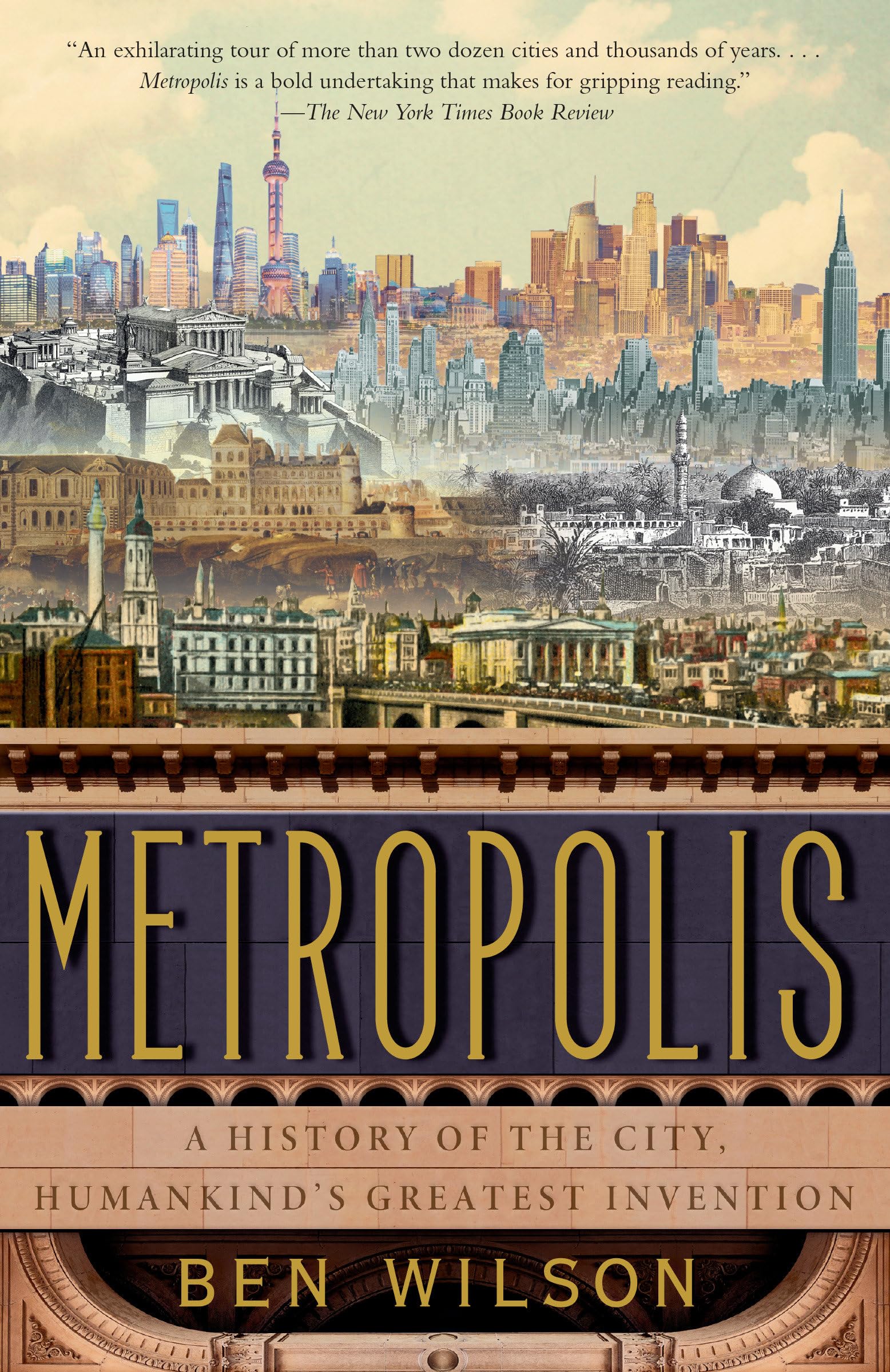



In a captivating tour of cities famous and forgotten, acclaimed historian Ben Wilson tells the glorious, millennia-spanning story how urban living sparked humankind's greatest innovations. “A towering achievement.... Reading this book is like visiting an exhilarating city for the first time—dazzling.” — The Wall Street Journal During the two hundred millennia of humanity’s existence, nothing has shaped us more profoundly than the city. From their very beginnings, cities created such a flourishing of human endeavor—new professions, new forms of art, worship and trade—that they kick-started civilization. Guiding us through the centuries, Wilson reveals the innovations nurtured by the inimitable energy of human beings together: civics in the agora of Athens, global trade in ninth-century Baghdad, finance in the coffeehouses of London, domestic comforts in the heart of Amsterdam, peacocking in Belle Époque Paris. In the modern age, the skyscrapers of New York City inspired utopian visions of community design, while the trees of twenty-first-century Seattle and Shanghai point to a sustainable future in the age of climate change. Page-turning, irresistible, and rich with engrossing detail, Metropolis is a brilliant demonstration that the story of human civilization is the story of cities. " Metropolis teems with information and observations." —The Wall Street Journal "Ben Wilson takes us on an exhilarating tour of more than two dozen cities and thousands of years . . . Metropolis is a bold undertaking that makes for gripping reading." —The New York Times Book Review "[An] ode to cities and cosmopolitan life . . . Metropolis has the added virtue of Wilson as an erudite, creative guide to the history of civilization through its great urban areas." —TIME magazine "He explores the growth, diversity and evolution of human civilisation in this enchanting and meandering book." —The Evening Standard "[A] sharp reminder that the metropolis is vulnerable... [Wilson] brilliantly synthesises the forces that make cities hum." —Financial Times "[Wilson] hops from city to city and century to century, interweaving data, primary sources, anecdotes and the arts. . . . Wilson has done an admirable job wrangling his topic down to an easily digestible size." —Star Tribune "Historian Wilson ( Empire of the Deep ) offers a sweeping survey of how the rise of cities over the past 6,000 years has shaped human history. . . . An amiable and well-informed tour guide, Wilson stuffs his account with intriguing arcana and analysis. Armchair travelers will be enlightened and entertained." —Publishers Weekly "Information rich and accessible. For history and public policy readers seeking a global vision of the impact of world cities." — Library Journal "Wilson has mastered a gargantuan sweep of knowledge. . . Wilson’s enthusiasm for what ancient and modern cities have done for civilization is infectious, as is his magpie approach to various subjects under discussion . . . impeccably crafted." —Highbrow Magazine BEN WILSON is the author of five critically acclaimed books, including What Price Liberty? , for which he received the Somerset Maugham Award; the Sunday Times bestseller Empire of the Deep ; and, most recently, Heyday: The Dawn of the Global Age . He graduated with a first-class degree and an MPhil in history from Pembroke College, Cambridge, and writes regularly for publications such as The Times, Daily Telegraph , and Prospect. 1 dawn of the city Uruk, 4000–1900 bc Enkidu lives in harmony with nature. Strong as a “rock from the sky” and possessing godlike beauty, his heart delights as he runs free with the wild animals. That is until he sees the naked figure of Shamat bathing at the waterhole. Entranced by his first sight of a woman, Enkidu makes love to Shamat for six days and seven nights. Sated by their unbridled, rapturous sexual union, Enkidu attempts to return to the freedom of the wilderness. But his power over nature has faded. The beasts shun him; his strength is diminished; and he feels pangs of loneliness for the first time. Confused, he returns to Shamat. She tells her lover about her home, the fabled city of Uruk, a place of monumental buildings, shady palm groves and great throngs of humanity behind mighty walls. In the city men labour with their brains, not just their brawn. The people wear gorgeous clothing and every day there is a festival, when “drums rap out the beat.” And there are the most beautiful women in the world, “graced with charm and full of delights.” Shamat teaches Enkidu how to eat bread and drink ale. In the city, Shamat tells Enkidu, his godlike potential will be translated into real power. His hairy body shaved, his skin anointed with oils, and his nakedness concealed under costly garments, Enkidu sets off for Uruk. He has renounced the freedom and instincts of nature, drawn to the city by the lure of sex, food and luxury. Cities from Uruk and Babylon t