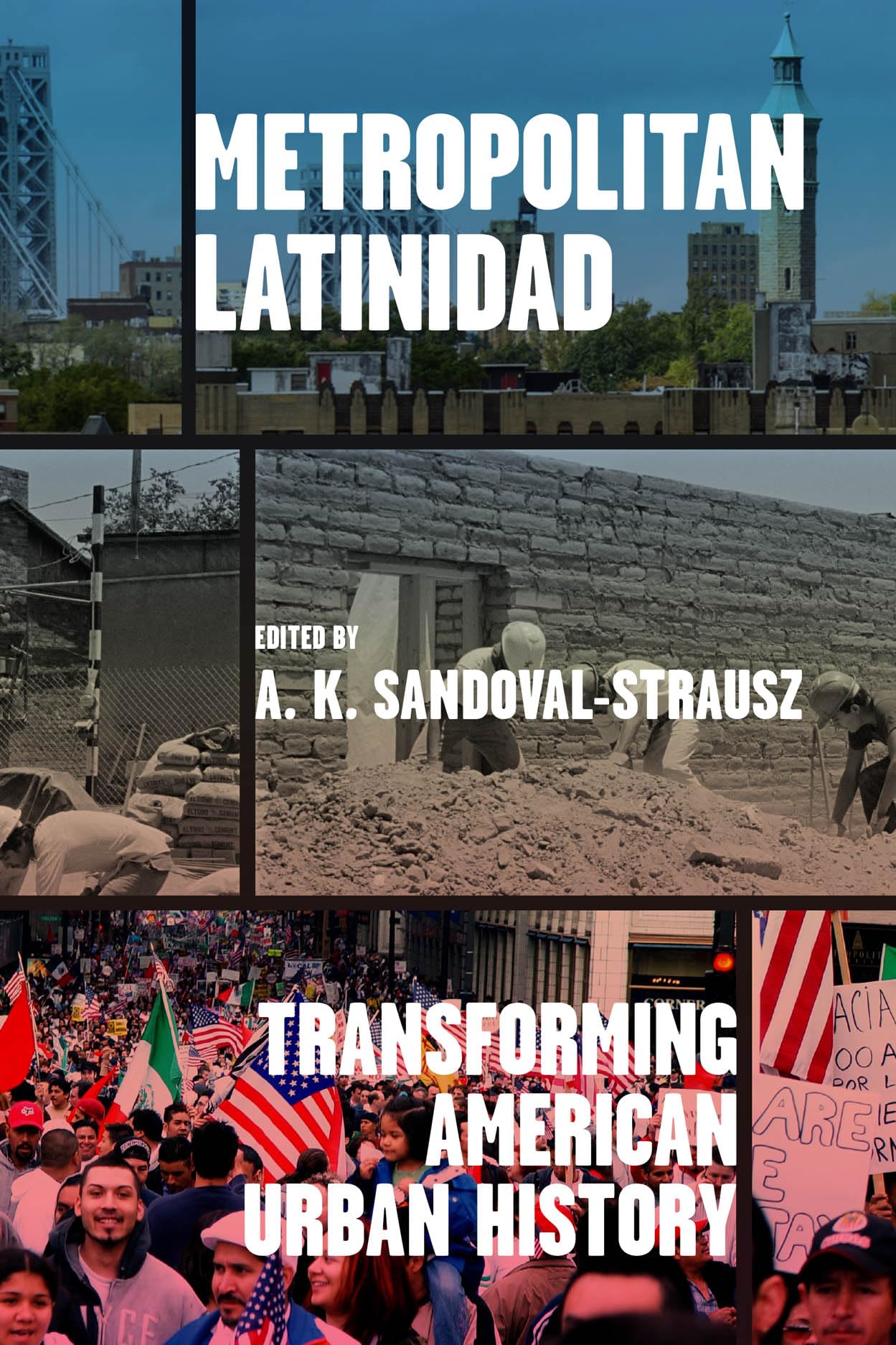
Metropolitan Latinidad: Transforming American Urban History (Historical Studies of Urban America)
$29.80
by A. K. Sandoval-Strausz



A wide-ranging collection of essays that centers Latinos in the history of American cities and suburbs. Latino urban history has been underappreciated not only in its own right but for the centrality of its narratives to urban history as a field. A scholarly discipline that has long scrutinized economics, politics, and the built environment has too often framed race as literally Black and white. This has resulted in a fundamental misunderstanding of the full social canvas of American cities since at least the early twentieth century. Traversing metropolitan areas like Atlanta, Chicago, El Paso, Fort Worth, Los Angeles, Miami, and New York, this collection of essays brings together both established and emerging scholars, including long-time urbanists and academics working in the fields of Latino, borderlands, political, landscape, and religious history. Organized at different scales—including city, suburb, neighborhood, and hemisphere—this impressive body of work challenges long-standing narratives about metropolitan America. The contributors—Llana Barber, Mauricio Castro, Eduardo Contreras, Sandra I. Enríquez, Monika Gosin, Cecilia Sánchez Hill, Felipe Hinojosa, Michael Innis-Jiménez, Max Krochmal, Becky M. Nicolaides, Pedro A. Regalado, Iliana Yamileth Rodriguez, and Thomas J. Sugrue—engage a diverse range of subjects, such as urban rebellions, the suburbanization of Latinos, affordable housing, labor, the built environment, transnationalism, place-making, and religious life. The scholars also explore race within Latino communities, as well as the role that political and economic dynamics have played in creating Latino urban spaces. After reading this book, you will never see American cities the same way again. “Exploring a range of urban experiences, evangelical faith, culinary practices, suburbanization, political activism on many issues, this book highlights the urgency of rewriting urban history by rewriting the history of the Latino metropolis in the United States, based on previously marginalized. Metropolitan Latinidad offers, among its many virtues, away of imagining who has the right to narrate the US city.” ― Society for US Intellectual History “ Metropolitan Latinidad provides readers with a terrific introduction to a dynamic and exciting field. Across a range of approaches and geographic locations, these essays delve into histories of race, space, and politics that have too often been ignored in the field of urban history in the United States. Collectively, they push the field in crucial new directions.” ― Jesse Hoffnung-Garskof, author of “Racial Migrations: New York City and the Revolutionary Politics of the Spanish Caribbean” “ Metropolitan Latinidad reshapes the narrative of Latino urban history, bringing attention to how migration, settlement, labor, and place-making operate in often overlooked regions like the US South and the suburbs. With a scope ranging from the neighborhood to the continent, this collection brings urgency, depth, and nuance to the study of Latinos’ ever-evolving role in transforming American cities and suburbs.” -- Natalia Molina, author of “A Place at the Nayarit: How a Mexican Restaurant Nourished a Community” “ Metropolitan Latinidad provides readers with a terrific introduction to a dynamic and exciting field. Across a range of approaches and geographic locations, these essays delve into histories of race, space, and politics that have too often been ignored in the field of urban history in the United States. Collectively, they push the field in crucial new directions.” ― Jesse Hoffnung-Garskof, author of “Racial Migrations: New York City and the Revolutionary Politics of the Spanish Caribbean” “ Metropolitan Latinidad reshapes the narrative of Latino urban history, bringing attention to how migration, settlement, labor, and place-making operate in often overlooked regions like the US South and the suburbs. With a scope ranging from the neighborhood to the continent, this collection brings urgency, depth, and nuance to the study of Latinos’ ever-evolving role in transforming American cities and suburbs.” -- Natalia Molina, author of “A Place at the Nayarit: How a Mexican Restaurant Nourished a Community” A. K. Sandoval-Strausz is director of the Latina/o Studies Program and professor of history at the Pennsylvania State University. He is the author of Barrio America: How Latino Immigrants Saved the American City and Hotel: An American History . For at least half a century, urban history has fallen behind the pace of change in American cities. In the nation’s largest metropolis, young people growing up in most neighborhoods in the 1970s would have heard Spanish spoken every day: perhaps in their own homes, possibly at school or work, almost certainly on the streets of the city. The most recent census had found that nearly one in six New Yorkers was Hispanic; in the Bronx, where I was born, the proportion was approaching one in three. A