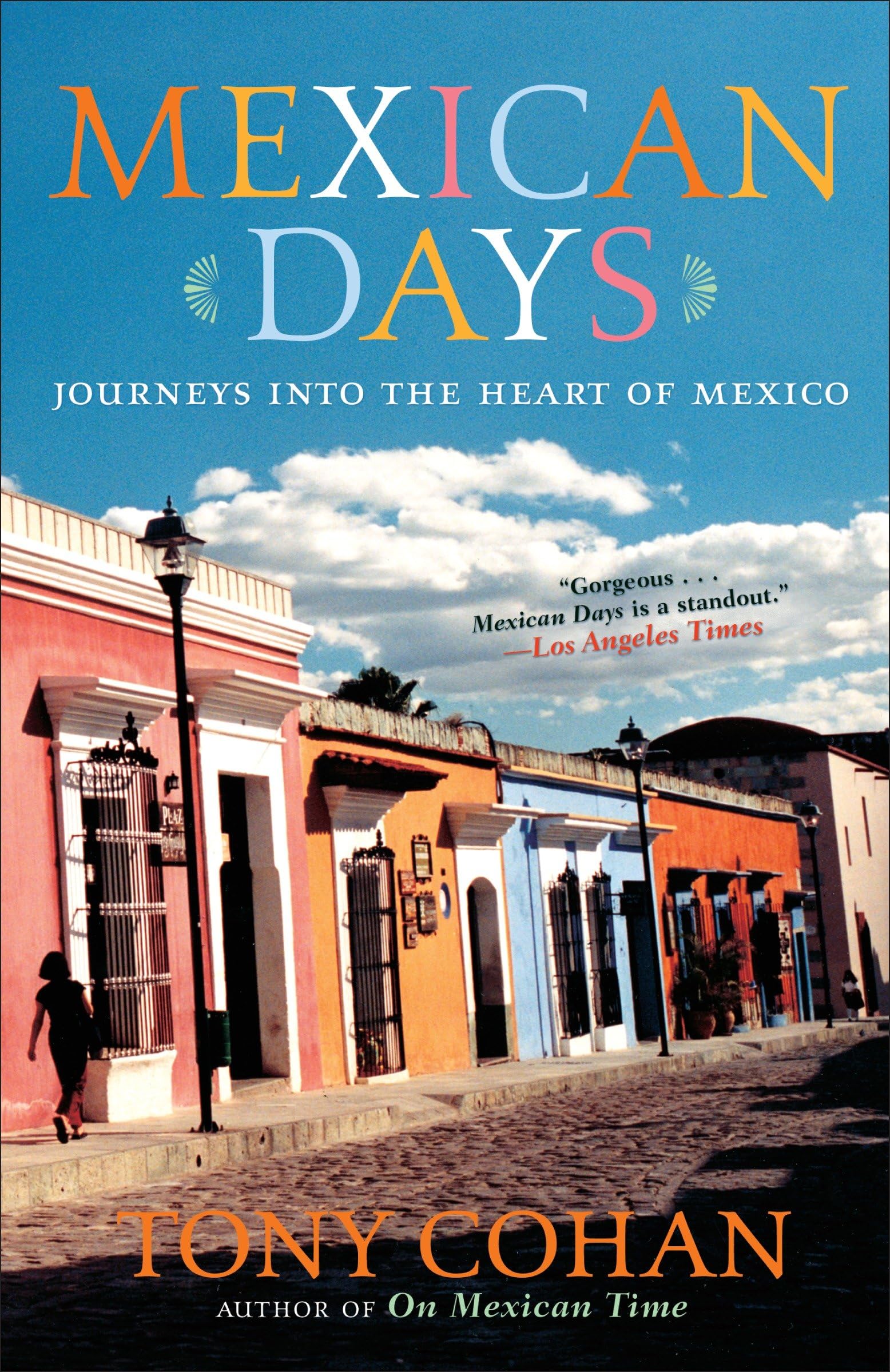



Tony Cohan’s On Mexican Time , his chronicle of discovering a new life in the small Mexican mountain town of San Miguel de Allende, has beguiled readers and become a travel classic. Now, in Mexican Days , point of arrival becomes point of departure as—faced with the invasion of the town by tourists and an entire Hollywood movie crew, a magazine editor’s irresistible invitation, and his own incurable wanderlust—Cohan undertakes a richer, wider exploration of the country he has settled in. Told with the intimate, sensuous insight and broad sweep that captivated readers of On Mexican Time , Mexican Days is set against a changing world as Cohan encounters surprise and adventure in a Mexico both old and new: among the misty mountains and coastal Caribbean towns of Veracruz; the ruins and resorts of Yucatán; the stirring indigenous world of Chiapas; the markets and galleries of Oaxaca; the teeming labyrinth of Mexico City; the remote Sierra Gorda mountains; the haunted city of Guanajuato; and the evocative Mayan ruins of Palenque. Along the way he encounters expatriates and artists, shady operatives and surrealists, and figures from his past. More than an immensely pleasurable and entertaining travel narrative by one of the most vivid, compelling travel voices to emerge in recent years, Mexican Days is both a celebration of the joys and revelations to be found in this inexhaustibly interesting country and a searching investigation of the Mexican landscape and the grip it is coming to have in the North American imagination. Praise for Tony Cohan Mexican Days “Tony Cohan’s singular novelist’s heart and eye, and the master-craftsmanship of his prose, set him far apart from anyone else today writing about ‘travel.’ Tony Cohan goes through the looking glass beyond ordinary journeying and discovers not just a place, a culture, a history, but the interstices of mood, longing, the beauty and tragedy of the people he finds in that place. He is our pre-eminent explorer of Mexico, and anywhere else he may voyage to.” —Peter Nichols, author of A Voyage for Madmen On Mexican Time “Terribly seductive—an enticing and intoxicating vision of Mexico.” — Denver Post “Cohan describes life in Mexico as ‘intimate, voluptuous, sense driven,’ a phrase that also describes On Mexican Time .” — Boston Sunday Globe “ On Mexican Time is more than a travelogue, more than a vicarious journey for the reader. It is a gentle reminder to examine our lives and weed out the unnecessary, the chaotic, and the frivolous.” —Tennessean TONY COHAN is the author of On Mexican Time , the memoir Native State (a Los Angeles Times Notable Book of the Year), and the novels Opium and Canary (a New York Times Notable Book of the Year). His articles, essays, and reviews have appeared in the New York Times , the Washington Post , the Los Angeles Times , and Condé Nast Traveler . He divides his time between Mexico and California. 1. Once Upon a Time in Mexico So what do you make of this?” said Xavier. I watched, from behind a cordon of yellow police tape, Antonio Banderas in a mariachi outfit, and Salma Hayek in far less, dangling from cables affixed to the rooftop of the Hotel San Francisco in San Miguel de Allende’s central plaza, el jardín . Walkie-talkies crackled in Spanish and English. A utility van edged slowly past with a card taped to its windshield reading ONCE UPON A TIME IN MEXICO. “¡Acción!” A volley of fake gunshots burst forth; cameras droned. As the pair descended on the cables in the burnished early twilight, kicking the air, I realized they weren’t Antonio and Salma at all but stunt doubles. “Cut!” I heard in English. Then I saw, over the heads of the gawkers, the real Johnny Depp, pale and slight, emerging from Xavier’s dad’s restaurant with his lady, Vanessa Paradis, on his arm. Willem Dafoe swung into view, followed by Cheech Marin. Was that Mickey Rourke across the plaza? Rubén Blades? Girls’ screams signaled the arrival of the true Banderas, Melanie Griffith close beside him; then la Salma herself with her swain, Edward Norton. Cast and crew had been shooting for months in and around San Miguel, Xavier said. Local nerves were frayed. First flutters of pride and curiosity had given way to resentment. Shopkeepers were up in arms at street blockades preventing access to their stores. An old gringo had cursed out a camera crew some days earlier, to the amusement of the local town paper, Atención —as if he had any more or less right to be here than they did. Hungry locals, hoping to hire on for a few days’ work as extras in a bullfight scene, complained about low pay and dry sandwiches. News had leaked out that Melanie Griffith refused to leave the room while a woman masseuse attended to Antonio. “They’ve rented our town,” Xavier said. “Or maybe I should say they’ve bought it.” Banderas and director Robert Rodriguez, of El Mariachi fame, hoping to mollify criticism for “not giving somethi