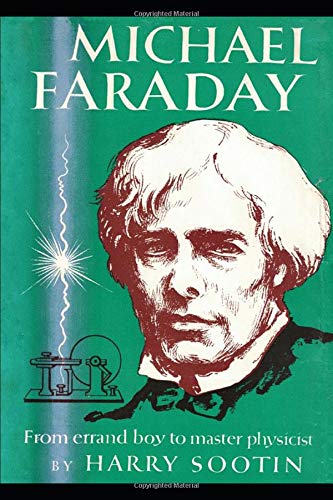



The life story of one of the leading scientists of the 19th century whose experiments led to the development of the dynamo, the electric motor, and to an industrial revolution. Michael Faraday, son of a blacksmith, was apprenticed at fourteen to a bookbinder in whose shop he gained most of his education and acquired an interest in science—from the Encyclopedia Britannica. That interest changed and dominated his entire life, and led from errand boy to Fellow of the Royal Society. Faraday attracted the attention of Sir Humphry Davy, a Professor of Chemistry at the Royal Institution, who hired the boy as a laboratory assistant. Faraday worked with the professor on chemical research for a number of years. He discovered benzene, butylene and the acids of naphthalene, but he never lost interest in electricity and conducted thousands of ex-periments in an effort to turn electrical energy into mechanical motion. He invented the first primitive dynamo and equally primitive motor, and made the first generator. For forty years Faraday lived and worked in his rooms and laboratory at the Royal Institution. When Queen Victoria learned that he and his wife were finding it difficult to climb the stairs to their attic rooms, she presented him with one of the houses in Hampton Green Court. Faraday was a simple man, proud and sensitive. He loved his work and refused many commercial offers that would have made him a fortune. He also refused a knighthood from a grateful country to whom he brought honor and glory as its leading scientist. He did, through the help and urging of his friends, accept a Fellowship in the Royal Society, and he finally accepted a pension, though this precipitated the kind of publicity he had sought so hard to avoid all his life. Today his laws of electrolysis are part of every modern textbook in chemistry and physics, and the unit of electric capacity, the Farad, was named for him.