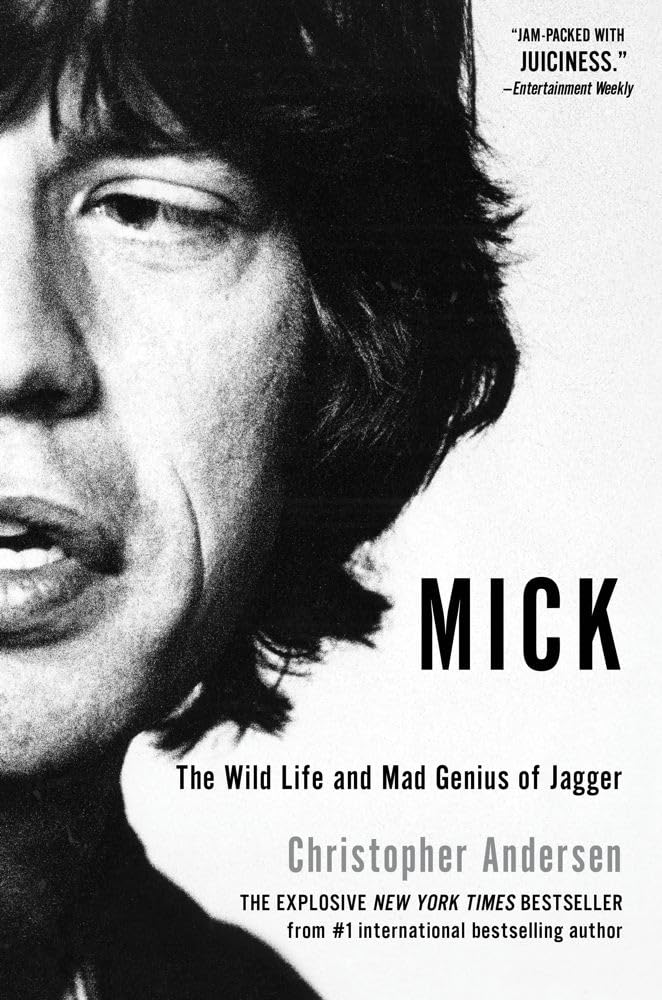



#1 New York Times bestselling author Christopher Andersen tears the mask from rock’s most complex and enigmatic icon in a no-holds-barred biography as enticing as Jagger himself. Is he Jumpin’ Jack Flash? A Street Fighting Man? A Man of Wealth and Taste? All this, it turns out, and far more. By any definition, Mick Jagger is a force of nature, a complete original—and undeniably one of the dominant cultural figures of our time. Swaggering, strutting, sometimes elusive, always spellbinding, he grabbed us by our collective throat a half-century ago and—unlike so many of his gifted peers—never let go. For decades, Mick has jealously guarded his many shocking secrets—until now. As the Rolling Stones mark their 50th anniversary, #1 New York Times bestselling author Christopher Andersen tears the mask from rock’s most complex and enigmatic icon in a no-holds-barred biography as impossible to ignore as Jagger himself. "Jam-packed with juiciness." -- Entertainment Weekly "Hot tub reading at its very tingliest." -- National Post "Explosive...You'd have to be fairly high-minded not to be curious." -- The Telegraph "Breathless." -- Bloomberg News Christopher Andersen is the critically acclaimed author of eighteen New York Times bestsellers which have been translated into more than twenty-five languages worldwide. Two of his books— The Day Diana Died and The Day John Died (about JFK Jr.)—reached #1. A former contributing editor of Time and longtime senior editor of People , Andersen has also written hundreds of articles for a wide range of publications, including The New York Times , Life , and Vanity Fair . Andersen has appeared frequently on such programs as Today , Good Morning America , NBC Nightly News , CBS This Morning , 20/20 , Anderson Cooper 360 , Dateline NBC , Access Hollywood , Entertainment Tonight , Inside Edition , 48 Hours , and more. ? ? ? When Justin Timberlake chronicled his painful breakup with Britney Spears in 2002’s “Cry Me a River,” Lizzy Jagger showed the autobiographical video to her father. “You see the scene in the video?” she asked. “That actually happened, Dad.” Mick Jagger knew instinctively that the rules that applied to other stars did not necessarily apply to him. “If I wrote about what my life is really about, directly and on the money,” Mick said, “people would cringe.” No matter to the millions of fans who spanned the generations, and for whom the term “Jagger swagger” defines what it means to be truly hip and cutting edge—not just fifty years ago when Mick first stepped onto a stage with the Rolling Stones, but today. As the Stones approach their half-century milestone, such contemporary artists as Ke$ha, Kanye West, and the Black Eyed Peas pay musical homage to Jagger—none more memorably than Maroon 5’s Adam Levine and Christina Aguilera, who added their voices to the mounting crescendo of musical tributes with “Moves Like Jagger.” First performed on the hit NBC reality TV show The Voice in June 2011, “Moves Like Jagger” zoomed to number one. With the aid of a hit video featuring the lanky, tattooed Levine, a seductive Christina, and riveting archive footage of a fleet-footed Mick—the true star of the production—“Moves Like Jagger” dominated the musical landscape for the rest of the year. Is he Jumpin’ Jack Flash? A Street Fighting Man? The Midnight Rambler? A Man of Wealth and Taste? All this, it turns out, and far, far more. By any definition, Mick Jagger is an original, one of the dominant cultural figures of our time. Swaggering, strutting, sometimes sinister, always mesmerizing, he grabbed us by our collective throat a half century ago and—unlike so many of his gifted peers—never let go. Jagger is arguably the last of the rock titans, although even that description sells him short. Over the past half century—from the tumultuous sixties and hedonistic seventies to the booming eighties and no-holds-barred nineties to hardscrabble 2012—Mick seeped into the pores of the culture in a way few others have. To baby boomers and subsequent generations, Mick was a fun-house mirror reflection of every phase, fad, movement, and trend. Once the Beatles paved the way with their squeaky-clean brand of youthful rebellion, the Stones gloried in being dirty, scruffy, raunchy, and rude. Students took to the streets to protest the war in Vietnam, and Mick supplied them with rage-filled anthems. No group epitomized the sex, drugs, and rock-and-roll ethos of the psychedelic era more than the Stones. And when the occult was added to the mix, Mick wrapped himself not in some mystic’s robes but in Lucifer’s crimson cloak. His macho street fighter image behind him, Mick became an avatar of androgynous chic, wearing mascara and lipstick and exploring his bisexual side. This, in turn, morphed seamlessly into the disco era, when Mick slipped his bony frame into white satin jumpsuits, bathed himself in glitter, and belted out dance hits between hits of coca