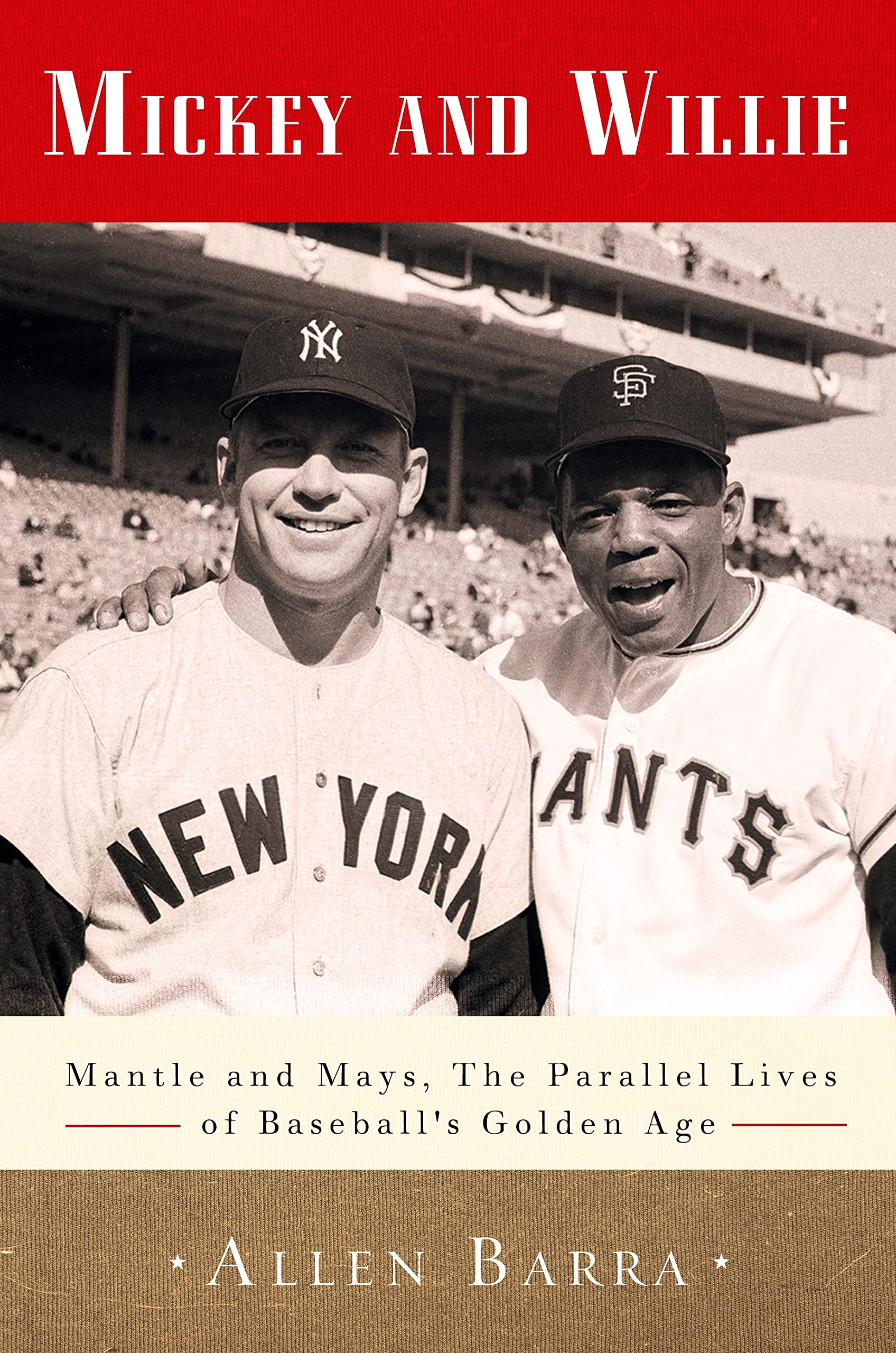
Mickey and Willie: Mantle and Mays, the Parallel Lives of Baseball's Golden Age
$13.92
by Allen Barra



Acclaimed sportswriter Allen Barra exposes the uncanny parallels--and lifelong friendship--between two of the greatest baseball players ever to take the field. Culturally, Mickey Mantle and Willie Mays were light-years apart. Yet they were nearly the same age and almost the same size, and they came to New York at the same time. They possessed virtually the same talents and played the same position. They were both products of generations of baseball-playing families, for whom the game was the only escape from a lifetime of brutal manual labor. Both were nearly crushed by the weight of the outsized expectations placed on them, first by their families and later by America. Both lived secret lives far different from those their fans knew. What their fans also didn't know was that the two men shared a close personal friendship--and that each was the only man who could truly understand the other's experience. In the 1950s, Willie Mays and Mickey Mantle played center field a few miles apart from one another—Mays in Manhattan’s Polo Grounds, for the New York Giants; Mantle at Yankee Stadium, in the Bronx. They were certainly the best players of their era and among the best of all time. Much has been written about both Mays and Mantle, but Barra takes a new and revealing tack: focusing on the uncanny parallels in the pair’s lives and careers. It is a remarkable story: two men, one black, one white, born in the same year, both raised in poverty by baseball-playing fathers who groomed their sons for stardom. Barra follows the pair’s development as players and their careers in the major leagues, always noting the eerie similarities: both started slowly but quickly rose like meteors, each enjoying unimagined celebrity and each, in different ways, reeling from the attention. Juxtaposing Mantle’s alcoholism against Mays’ growing bitterness over perceived and very real slights (his cool reception in San Francisco, when the Giants relocated from New York), Barra produces a compelling and deeply affecting portrait of two superior athletes who shared the terrible burden of being heroes. --Bill Ott ALLEN BARRA is the author of Inventing Wyatt Earp , The Last Coach , and Yogi Berra , as well as several essay collections. He is a regular contributor to such publications as the Wall Street Journal , Daily Beast , and Salon . 1 Fathers and Sons If a scientific research team were to conduct an exhaustive study of the ideal places, times, and conditions for breeding the perfect baseball player, they’d surely come up with something very close to Westfield, Alabama, in the heart of Birmingham’s steel industry, or the mining district of Commerce, Oklahoma. Thousands of southern blacks left their homes during the Depression and moved to industrial cities in the North, but in Westfield, Alabama, William Howard “Cat” Mays chose to stay home. Grueling as the work in the local steel mills was, Cat understood that the promise of a better life in towns like Gary, Indiana, Flint, Michigan, and Pittsburgh, Pennsylvania, was remote. He stayed in Alabama. At the same time, countless families from Oklahoma and adjoining states made the decision to abandon everything and make the hazardous trek to California; their stories would be told in prose by John Steinbeck and in song by Woody Guthrie. No one spoke for Elvin Charles “Mutt” Mantle, who chose to keep his family in Oklahoma, taking jobs as a road grader, tenant farmer, and, finally, miner to put food on the table. For both Cat Mays and Mutt Mantle, the main recreation—practically the only one—was baseball, specifically the industrial league baseball organized by their companies. They raised their boys in a baseball culture. No fathers ever guided their sons toward professional baseball with more single-mindedness than Cat and Mutt. Both men saw baseball as a way to get their sons out of those small towns, out of the mills and mines, although they guided them in very different ways. And once Mickey and Willie left, neither ever lived in his hometown again. Willie Howard Mays—why he was not named William like his father has never been explained—was born in Westfield on May 6, 1931. There’s no monument or plaque to mark the spot; little of the Westfield that Willie knew remains standing today. A pamphlet printed by the Birmingham Chamber of Commerce in the 1960s called it a “village,” which is inaccurate—Westfield was never a village or a town, but a community of neighborhoods populated by black working-class families whose lifeline was the steel mills in nearby Fairfield. Virtually all the houses were of the type called “shotgun”—it was said that you could fire a shotgun at the front door and the pellets would go out the back door. They were built and owned by mills such as the Tennessee Cast Iron and Railroad Company (TCI), the great subcorporation of U.S. Steel, officially to “benefit” the workers but in reality to maintain their dependence on their employers. The larger town of