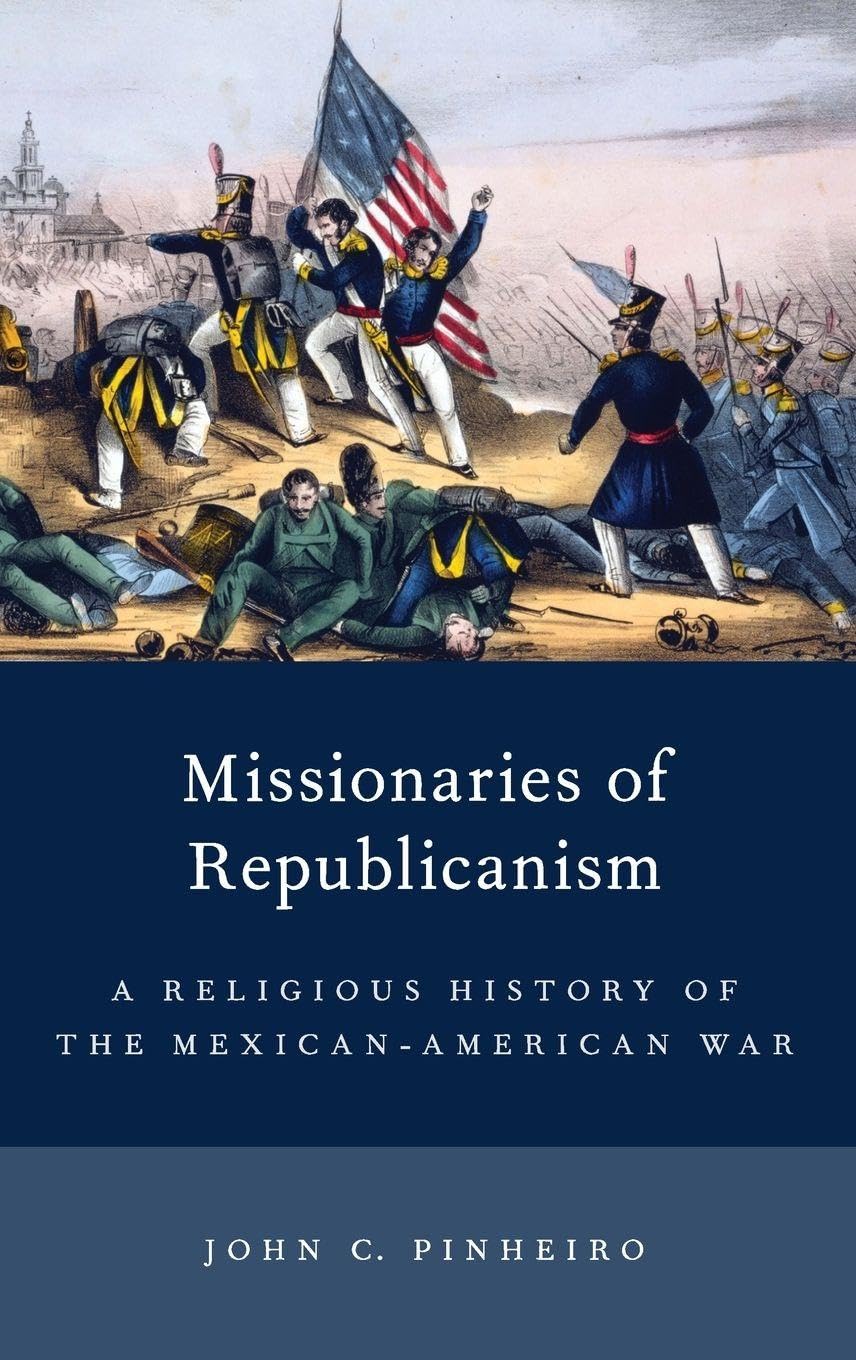
Missionaries of Republicanism: A Religious History of the Mexican-American War (Religion in America)
$90.21
by John C. Pinheiro



Winner of the Fr. Paul J. Foik Award from the Texas Catholic Historical Society The term "Manifest Destiny" has traditionally been linked to U.S. westward expansion in the nineteenth century, the desire to spread republican government, and racialist theories like Anglo-Saxonism. Yet few people realize the degree to which Manifest Destiny and American republicanism relied on a deeply anti-Catholic civil-religious discourse. John C. Pinheiro traces the rise to prominence of this discourse, beginning in the 1820s and culminating in the Mexican-American War of 1846-1848. Pinheiro begins with social reformer and Protestant evangelist Lyman Beecher, who was largely responsible for synthesizing seemingly unrelated strands of religious, patriotic, expansionist, and political sentiment into one universally understood argument about the future of the United States. When the overwhelmingly Protestant United States went to war with Catholic Mexico, this "Beecherite Synthesis" provided Americans with the most important means of defining their own identity, understanding Mexicans, and interpreting the larger meaning of the war. Anti-Catholic rhetoric constituted an integral piece of nearly every major argument for or against the war and was so universally accepted that recruiters, politicians, diplomats, journalists, soldiers, evangelical activists, abolitionists, and pacifists used it. It was also, Pinheiro shows, the primary tool used by American soldiers to interpret Mexico's culture. All this activity in turn reshaped the anti-Catholic movement. Preachers could now use caricatures of Mexicans to illustrate Roman Catholic depravity and nativists could point to Mexico as a warning about what America would be like if dominated by Catholics. Missionaries of Republicanism provides a critical new perspective on Manifest Destiny, American republicanism, anti-Catholicism, and Mexican-American relations in the nineteenth century. "This book is essential reading for students of the Mexican War as well as American political culture. Pinheiro is especially strong in documenting how Protestant Anglo-Saxonism shaped political discourse throughout the conflict but also conditioned military decisions and the wartime experiences of countless Protestant and Catholic soldiers. Although scholars have long recognized the influence of anti-Catholicism in antebellum society, Pinheiro convincingly demonstrates that anti-Catholic Anglo-Saxonism sparked militant nativism long before the late nineteenth century." --James R. Rohrer, Fides et Historia "John C. Pinheiro provides an elegant and concise overview of the growth of American anti-Catholicism in the 1830s and 1840s ...The most compelling consideration yet of the power of anti-Catholic discourse on the U.S. side of the conflict."-- Journal of American History "John C. Pinheiro has opened the door to a fresh, but convincing, understanding of the events and ideological milieu that led to the Mexican War. " -- First Things "For those interested in the interplay of politics and religion within the context of American history, Pinheiro's book sets a new standard for sophistication of analysis. His point is not to engage in reviving and refighting sectarian battles but rather to bring to light and contextualize religion's influence, for better and worse, upon the formation of American political culture. The fact that he writes in an accessible way, but without over-simplifying matters, means that the audience for this book goes far beyond the academy. For anyone interested in the religious history of the United States and the way this has impacted America's relations with its neighbors, this book would be a welcome addition to their library."-- Religion and Liberty "Pinheiro demonstrates persuasively how anti-Catholicism informed arguments both for and against the Mexican-American War, and how its rhetoric and logic permeated Protestant and Catholic Americans experiences of the War, from policy-makers to foot soldiers." -- Religion in American History "Pinheiro effectively incorporates religion into the American worldview during the Mexican American war. Oftentimes, historians fail to acknowledge the the central importance of religion in shaping United States history, but Pinheiro successfully gives his readers a more holistic understanding." -- Daily History "In a time when so much political attention is focused on questions of religious liberty, the brutal honesty of Missionaries [of Republicanism] is a breath of fresh air." -- Ethika Politika "Focusing on the widespread anti-Catholicism that shaped much of American culture in the 1840s, Pinheiro has written an unusual, provocative, and important analysis of the nation's creed and how it was shaped by the unfolding war with Mexico. This book is a groundbreaking achievement." --Joel H. Silbey, author of Party Over Section: The Rough and Ready Presidential Election of 1848 "For too long, American religious h