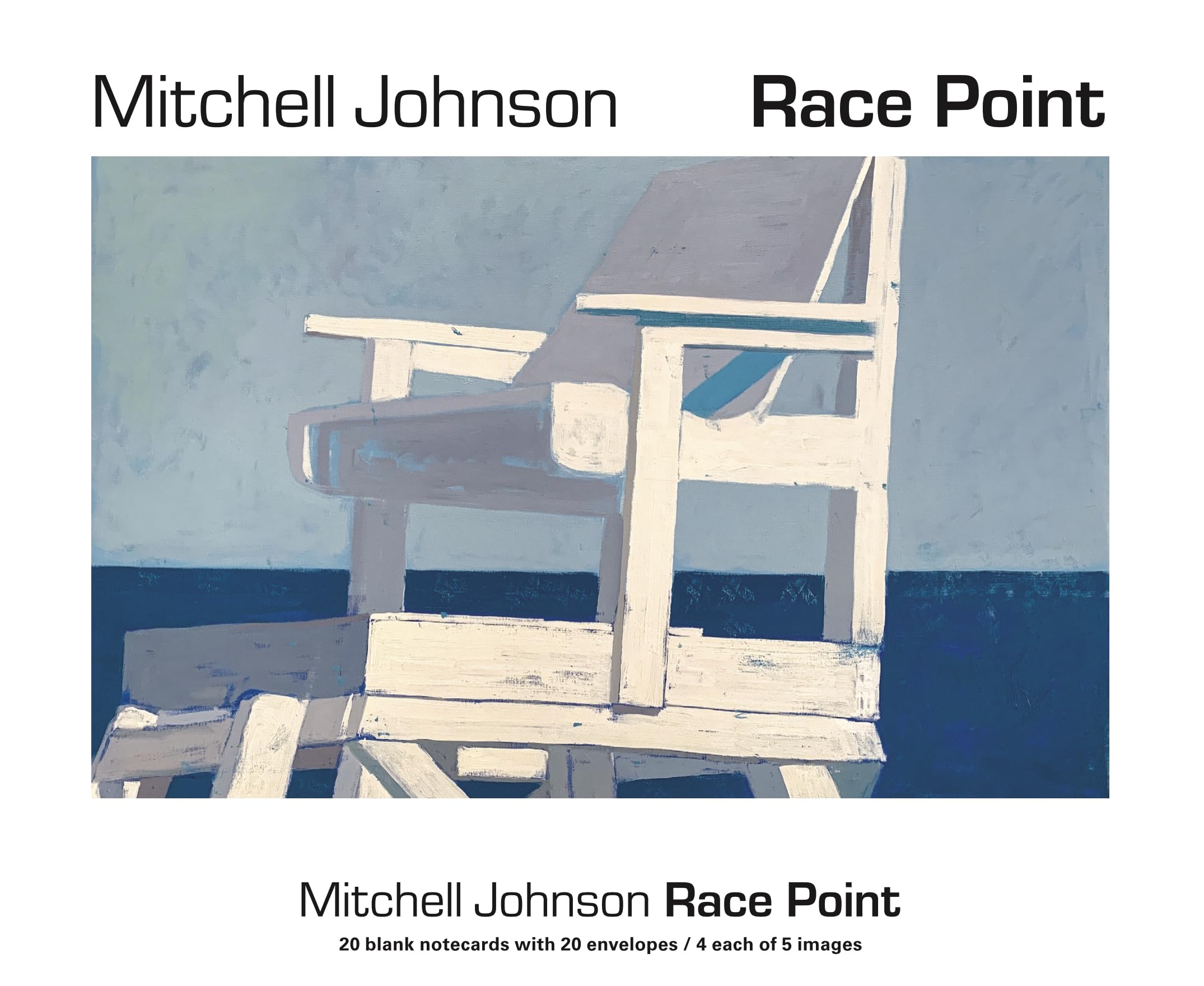



Race Point Boxed Notecards is set #2 of seven new Mitchell Johnson notecard sets being released in January, 2025. These sets go with the exhibition, Giant Paintings from New England, California and Newfoundland", on view at 425 Market Street in San Francisco, March 17-May 30, 2025. Each of these seven limited-edition box sets of notecards are beautifully designed and feature 20 blank cards of 5 different paintings (4 cards of each) and 20 blank envelopes. The seven themes in this series capture the gamut of places that inspire Johnson's work: Amalfi Coast, North Truro (Cape Cod), Paris, Maine, Race Point (Provincetown), Newfoundland and of course, San Francisco. The photos included with each Amazon listing, provide a clear description of the contents of the set you are considering. A biographical flysheet accompanies each set and the colorful notecards are printed on high quality stock and are perfect for writing correspondence and thank you notes. The Race Point set includes five paintings inspired by the Provincetown beach, Race Point, located on the tip of the Outer Cape. Johnson often takes a collection of beach chairs to Race Point to carefully arrange groups of chairs in order to draw them and photograph them searching for compelling compositions that comment on perception, scale, familiarity and sustained observation. These paintings are ultimately conceptual being finished in the studio. The set also includes one of the lifeguard stand paintings Johnson's has become famous for and a painting of the historic Coast Guard building overlooking Race Point beach. Mitchell Johnson has been making annual painting trips to Cape Cod since 2005, where he teaches a master color class at the Truro Center for the Arts each September. Many of these paintings have appeared in The New York Times Magazine and The New Yorker. The legendary art critic Donald Kuspit wrote about Johnson’s work in the July 2023 issue of Whitehot Magazine: “Johnson is a master of abstraction, as his oddly constructivist paintings show, but of unconscious feeling, for his geometry serves to contain and with that control the strong feelings implicit in his strong colors. Apart from that, his paintings are art historically important, because they seamlessly fuse abstraction and realism, which Kandinsky tore apart to the detriment of both even as he recognized that they were implicitly inseparable, tied together in a Gordian knot, as they masterfully are in Johnson’s paintings.” Mitchell Johnson has been making annual painting trips to Cape Cod since 2005. He teaches a master color class at Truro Center for the Arts each fall. Johnson's color- and shape-driven paintings exist at the intersection of color theory, art history, nostalgia, and observed experience. His work is in the permanent collections of over 35 museums and has been exhibited alongside that of Milton Avery, Georgia O'Keeffe, Wolf Kahn, and Richard Diebenkorn. The legendary art critic, Donald Kuspit, wrote about Johnson's work in Whitehot Magazine: "Johnson is a master of abstraction, as his oddly constructivist paintings show, but of unconscious feeling, for his geometry serves to contain and with that control the strong feelings implicit in his strong colors. Apart from that, his paintings are art historically important, because they seamlessly fuse abstraction and realism, which Kandinsky tore apart to the detriment of both even as he recognized that they were implicitly inseparable, tied together in a Gordian knot, as they masterfully are in Johnson's paintings. If many of Johnson's paintings are titled after the places that inspired them, no such places actually exist. Each one is a collage of compressed intimacies spread out over the months it takes to paint them. He has done what Edwin Dickinson called Premier Coup, in which a painting is completed outdoors in one blow. Yet his typical practice is to hold a painting for several months, or more, in the studio, to see if a painting stands the test of repeated looking, often involving the process of memory revision, where a succession of impressions gained over weeks or months is expressed as continuous flow. - Chris Busa --Provincetown Arts 2012 In 2014, Stanford art historian Alexander Nemerov wrote an essay, “Heir of Theirs: Mitchell Johnson and Fairfield Porter,” for the monograph Color as Content. His two opening paragraphs: “A pleasing thing about Mitchell Johnson’s paintings is how they suggest other artists such as Pierre Bonnard, Edouard Vuillard, Giorgio Morandi, and Josef Albers. The references are pleasing because they do not come across as superficial signs of “influence” any more than as melodramatic indications of heroic artistic struggle. Johnson is neither creating a superficial pastiche nor waging an epic battle to win a style of his own. Both those art historical stories make little sense when looking at his art. Instead his paintings are achieved—that word, “achieved,” indicating a quiet and intense tran