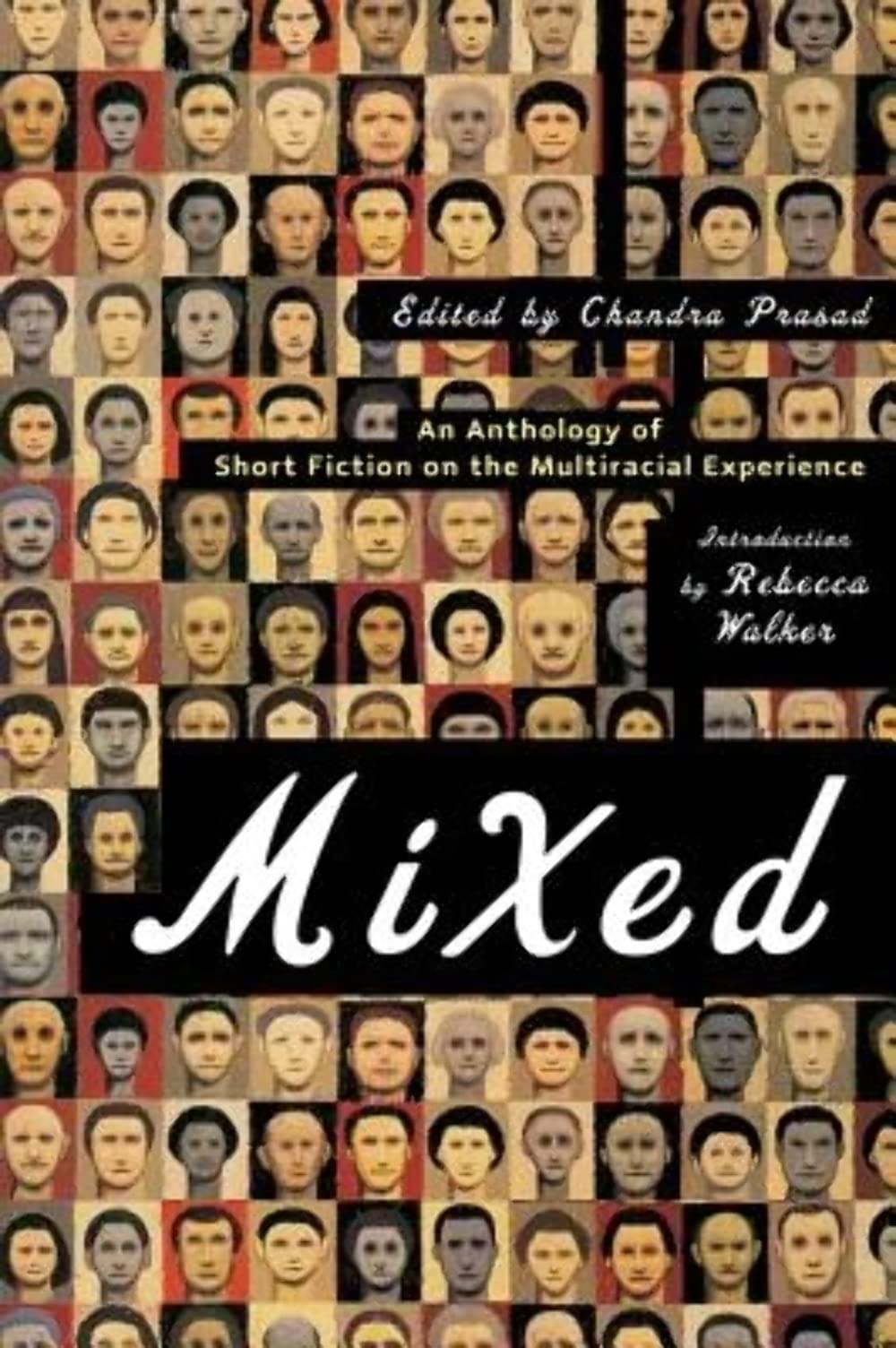
Mixed: An Anthology of Short Fiction on the Multiracial Experience
$16.50
by Chandra Prasad



Though multiracialism has recently become a popular aspect of many memoirs and novels, "Mixed" is the first of its kind: a fiction anthology with racial overlap as its compass. With original pieces by both established and emerging writers, "Mixed" explores the complexities of identity that come with being a multiracial person. Every story, crafted by authors who are themselves mixed-race, broaches multiracialism through character or theme. With contributors such as Cristina Garcia, Danzy Senna, Ruth Ozeki, Mat Johnson, Wayde Compton, Diana Abu-Jaber, Emily Raboteau, Mary Yukari Waters, and Peter Ho Davies, and an illuminating introduction by Rebecca Walker, "Mixed" gives narrative voice to the multiple identities of the rising generation. Contents: The anthropologists' kids by Ruth Ozeki Effigies by Lucinda Roy Minotaur by Peter Ho Davies Mrs. Turner's lawn Jockeys by Emily Raboteau Footnote by Carmit Delman My Elizabeth by Diana Abu-Jaber Gift giving by Mat Johnson Shadey by Stewart David Ikeda Unacknowledged by Brian Ascalon Roley Caste system by Mary Yukari Waters Wayward by Chandra Prasad Falling sky by Cristina Garcia The non-Babylonians by Wayde Compton Hollywood by Marina Budhos Human mathematics by Mamle Kabu Bing-Chen by Neela Vaswani The lost sparrow by Kien Nguyen Triad by Danzy Senna Going way beyond the mythology of the tragic mulatto, this anthology of short stories by and about people of mixed racial heritage explores the complexities of multiracialism and multiculturalism. Ruth Ozeki offers a quasi-autobiographical story about the children of white anthropologists and their Asian wives; British Jamaican Lucinda Roy tells of a mixed-race professor whose authenticity as a black man is questioned; Peter Ho Davies, Welsh and Chinese, writes of a confused minotaur, the result of a mixed-species liaison; Prasad, of Italian, English, Swedish, and Indian heritage, conveys the alienation of an adolescent girl who is part-Indian, part-Russian. Other contributors include Emily Raboteau, Diana Abu-Jaber, Mat Johnson, Cristina Garcia, Wayde Compton, and Neela Vaswani. Each piece is preceded by a short biographical sketch of the writer and concludes with a commentary. This is an absorbing and thought-provoking collection of stories that explore racial identity, alienation, and people often forced to choose between races and cultures in a search for self-identity. Vanessa Bush Copyright © American Library Association. All rights reserved A well-conceived anthology with stories that are compelling and revealing. -- Lyn Miller-Lachmann, Editor-in-Chief, MultiCultural Review I wish I had grown up on these stories. Luckily, I have them to share with my son. -- Catherine McKinley, author of The Book of Sarahs: A Family In Parts Nuanced, thoughtful, and deeply human. -- Bliss Broyard, author of My Father, Dancing Refreshingly complex and compelling. -- Pearl Fuyo Gaskins, author of What Are You?: Voices of Mixed-Race Young People The next time someone asks me, "What are you?" I plan to hand them this book by way of explanation. -- Meredith Broussard, editor of The Dictionary of Failed Relationships and The Encyclopedia of Exes With great skill, these stories convey the shades of grayor black, yellow and brownthat get lost amid easy labels. -- Paul Zakrzewski, editor of Lost Tribe: Jewish Fiction from the Edge A greater awareness of multiracial people is underway. Dozens of web sites devoted to multiracial issues have sprung up across the Internet, and they are frequented by tens of thousands of new visitors each year. Celebrities of mixed-race are now mainstays of music and movies. Think Halle Berry, Norah Jones, and Lenny Kravitz. Multiracial sports stars like Derek Jeter and Tiger Woods continue to snag the spotlight. In fact, in a country that is undeniably race-conscious, multiracial people are well on their way to being focal rather than peripheral. The old adage is that writers should write about what they know. In Mixed, this is precisely what they do. Multiracial authors draw upon their own experiences in identity negotiation as they construct their prose. Because multiracial people are united only by the fact that they not easily categorizeable, the stories in this collection are as divergent as the writers themselves. Yet when taken together, they reflect a singular spirit, one of nonconformity in a world where people continue to ask the question--"What are you?"--and then wait for a one word response.