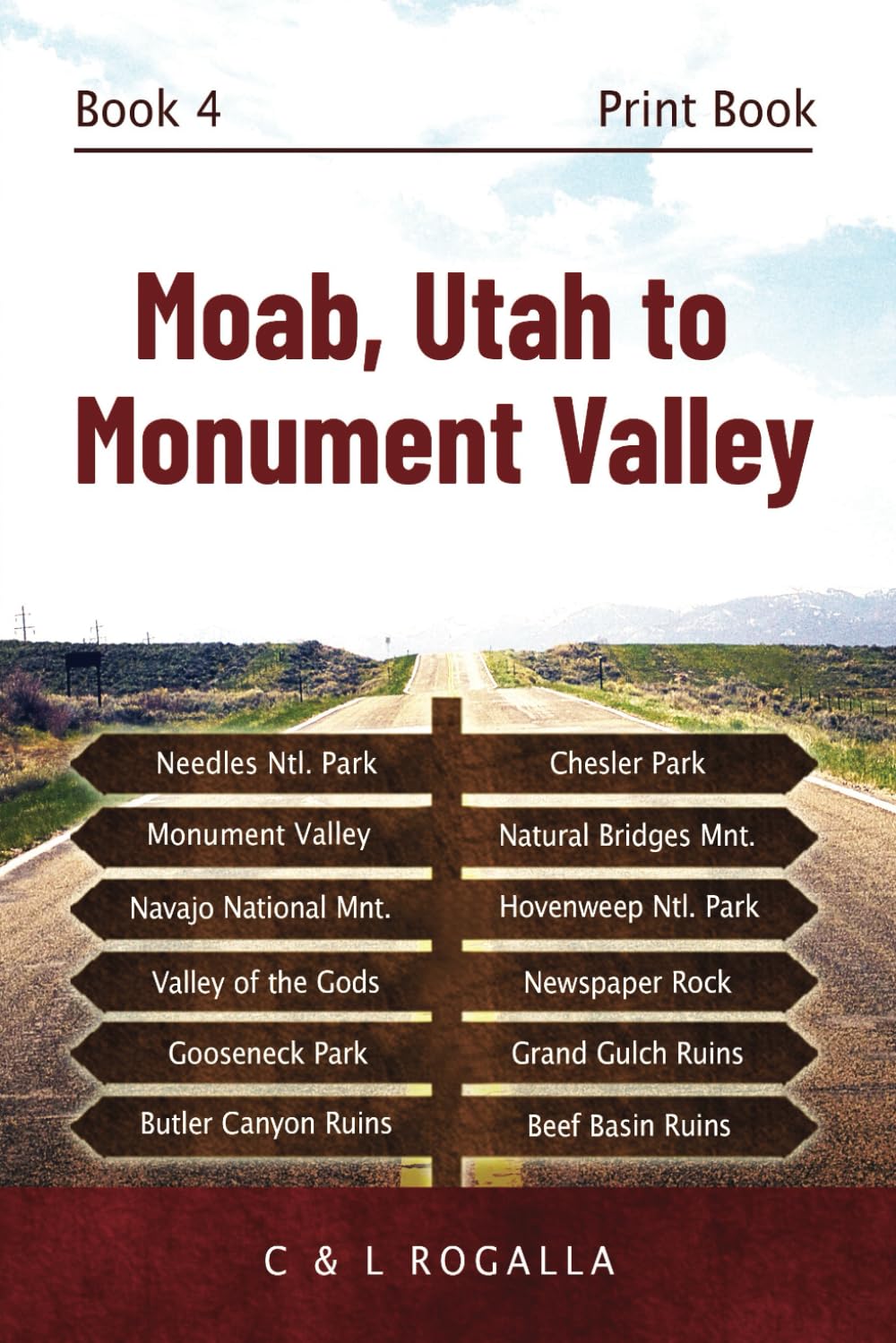
Moab, Utah to Monument Valley: Canyonlands Needles, Monument Valley, Moab, Hovenweep, Escalante
$13.95
by C & L Rogalla



This is one of six books that tours the Grand Circle Adventure parks in southern Utah and northern Arizona. The areas covered in this book are shown in the front cover and the Table of Contents when you use the “Look Inside” option available by opening the Amazon book Internet site. Most print books are black/white to avoid prohibitive cost of color ($30). Only Book 5 and 7 are and color. All Kindle E-books are in color that can be viewed on your TV connected to a computer. (Buy both - one for home and one for travel). All books are available at: www.southutahparks.com * This book is a combination of driving, hiking, mountain-biking and other tours. Where applicable, valuable specific history of that area is included from ancient Indian to modern pioneer evolution. There are suggestions of what to see and do for each tour. Your exact location is known by using a meticulous identification of MPs (mile posts along the road indicating mileage) located at each mile (1.6 km) on every improved road. Where those MPs are not available, we use actual miles from a designated reference point. Where applicable, Global Positioning data (GPS) is supplied to complement walking tours in remote areas. Using this collection of information, you will always know your exact location. * Book navigation starts with the Table of Contents. Under each major Trip there are many individual Tours. Each Tour has the following segments: 1.0 Information: 2-Visitor Center; 3-Services; 4-Lodging; 5-Camping, 6-Hiking; 7-Other Tours (Biking, Horse, Rafting, etc.) and 8-Driving Tours. - Introduction to Major Parks - * Canyonlands-Needles District – Tall multicolored Cedar Mesa Sandstone spires (needles) are unique to this park. Needles is primarily a hiking adventure that lures backcountry hikers from around the world to marvel at its geology along its 60 miles (96 km) of trails and challenging 4-Wheel Drive (4-WD) roads. Within Needles there are many natural arches and ancient Indian ruins and their rock art consisting of petroglyphs and pictographs. Unique to Needles, are the pictographs of faces including the famous All American Man. * National Bridges National Monument consists of three massive natural bridges created by water erosion. A canyon hike passes under each bridge where ancient Indian ruins and rock art are located. * Gooseneck State Park - The San Juan River twists 6 miles (9.7 km) while only traversing 1.5 miles (2.4 km) east to west. The river is almost 1,500 feet (457 m) below the cliff edge. * Hovenweep National Monument is an area where over 2,500 people lived in four separate villages arriving here about 900 A.D. Their dwellings were on open mesas or in a shallow canyon. Their artistic high tower design are very unique. * Monument Valley – No area on earth is more representative of America’s wild west era of cowboys and Indians. There is a 17-mile (27 km) driving tour along these buttes (mittens). Individual Navajo guided tours are also available that includes horse rides. This park is owned by the Navajo Indian nation. * Navajo National Monument hosts the finest preserved ancient Anasazi Indian ruin village in the U.S. – Keet Seel. Another adjacent ancient village is Betaken. There are hiking trails to both sites. Keet Seel should be an overnight hike. There are two excellent park campgrounds. * Grand Gulch Indian Ruins is a vast general area hosts over hundreds of ancient Indian ruins and unlimited hiking. The most concentrated and grandeur are in the deep Grand Gulch favoring overnight camping (permits). The most significant, not in the gulch, is Moon House Ruin known for its broad white banner, with an image of a moon within it. The other is the Citadel situated on a long narrow peninsula jutting out into the canyon afford superb views. * Valley of the Gods area hosts magnificent buttes on a smaller scale than those at Monument Valley. There are free camp sites along the road.