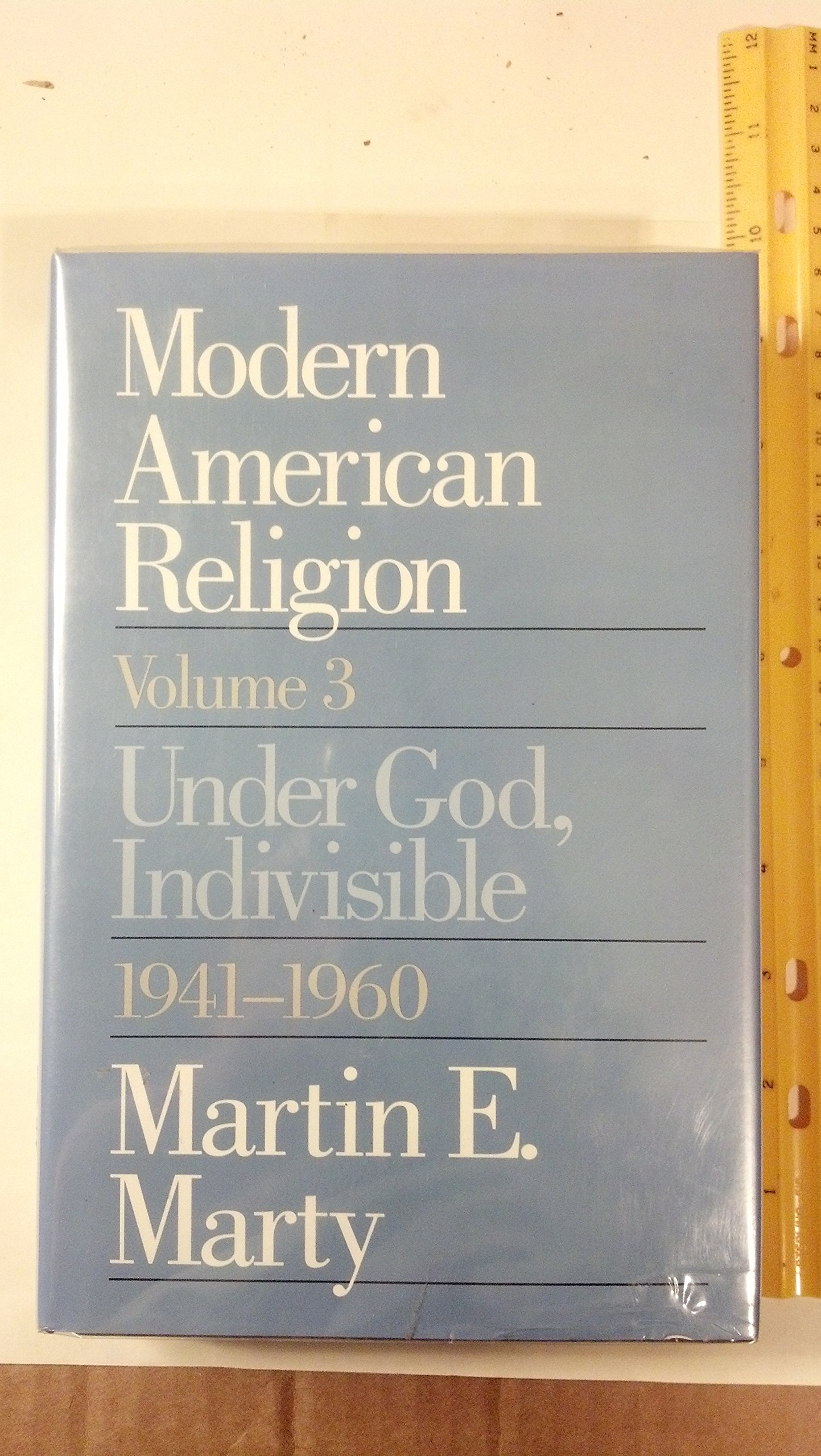
Modern American Religion, Volume 3: Under God, Indivisible, 1941-1960
$24.93
by Martin E. Marty



In this third volume of his acclaimed chronicle of faith in twentieth-century America, Martin E. Marty presents the first authoritative account of American religious culture from the entry of the United States into World War II through the Eisenhower years. Under God, Indivisible, 1941-1960 is the first book to systematically address religion and the roles it played in shaping the social and political life of mid-century America. A work of exceptional clarity and historical depth, it will interest general readers as well as historians of American and church history. "The series will become a standard account of the nation's variegated religious culture during the current century. The four volumes, the fruition of decades of research, may rank as much honored Marty's most significant contribution to U.S. studies."—Richard N. Ostling, Time "When America needs some advice or commentary on the state of modern theology, the person it turns to is Martin Marty."— Publishers Weekly In volume three of this outstanding series on the history of religion in the modern United States, Marty turns a critical eye to the behavior of Christian churches during WWII. He points to the major Christian churches' failure to address significant moral issues arising from the war: the defense of Jews and other refugees, the internment of Japanese civilians, racial segregation, the military tactic of saturation bombing of civilians, and the use of the atomic bomb. Immediately after the war, Protestant leaders returned to their inglorious preoccupation with the threat to religious freedom posed by Roman Catholicism. Only with the social prosperity of the late 1950s did American religious life take on a more forgiving role that embraced ecumenism. Marty, who won the National Book Award for Righteous Empire (LJ 10/1/70), is a respected authority on American religion. Like the first two of his four-volume survey (The Irony of It All, 1893-1919, LJ 10/15/86; The Noise of Conflict, 1919-1941, Univ. of Chicago Pr., 1991), this work successfully stands alone as a detailed and perceptive analysis of two decades of American life. Marty's subject is neither theology nor private faith but rather religion's intersection with mainstream culture. Marty describes Protestant, Catholic, and Jewish unity first in opposition to Hitler and then in resistance to the forces of "godless Communism." He also discusses the currents of separatism and exclusion from "one nation under God." There is no richer source available than this clearly written study, and it is equally valuable for scholars, students, and lay readers. Essential for collections in American religion or cultural history.?Wendy Knickerbocker, Rhode Island Coll. Lib., Providence Copyright 1996 Reed Business Information, Inc. The third volume in Marty's history of modern U.S. religion is "the story of an argument about One Nation" and therefore attends to the ethos of the arguers, the pathos of their audiences, and the logos of their arguments. The book is divided into three parts, the first focusing on World War II, when "indivisibility" went largely unchallenged; the second addressing the early cold war, with particular attention to the emergence of Israel during the Truman administration; and the third examining Eisenhower's presidency. The specter of the Vietnam War haunts the end of the book, threatening the unity of the tripartite and post-Protestant "Judeo-Christian" tradition constructed after World War II. Marty's writing is lucid and accessible to general audiences. He offers a few pointers to those readers wanting to move away from the text's largely middle-of-the-road position, but by staying close to the yellow line, he helps ensure that this impressive account will become a standard in the field. Steve Schroeder An excellent history by one of the most distinguished American religious scholars of our time. Marty is a professor at the University of Chicago and editor of the Christian Century. In this third installment in his Modern American Religion series, he explores the volatile wartime and postwar years, when American Protestantism enjoyed its renaissance and the Eisenhower administration saw fit to insert ``under God'' in the nation's Pledge of Allegiance. Marty calls recent revisionist scholarship to task by reminding us that while there were important dissenting groups during the 1950s, there was also a predominant WASP cultural landscape that dissenters were reacting against. Protestant hegemony was still very real, especially as Americans tried to unite themselves spiritually in the face of two historical crises: WW II and the Cold War. To achieve this unity, ecumenism was the spirit of the age, resulting in the rise of the World Council of Churches and other cooperative institutions. This study is impressively researched and the writing is free of jargon, though at times a bit dry. Scholars will appreciate the depth of detail that Marty offers here; not content to