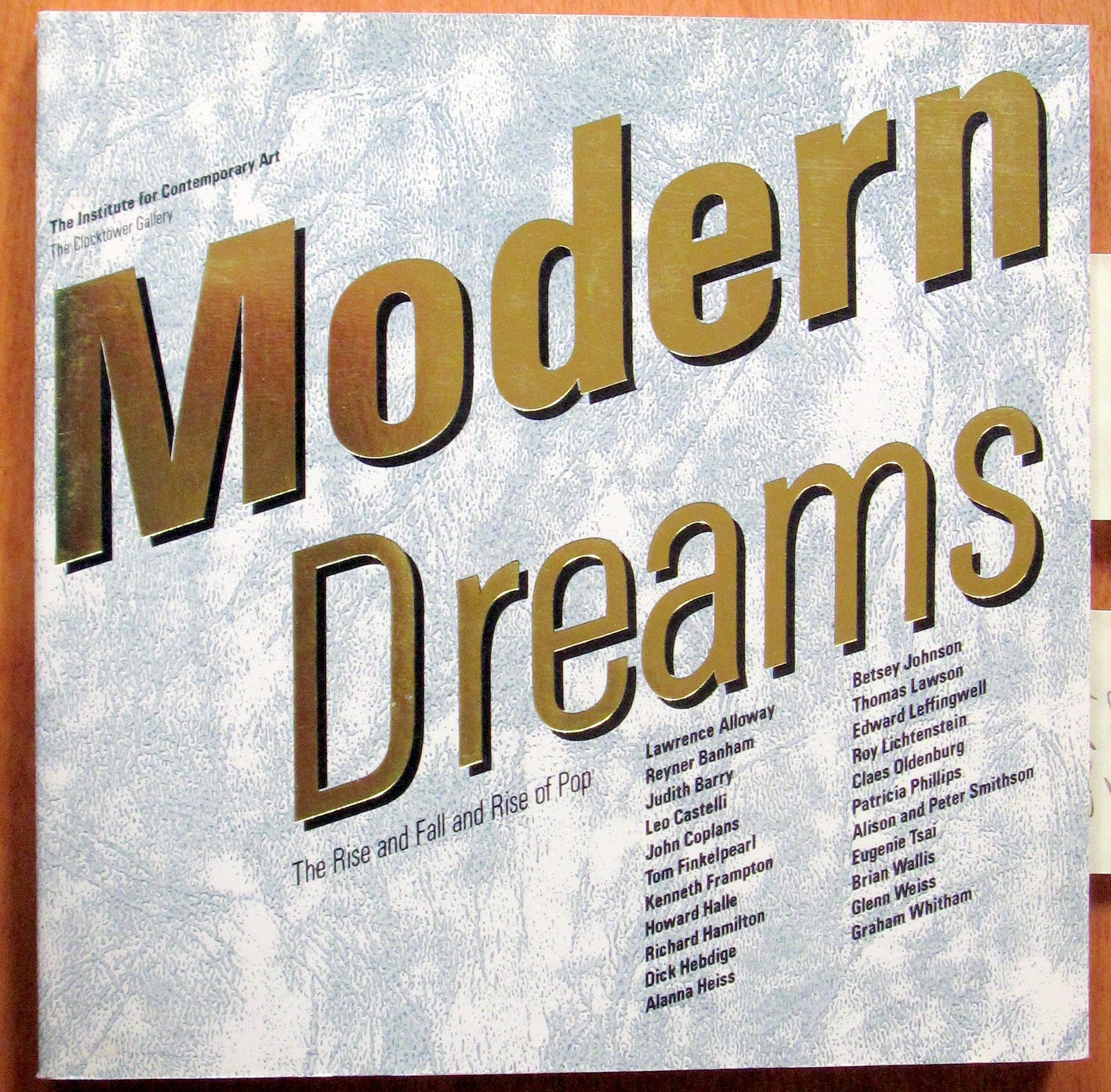



Modern Dreams explores the distinction between the theoretical and sociological production of London in the fifties and conceptually related work of New York in the eighties. The art objects and theoretical strategies presented by the artists, architects, and writers included in this book engage in a continuing, questioning struggle with the means and ends of presentation and representation, focusing in particular on the effects of media images in photographs and on television. Modern Dreams pursues the transformation of images of popular culture into meaningful icons of contemporary society on four fronts. It begins by investigating the Independent Group's landmark exhibition "This is Tomorrow Today" held at the Whitechapel Gallery in London in 1956 as proto-Pop; examines the utilization of art related technology and imagery as a kind of agit-Pop of the streets; explores the theoretical ramifications, qualified accomplishments, and possibilities of archi-Pop; and discusses the self referential, picture oriented production of post-Pop. A conversation among the Americans who were instrumental in defining Pop interprets the impact, of the British "proto-Pop" group on emerging American Pop artists, and provides a revealing look at some of the issues at stake, in the mass media environment that informs the work of artists of the 1980s. Distributed for the P.S. 1 Museum, The Institute for Art and Urban Resources. Essays by Dennis Adams, Lawrence Alloway, Reyner Banham, Judith Barry, Thomas Finkelpearl, Kenneth Frampton, Richard Hamilton, Dick Hebdige, Thomas Lawson, Patricia Phillips, Alison and Peter Smithson, Eugenie Tsai, Brian Wallis, Glenn Weiss, Krzysztof Wodiczko A conversation with Alanna Heiss, Leo Castelli, Claes Oldenburg, Roy Lichtenstein, John Coplans, Betsey Johnson This work was published to accompany a series of four linked exhibitions sponsored by the Institute and held at the Clocktower Gallery in New York. The overall title was "Me Pop Project~" and it included 'This is Tomorrow Today," curated by Brian Wallis; "Public Image: Homeless Projects by Kryzsztof Wodiczko and Dennis Adams," curated by Tom Finkelpearl; "Present Tensions: 25 Years of Irrelevance in Architecture," by Patricia Phillips and Glenn Weiss; and "Nostalgia as Resistance," by Thomas Sawson. These four exhibits trace the development of the phenomenon known as "Pop," fixing on certain specific activities, moments, and ideas of the past thirty years. The essays cover many topics, some relating directly to the exhibitions and some going further afield to discuss the historical aspects and cultural influences of the movement. They investigate the relationship between the 1950s British Independent Group and the American advocates of the conceptually involved work of the past years. The sociological approach is never far from these discussions of an activity which incorporated everyday objects, mass communication, and popular culture into the creative process. It was the material world that fascinated and repulsed the artists and architects of Pop causing a rejection of ..style" in favor of fantasy mixed with kitsch, banality with humor. It is ironic that it has influenced contemporary culture which often seems all style and little substance. Architecture, the photographic image, mass media, and graphic design-all are topics for this work as well as conversations with many of the prominent people-creators and critics-active in the field. However, the final result fails to transform "everyday object to fine art manifestation," and although the work is interesting as historical record, it is uneven and meandering. The self-awareness sought by the founders of the Pop movement is obscured by a self-consciousness which minimizes its impact. -- From Independent Publisher Tom Finkelpearl is Program Director of PS 1 Contemporary Art Center in New York City. From 1990 to 1996, he was Director of New York City's Percent for Art Program.