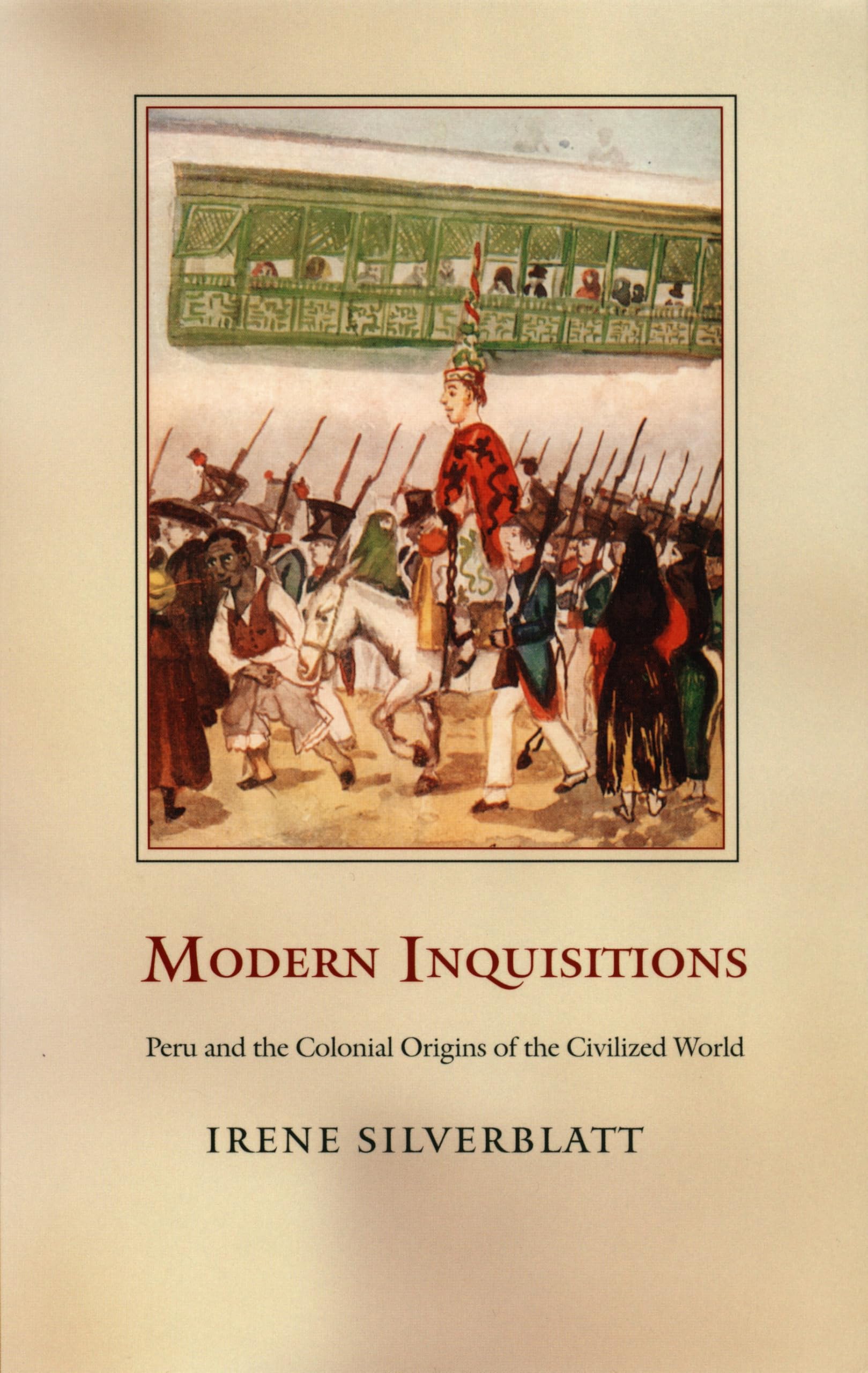
Modern Inquisitions: Peru and the Colonial Origins of the Civilized World (Latin America Otherwise)
$20.51
by Irene Silverblatt



Trying to understand how “civilized” people could embrace fascism, Hannah Arendt searched for a precedent in modern Western history. She found it in nineteenth-century colonialism, with its mix of bureaucratic rule, racial superiority, and appeals to rationality. Modern Inquisitions takes Arendt’s insights into the barbaric underside of Western civilization and moves them back to the sixteenth century and seventeenth, when Spanish colonialism dominated the globe. Irene Silverblatt describes how the modern world developed in tandem with Spanish imperialism and argues that key characteristics of the modern state are evident in the workings of the Inquisition. Her analysis of the tribunal’s persecution of women and men in colonial Peru illuminates modernity’s intricate “dance of bureaucracy and race.” Drawing on extensive research in Peruvian and Spanish archives, Silverblatt uses church records, evangelizing sermons, and missionary guides to explore how the emerging modern world was built, experienced, and understood by colonists, native peoples, and Inquisition officials: Early missionaries preached about world history and about the races and nations that inhabited the globe; Inquisitors, able bureaucrats, defined who was a legitimate Spaniard as they executed heretics for “reasons of state”; the “stained blood” of Indians, blacks, and descendants of Jews and Moors was said to cause their deficient character; and native Peruvians began to call themselves Indian. In dialogue with Arendt and other theorists of modernity, Silverblatt shows that the modern world’s underside is tied to its origins in colonialism and to its capacity to rationalize violence. Modern Inquisitions forces the reader to confront the idea that the Inquisition was not only a product of the modern world of the sixteenth and seventeenth centuries, but party to the creation of the civilized world we know today. “ Modern Inquisitions is a superb inquiry into the obscured American origins of modernity. With exceptional lucidity and judicious indignation, Irene Silverblatt persuasively argues that the Spanish Inquisition in colonial Peru was a modern institution that intimately intertwined race-thinking and bureaucratic rationality. By illuminating the subterranean currents shaping the modern world, this outstanding book renders the violent civilizing hierarchies they have carved at once more comprehensible and more intolerable.”—Fernando Coronil, author of The Magical State: Nature, Money, and Modernity in Venezuela “ Modern Inquisitions is an extraordinary work of research and interpretation. Based on painstaking archival research in the Lima Inquisition records, it makes crucial contributions to the debates about race, state-formation, and colonialism.”—Barbara Weinstein, author of For Social Peace in Brazil: Industrialists and the Remaking of the Working Class in São Paulo, 1920–1964 ""Modern Inquisitions" is an extraordinary work of research and interpretation. Based on painstaking archival research in the Lima Inquisition records, it makes crucial contributions to the debates about race, state-formation, and colonialism."--Barbara Weinstein, author of "For Social Peace in Brazil: Industrialists and the Remaking of the Working Class in Sao Paulo, 1920-1964" Irene Silverblatt is Professor of Cultural Anthropology at Duke University. She is the author of Moon, Sun, and Witches: Gender Ideologies and Class in Inca and Colonial Peru . She is past president of the American Society for Ethnohistory (2001–02). Modern Inquisitions Peru and the Colonial Origins of the Civilized World By Irene Marsha Silverblatt Duke University Press ISBN: 0-8223-3417-8 Contents About the Series........................................ixAcknowledgments.........................................xiPrologue................................................3Three Accused Heretics..................................29Inquisition as Bureaucracy..............................55Mysteries of State......................................77Globalization and Guinea Pigs...........................99States and Stains.......................................117New Christians and New World Fears......................141The Inca's Witches......................................161Becoming Indian.........................................187Afterword...............................................217Appendix: Notes on Bias and Sources.....................227Notes...................................................235Bibliography............................................283Index...................................................293 Prologue We can no longer afford to take that which was good in the past and simply call it our heritage, to discard the bad and simply think of it as a dead load which by itself time will bury in oblivion. The subterranean stream of Western history has finally come to the surface.-HANNAH ARENDT, The Origins of Totalitarianism Puz