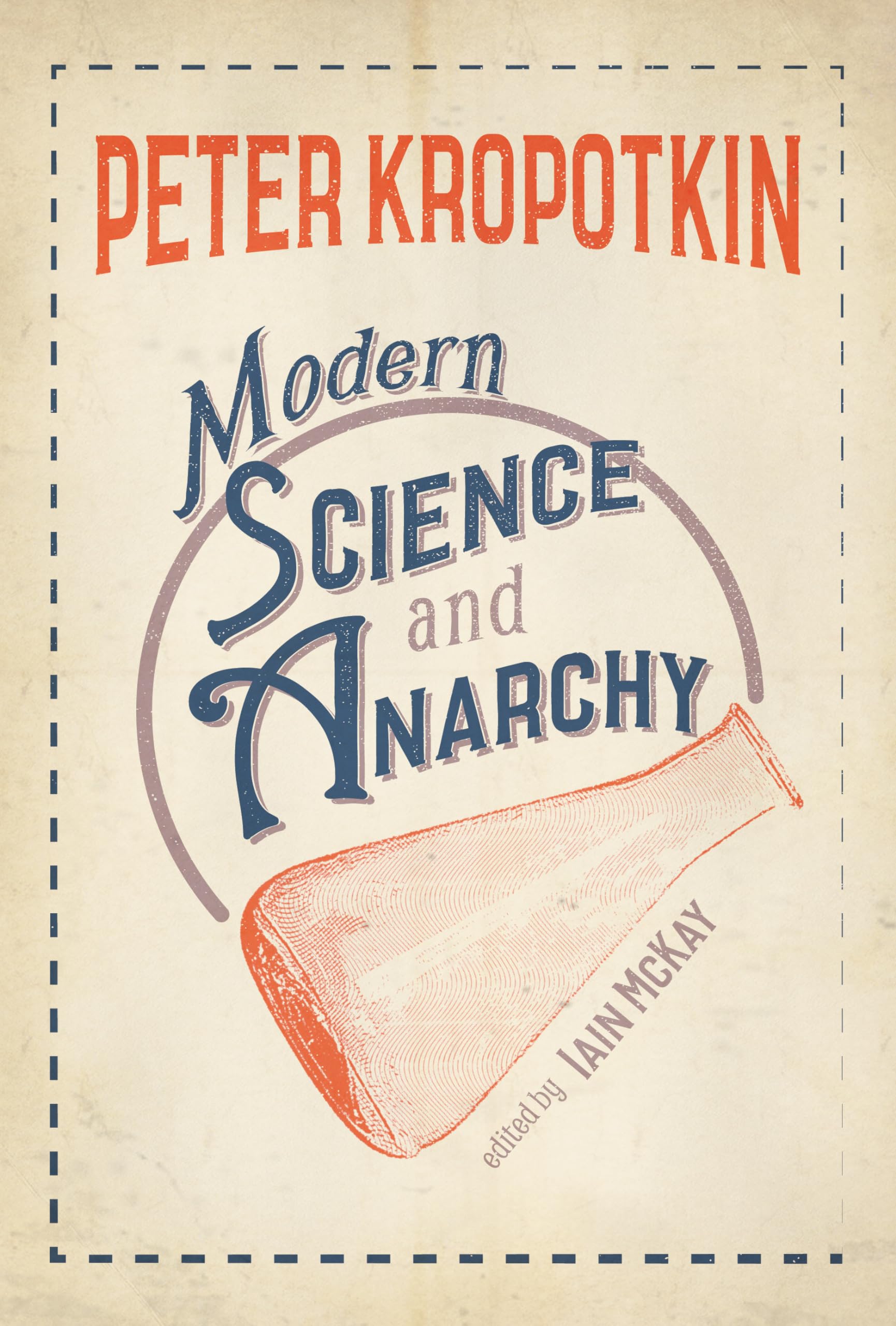



This was Peter Kropotkin's final book, in which he theorizes about the development of the modern state and how modern science and technology can assist in freeing working people from capitalism. First published in 1912 in France, sections of this book have been translated and published in English (as short books and pamphlets and journal articles), but never as a whole work as Kropotkin intended. More than 10 percent of this book has never before appeared in English. Introduced and annotated by Iain McKay. "Iain McKay's definitive version of Modern Science and Anarchy is another welcome product of his continuing effort to broaden our understanding of Kropotkin's ideas, recovering texts scattered and forgotten in the course of Kropotkin's transnational activism. More than an exercise in Kropotkiana however, this work offers Kropotkin's most concise exposition of the ideas that defined his life, focusing on anarchism's interactions with the defining scientific and political currents of modern European history, and staking a claim for anarchism as a vital, and intellectually sophisticated, component of this story." —Matthew Adams, author of Kropotkin, Read, and the Intellectual History of British Anarchism "Finally, after all these years the definitive edition of Kropotkin's Modern Science and Anarchy . Here we have not only a mature restatement of Kropotkin's anarchist communism, but Kropotkin's own history of anarchist ideas and movements, a survey of libertarian and anarchist currents throughout human history, as Kropotkin describes the perennial struggle between authority and liberty. But that is not all—the second half of the book, a series of essays selected by Kropotkin himself on the rise of capitalism and the state, contains some of Kropotkin's best work, including "The State: Its Historic Role." Iain McKay is to be commended for so carefully editing and annotating one of Kropotkin's most important books, well deserving a place alongside Mutual Aid and The Conquest of Bread." —Robert Graham, author of We Do Not Fear Anarchy—We Invoke it: The First International and the Origins of the Anarchist Movement and editor of Anarchism: A Documentary History of Libertarian Ideas . "This new, definitive edition of Kropotkin's Modern Science and Anarchy is an important addition to the literature on one of the most influential figures in the development of modern libertarian communism. Iain McKay's introduction is a model of scholarship and succeeds not only in contextualising and explaining Kropotkin's ideas, but also in addressing a number of misunderstandings and misrepresentations along the way. He also makes a convincing case for the book's continuing relevance for present-day radicals." —David Berry, author of A History of the French Anarchist Movement, 1917 to 1945 "This is a welcome new translation of a long neglected text by Peter Kropotkin. In the spirit of Kropotkin, the volume includes a highly knowledgeable and sympathetic—yet not uncritical—introduction by the editor, who also adds some clarifying footnotes to the original text." —Benjamin Franks, author of Rebel Alliances: The Means and Ends of Contemporary British Anarchisms Peter Kropotkin (1842-1921) was one of anarchism's most famous thinkers. His classic works include The Conquest of Bread ; Fields, Factories and Workshops ; Memoirs of a Revolutionist ; and Mutual Aid: A Factor of Evolution . Iain McKay is editor of An Anarchist FAQ (Vols. I and II), Direct Struggle against Capital: A Peter Kropotkin Anthology , and Property is Theft!: A Pierre Joseph-Proudhon Anthology . Conclusion [of Part I] Anarchy represents an attempt to apply the generalisations obtained by the inductive method of the natural sciences to the evaluation of human institutions. It is also an attempt to predict, on the basis of that evaluation, the march of humanity towards liberty, equality, and fraternity, in order to obtain the greatest possible sum of happiness for each of the units in human societies. Anarchy is the inevitable result of the intellectual movement in the natural sciences which began towards the end of the eighteenth century, was retarded by the triumphant reaction in Europe after the defeat of the French Revolution, and recommenced anew in the full blossoming of its forces since the end of the [eighteen-]fifties. The roots of Anarchy are in the naturalist philosophy of the eighteenth century. But it could not acquire its full foundations until the revival of science which took place at the beginning of the second half of the nineteenth century and which gave new life to the study of institutions and human societies on a naturalist basis. The purported "scientific laws" with which the German metaphysicians of the 1820s and 1830s were content find no place in the anarchist conception. It recognises no other method of research than the scientific method. And it applies this method to all the sciences generally known under the name