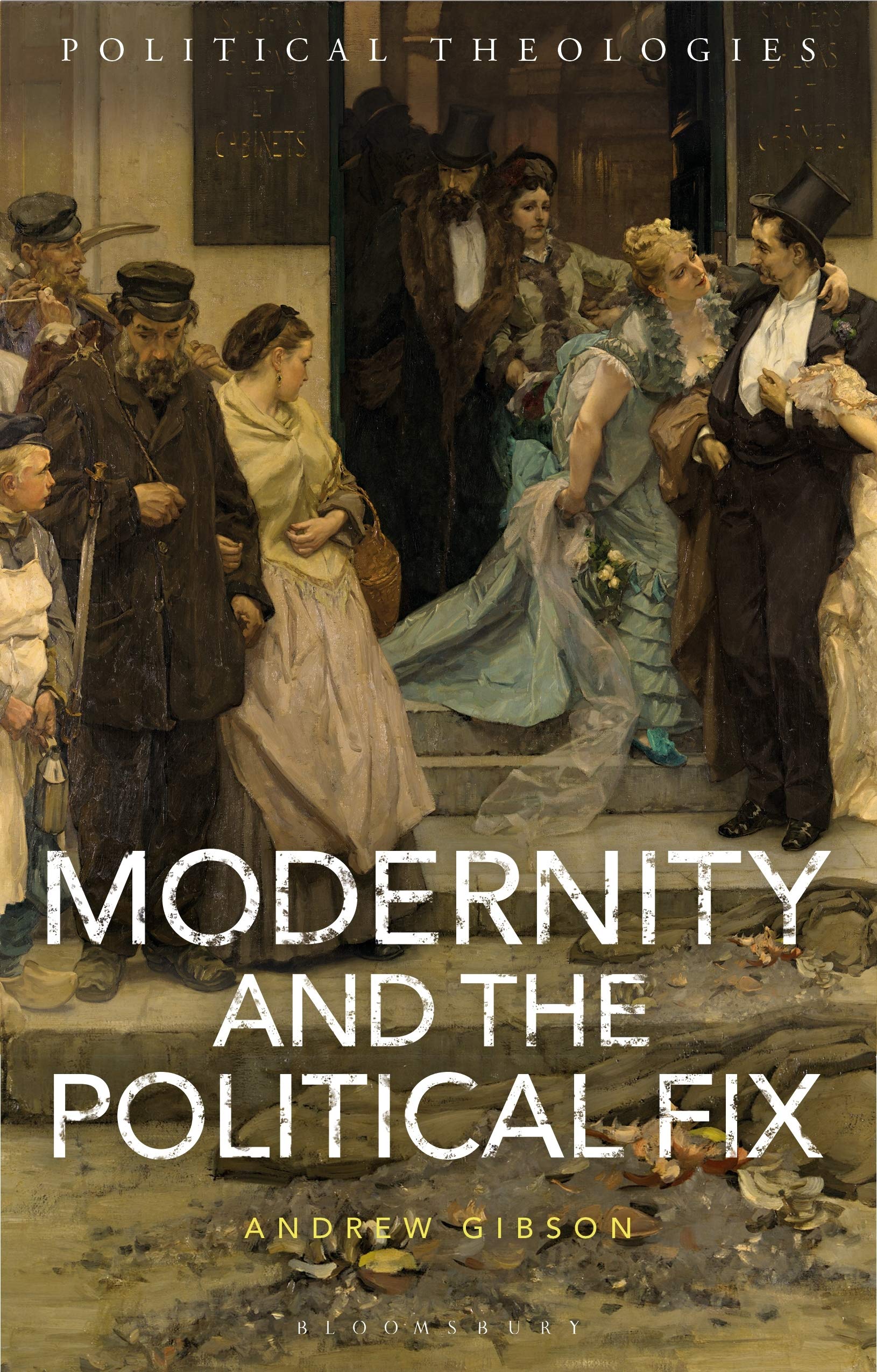



From their decisive emergence in the late eighteenth century, modernity and modern politics were long haunted by irony and paradox. Ours, however, is the age of the implosion of modernity. Modernity has degenerated into self-parody. The polarities that an ironic grasp of it could potentially always hold in tension are finally collapsing into each other. In Modernity and the Political Fix, Andrew Gibson tells the relevant story and asks what aspects of modern politics we might want to salvage and preserve and within what structure we might continue thinking about them. His answer is that these questions call for the isolation of a particular set of concepts; that, rightly positioned in relation to one another, the concepts amount to a political theology; that the very formulation of political temporality is therefore at stake; and that the thinking in question has been and is best represented in modern philosophy and art, above all, modern literature. Ranging through early modern and modern thought from Hobbes, Pascal and Leibniz to Rousseau, Kant, Schopenhauer and Kierkegaard to Foucault, Lacan, Badiou, Jambet and Rancière, and in modern literature and art from Wordsworth and Byron to Goya and Wagner, Huysmans and Wilde, Joyce and Woolf, Joseph Roth, Vicki Baum, Gabriele Tergit and the Weimar novel, Evelyn Waugh and George Orwell to R.S. Thomas and Norman Nicholson, Gibson seeks to compile a modern political aide-memoire , a treasury for a politics to come. Andrew Gibson's is a very significant book - a cultural intervention in the Nietzschean vein and, at times, manner. Paradoxically, it proposes a political theology that is resolutely secular, but justifies its resort to the materials of theology; in other words, it finesses the commonplace argument that modern political thought is necessarily if unwittingly and, in defiance of its own resolutions to the contrary, theological. It is a profound and passionate meditation on modernism - its achievements as well as its discontents - and I recommend it without reservation. Heeding vast amounts of historical, literary and conceptual work, Gibson weaves a compelling narrative that enlists thinking modalities from a wide variety of genres. What is especially important about Gibson's framing of the investigation is that in turning to the idea of "ironical modernity+? the book challenges Richard Rorty's stultifying assertion that irony is alien to political commitment. Politics and irony are intimately interconnected for Gibson, precisely because he embraces a politics that accepts historical contingency as much as it does the contingencies of subjectivity. Crucially Gibson embraces a political theology that is yet to come. He focuses on how we can enrich our political grasp of modernity to elaborate a theologically-influenced conception of historical or human time "without finality.+? Andrew Gibson was Research Professor of Modern Literature and Theory at Royal Holloway, University of London, UK, where he still teaches part-time. He is currently Visiting Professor at the J.M. Coetzee Centre at the University of Adelaide, Australia, and was until recently a member of the Conseil Scientifique of the Collège Internationale de Philosophie in Paris. His many books include Intermittency: The Concept of Historical Reason in Contemporary French Philosophy (2012) and Misanthropy (Bloomsbury, 2017). Arthur Bradley is Senior Lecturer in Literary and Cultural Studies at Lancaster University, UK. He is the author of Negative Theology and Modern French Philosophy; Derrida's Of Grammatology: A Philosophical Guide and (with Andrew Tate) The New Atheist Novel: Fiction, Philosophy and Polemic after 9/11. Michael Dillon is Professor of History and Affiliate of the Lau China Centre, King's College London, UK. He was Visiting Professor at Tsinghua University in 2009 and is a Fellow of the Royal Historical Society and Royal Asiatic Society. He was founding Director of the Centre for Contemporary Chinese Studies at the University of Durham, where he taught modern Chinese history. Yvonne Sherwood is senior lecturer in Old Testament/Tanakh and Jewish Studies at the University of Glasgow, Scotland.