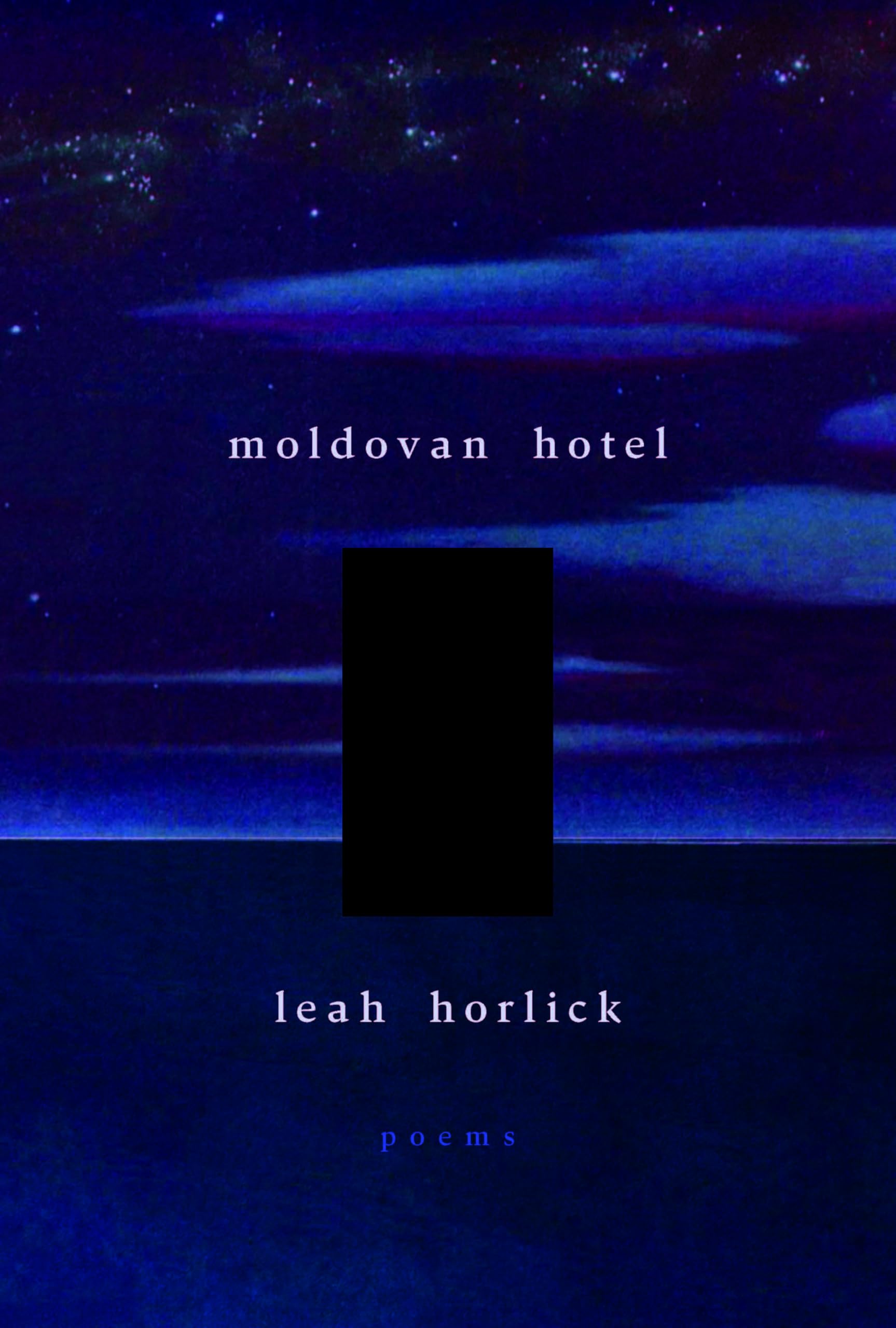



FINALIST FOR THE 2023 VINE AWARDS SHORTLISTED FOR THE 2023 WESTERN CANADA JEWISH BOOK AWARDS Moldovan Hotel explores the intergenerational trauma of the Holocaust in Romania through a queer Jewish voice in the Diaspora. In 2017, Leah Horlick travelled to Romania to revisit the region her Jewish ancestors fled. What she unearthed there is an elaborate web connecting conscious worlds to subconscious ones, fascism to neofascisms, Europe to the Americas to the Middle East, typhus to HIV/AIDS, genocide in Romania to land grabs in Palestine, women's lives in farming villages to queer lives in the city, language to its trap doors, and love to its hidden, ancestral obligations. With force, clarity and searing craft, Horlick's poems are equal to the urgency of our political moment. "No one ever thinks they might be the dragon," Horlick writes, and yet history repeats its cruelties. This work takes things apart to put them profoundly back together. "Every poem in Moldovan Hotel is a room thick with ghosts. Here, Horlick takes the language of the past―used to dehumanize and unmoor―and crystalizes it around revelation after revelation. A graceful, striking collection." ―Carmen Maria Machado "Horlick opens Moldovan Hotel with the fantasy of ancestors of past loves in a room together, their historical associations and interactions problematizing identity, relationship, truth, and story. The poems that follow pirouette between past and present, real and imagined, beautifully rendered countryside and the echoes of loss that does not come from the inevitability of life but from the purposeful destruction of other, whether national, religious, or ethnic. Yet these poems, with their purposeful and arresting use of language, together form a prayer for a better world, built not on burying old crimes, but on looking closely to see the truth of the past and to expose it so that it cannot poison the future." ―from the jurors of the Pat Lowther Memorial Award "In the masterful work of Moldovan Hotel , Leah Horlick lives not only a lineage, but a host of familial ghosts, each holding up a lantern, whispering of loss and landscape, of war and typhus, transforming the speaker into all of it―and the reader, with her―in surreal, linguistic leaps. Haunting details of the past, made visceral by the speaker's experience of the land her Jewish ancestors fled during World War II, become nightmare visions of the future as the jackboots of neo-fascism march ever forward and memories are confiscated by the CIA. Horlick's poems, making meaning of history with unflinching honesty, resonate electrically with our time." ―from the jurors of the Raymond Souster Award "If Leah Horlick's second book invited us to witness, this time she draws from her Jewish heritage and takes us back to show us how to read the landscape and mind-scape and tell us what the texts left out. This is an accounting, a calling, an invocation, a return, a skilful mediation on how to remember when the ‘names of the oppressors are blotted out'." ―Juliane Okot Bitek , The League of Canadian Poets Leah Horlick grew up as a settler on Treaty Six Cree territory and the homelands of the Métis in Saskatchewan. Her first collection of poetry, Riot Lung (Thistledown Press, 2012) was shortlisted for both a ReLit Award and a Saskatchewan Book Award. In 2016 she won the Dayne Ogilvie Prize, Canada's only award for LGBT emerging writers. That same year, her second collection, For Your Own Good (Caitlin Press, 2015), was named Stonewall Honor Title by the American Library Association. In 2018, her piece "You Are My Hiding Place" was named Poem of the Year by ARC Poetry Magazine and shortlisted for inclusion in the 44th Pushcart Prize by the Pushcart Board of Editors. She lives in Calgary. For You Shall Be Called to Account The ancestors of everyone I've let into my body are gathered in a small room with one window, no lights. Yes, the room is crowded. Yes, there are no chairs. Yes, they are talking-why are we here, says the Nazi resister. Where are the chairs, says the Viking (no horns). Where is the light, say the people with their new French name hung around their necks heavy like a long black cross. Here, says the grand wizard, and a long white light descends from a point from the ceiling. The people of the oldest empire are here, too, they have brought their own fire (hidden), they too can speak French, they know in an instant not to trust that light. They are opening the window. How do we get away from these people, they murmur. True Aryans! say the Nazis with their new French name. No one is speaking to the Catholics. There is a knock on the door- there is a door. More Nazis. How did this happen? Outside the open window there is a small huddle of shawls and feet and candlesticks, a suitcase and a cane. Someone has forgotten their things, says the Nazi resister. The candlesticks turn into my great-grandmother, their tarnish to coal smears, the cane grows tall into my great-z