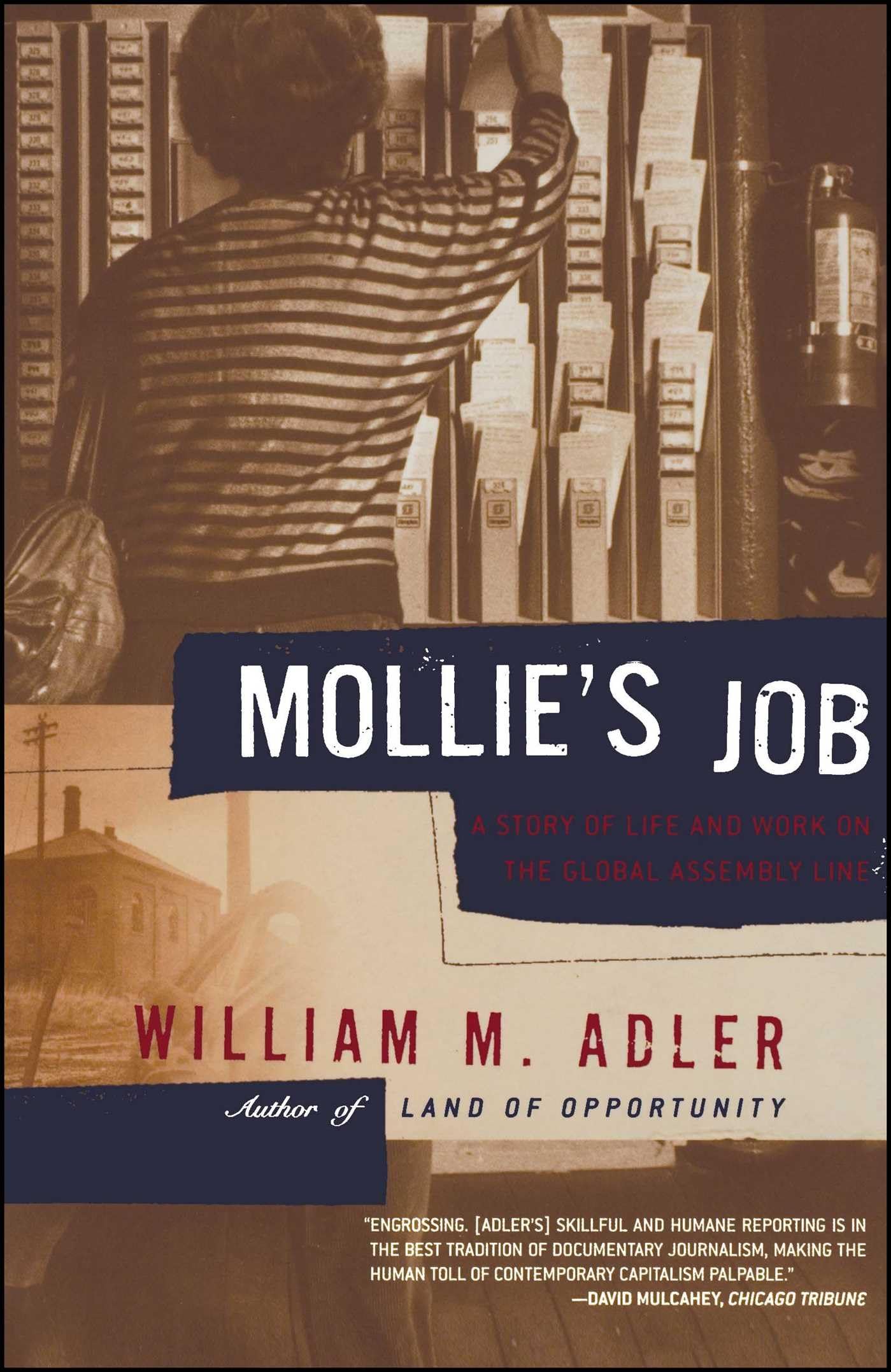
Mollie's Job: A Story of Life and Work on the Global Assembly Line
$15.79
by William M. Adler



Following the flight of one woman's factory job from the United States to Mexico, this compelling work offers a revealing and unprecedented look at the flesh-and-blood consequences of globalization. In this absorbing and affecting narrative history, investigative journalist William M. Adler traces the migration of one factory job as it passes from the cradle of American industry, Paterson, New Jersey, to rural Mississippi during the turmoil of the civil rights movement, to the burgeoning border city of Matamoros, Mexico. The story of Mollie James, Dorothy Carter, and Balbina Duque, their company, and their communities provides an ideal prism through which to explore the larger issues at the heart of the new economy: the decline of unions and the middle class, the growing gap between rich and poor, public policies rewarding U.S. companies for transferring jobs abroad, and the ways in which "free trade" undermines stable businesses and communities. Combining a deft historian's touch with first-rate reporting, Mollie's Job is a provocative and fresh perspective on the global economy -- at a time when downsizing is unraveling the American Dream for many working families. David Mulcahey Chicago Tribune Engrossing. [Adler's] skillful and humane reporting is in the best tradition of documentary journalism, making the human toll of contemporary capitalism palpable. Samuel G. Freedman The Washington Post By writing the biography of a single job, Adler has made a vital contribution to the debate over globalization. Michael King The Texas Observer You will simply be astonished by the whole of Mollie's Job. This is a book of impressive historical imagination. William M. Adler is a freelance writer who has written for numerous publications, including Esquire and Rolling Stone. He is also the author of Land of Opportunity. He lives in Texas. Introduction: End of the Line PATERSON, NEW JERSEY, JUNE 30, 1989. Mollie James sensed it the morning she came to work and noticed the hole in the floor. It wasn't a hole, really, in the sense of an opening; it was more of a void: a great yawning space of discolored concrete where just the afternoon before had sat a steel-stamping machine, a hulking piece of American industrial might. Before long, more holes appeared, each tracing the outline of the base of another machine, like chalk around a sidewalk corpse. It is three o'clock on a warm Friday afternoon, and the second of the two washup bells has rung for the final time. Mollie James has been here, on the assembly line at Universal Manufacturing Company, since 1955. She was the first female union steward and among the first African American union stewards; hers was a self-assured presence any grievant would want on his side. She was the first woman to run a stamping machine, the first to laminate steel. And now, after thirty-four years on the line -- nearly two-thirds of her life -- she is the last to go. Her wide shoulders are hunched over the sink as she rinses her hands with industrial soap alongside the others. She is a big-boned woman of fifty-nine, with a handsome, animated face framed by oversize glasses. At the end of every other shift for more than three decades, Mollie and her co-workers beat a quick path to the plant parking lot. On this day there is less sense of hurry. There are still children to feed, clothes to wash, bills to pay, errands to run, other jobs to race to. But as she and the others leave the washroom, no one seems pressed to leave. All about the plant entrance, and out in the lot, people stand in small clusters, like mourners at their own wake, talking, laughing, hugging, crying. Almost always Mollie James is outgoing and outspoken, her voice loud, assertive; her smile nicely lighted. She is a strong woman, her strength forged from a life of hard work and sacrifice and faith in God. She is not one to betray her emotions, but this day is different. Her bearing has turned to reserve, her normally quick eyes dull and watery. Her working life is over, and that is all she has ever known. During nearly two decades of ownership by the company's founder, a Paterson native named Archie Sergy, and two decades more by absentee corporations that more or less allowed the Paterson plant to operate as if it were still a locally owned business, Universal had always turned a tidy profit. Its signature product, ballasts for fluorescent lights (the ballast regulates the flow of current into the lamp), attracted attention only when the ballast failed -- causing the light fixture to hum or flicker. In the middle 1980s, however, the company was swept up in the gale winds of Wall Street's merger mania. Twice within eight months Universal was sold, both times to companies headed by disciples of Michael Milken, the Street's reigning evil genius. It was not until after its latest sale, in 1986, to an electrical-components conglomerate called MagneTek, Inc., that workers began taking plant-closing r