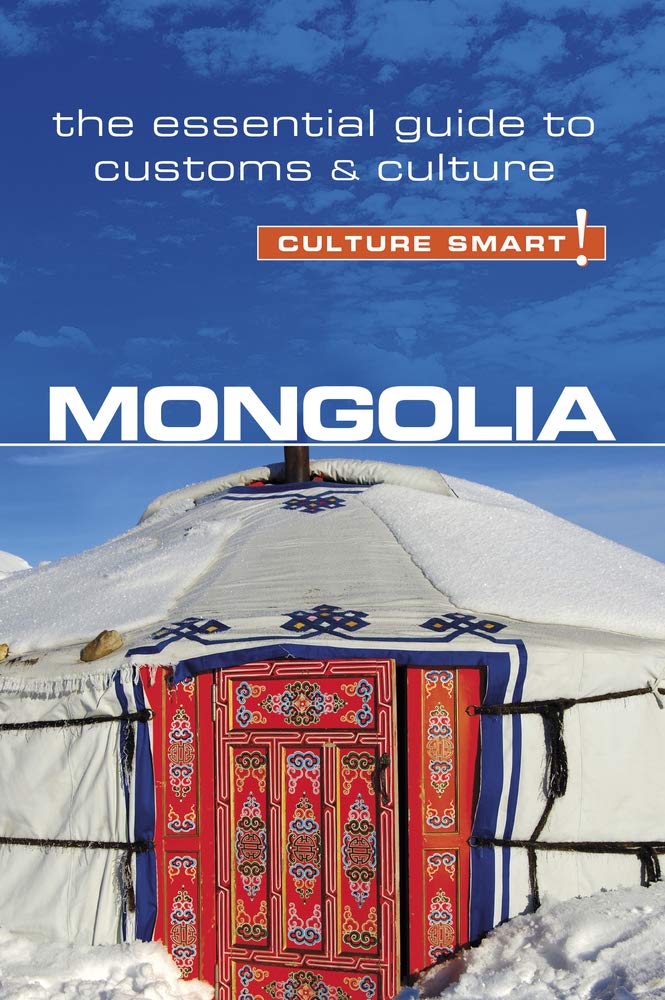



Mongolia is landlocked between its neighbors China and Russia in the heart of Asia. For centuries after the disintegration of Genghis Khan’s empire it was ruled by one or the other, but in 1990 the Mongols embraced democracy. Now, after two centuries of Manchu stagnation and seventy years of Soviet communism, they are rebuilding their national heritage. Rarely in the news but making progress toward a market economy, this resource-rich but infrastructure-poor country is a land of pioneers, and its greatest asset is the Mongol people, who are friendly, cooperative, ambitious, and well educated. English is now the first foreign language and the country’s leaders are forging new partnerships with international investors. Travelers from across the world are drawn to the “land of blue sky” by its picturesque mountains and lakes, flower-carpeted steppes and stony deserts, home to the snow leopard, the wild horse and camel, and the Gobi bear. The broad pasturelands, with herds of grazing livestock, and the traditional lifestyle of the nomads contrast with the busy streets of the capital Ulan Bator, a bustling metropolis of over one million people, modern hotels, apartments, and shops, interspersed with Buddhist monasteries and temples, surrounded by crowded suburbs of traditional felt tents. Mongolia’s many attractions range from dinosaur skeletons and the remains of ancient civilizations to relics and reenactments of the Genghis Khan era, and the traditional sports of wrestling, archery, and horse-racing. Culture Smart! Mongolia provides rare insights into contemporary Mongolian society, and offers practical tips on what to expect and how to conduct yourself in order to get the most out of your visit. Despite the undeniable challenges posed by modernity, these warm, tough, adaptable, and hospitable people welcome visitors and are open to the world. Alan Sanders is the leading British authority on Mongolia. A former lecturer in Mongolian Studies at London’s School of Oriental and African Studies, he worked for many years at the BBC and is now a freelance consultant, writing about Mongolia’s political and economic scene. He is a member of the International Association of Mongolian Studies, Ulan Bator, and contributes to seminars and publications of the Mongolia and Inner Asia Studies Unit of the University of Cambridge. He was awarded the Mongolian Order of the Pole Star for promoting British–Mongolian relations and knowledge about Mongolia. Mongolia By Alan Sanders Bravo Ltd Copyright © 2016 Alan Sanders All rights reserved. ISBN: 978-1-85733-717-4 Contents Cover, Title Page, Copyright, About the Author, Map of Mongolia, Introduction, Key Facts, Chapter 1: LAND AND PEOPLE, Chapter 2: VALUES AND ATTITUDES, Chapter 3: CUSTOMS AND TRADITIONS, Chapter 4: MAKING FRIENDS, Chapter 5: THE MONGOLS AT HOME, Chapter 6: TIME OUT, Chapter 7: TRAVEL, HEALTH, AND SAFETY, Chapter 8: BUSINESS BRIEFING, Chapter 9: COMMUNICATING, Conclusion, Further Reading, Acknowledgment, CHAPTER 1 LAND & PEOPLE GEOGRAPHY An independent landlocked country in the heart of Asia between N41° and 52° and E88° and 120°, Mongolia borders Russia (RF) for 2,202 miles (3,543 km) to the north and China (PRC) for 2,926 miles (4,709 km) to the east, south, and west. Mongolia's area of 603,909 square miles (1,564,116 sq. km) makes it the eighteenth-largest country in the world, but with a population of three million the average density is fewer than five persons per square mile (or 2 per sq. km). The capital, Ulan Bator (Ulaanbaatar), 4,400 feet (1,350 m) above sea level, has a population of 1.3 million. The western and northern borders and central plateau are mountainous, the south and east flat, mostly steppe and govi (gobi), or gravel semi-desert. The highest peak, Khüiten ("cold"), rises to 14,355 feet (4,374 m) at the western junction of Mongolia's borders with China and Russia in the Tavan Bogd ("holy five") range of the Mongol Altai Mountains. The lowest point is Lake Khökhnuur (1,745 feet, or 532 m. above sea level) in the eastern plains, but the biggest lakes are in the west and north: Lake Uvs (1,446 sq. miles, or 3,376 sq. km), and Lake Khövsgöl (1,057 sq. miles, or 2,738 sq. km). The longest river, the Kherlen, 754 miles (1,213 km), rises in the northern Khentii Mountains, loops east and, via Chinese Inner Mongolia, joins the Argun tributary of the Amur (Heilongjiang, Black Dragon River) forming the Russian–Chinese border. The Orkhon, 698 miles (1,124 km), rises in the Khangai Mountains and flows north, near the Russian border joining the Selenge, which enters Lake Baikal. Forest, mostly Siberian larch, covers about 8 percent of Mongolia, mainly on the northern mountain slopes. Some 36 percent is desert and govi, but dunes form only a small proportion. The Gobi mesas are the source of dinosaur fossils and eggs. Altan Els ("golden sands"), east of Lake Uvs, is the world's northernmost desert.