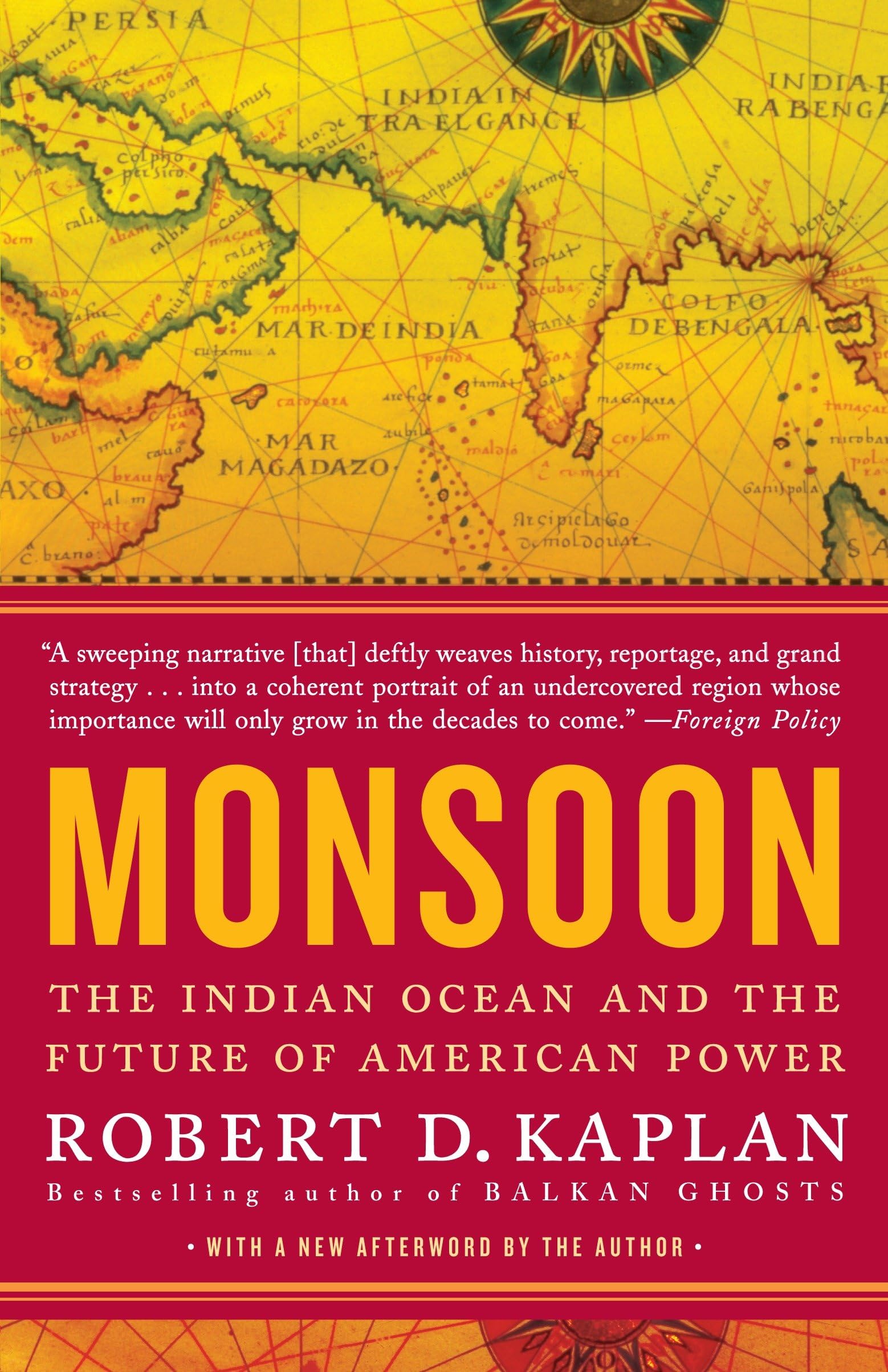



On the world maps common in America, the Western Hemisphere lies front and center, while the Indian Ocean region all but disappears. This convention reveals the geopolitical focus of the now-departed twentieth century, but in the twenty-first century that focus will fundamentally change. In this pivotal examination of the countries known as “Monsoon Asia”—which include India, Pakistan, China, Indonesia, Burma, Oman, Sri Lanka, Bangladesh, and Tanzania—bestselling author Robert D. Kaplan shows how crucial this dynamic area has become to American power. It is here that the fight for democracy, energy independence, and religious freedom will be lost or won, and it is here that American foreign policy must concentrate if the United States is to remain relevant in an ever-changing world. From the Horn of Africa to the Indonesian archipelago and beyond, Kaplan exposes the effects of population growth, climate change, and extremist politics on this unstable region, demonstrating why Americans can no longer afford to ignore this important area of the world. “A sweeping narrative [that] deftly weaves history, reportage, and grand strategy . . . into a coherent portrait of an undercovered region whose importance will only grow in the decades to come.”— Foreign Policy “Few books can be considered indispensable, but Monsoon is one of them. . . . An essential primer for this new century’s evolving politics.”— The Dallas Morning News “A special blend of first-person travel writing, brief historical sketches and wide-ranging strategic analysis.”— The New York Times Book Review “Compelling . . . Kaplan’s breadth of travel and learning leads to intriguing insights.”— The Washington Post “[Kaplan] has a gift for geopolitical imagination.”— The Wall Street Journal Robert D. Kaplan is the bestselling author of twenty books on foreign affairs and travel translated into many languages, including Adriatic, The Good American , The Revenge of Geography, Asia’s Cauldron, Monsoon, The Coming Anarchy, and Balkan Ghosts. He holds the Robert Strausz-Hupé Chair in Geopolitics at the Foreign Policy Research Institute. For three decades he reported on foreign affairs for The Atlantic . He was a member of the Pentagon’s Defense Policy Board and the U.S. Navy’s Executive Panel. Foreign Policy magazine twice named him one of the world’s “Top 100 Global Thinkers.” Chapter One CHINA EXPANDS VERTICALLY, INDIA HORIZONTALLY Al Bahr al Hindi is what the Arabs called the ocean in their old navigational treatises. The Indian Ocean and its tributary waters bear the imprint of that great, proselytizing wave of Islam that spread from its Red Sea base across the longitudes to India and as far as Indonesia and Malaysia, so a map of these seas is central to a historical understanding of the faith. This is a geography that encompasses, going from west to east, the Red Sea, Arabian Sea, Bay of Bengal, and Java and South China seas. Here, in our day, are located the violence- and famine-plagued nations of the Horn of Africa, the geopolitical challenges of Iraq and Iran, the fissuring fundamentalist cauldron of Pakistan, economically rising India and its teetering neighbors Sri Lanka and Bangladesh, despotic Burma (over which a contest looms between China and India), and Thailand, through which the Chinese and Japanese, too, may help finance a canal sometime in this century that will affect the Asian balance of power in their favor. Indeed, the canal is just one of several projects on the drawing board, including land bridges and pipelines, that aim to unite the Indian Ocean with the western Pacific. On the Indian Ocean's western shores, we have the emerging and volatile democracies of East Africa, as well as anarchic Somalia; almost four thousand miles away on its eastern shores the evolving, post-fundamentalist face of Indonesia, the most populous Muslim country in the world. No image epitomizes the spirit of our borderless world, with its civilizational competition on one hand and intense, inarticulate yearning for unity on the other, as much as an Indian Ocean map. Water, unlike land, bears no trace of history, no message really, but the very act of crossing and recrossing it makes this ocean, in the words of Harvard professor of history Sugata Bose, a "symbol of universal humanity." There are Indian and Chinese, Arab and Persian trading arrangements creating a grand network of cross-oceanic communal ties, brought even closer over the centuries by the monsoon winds and, in the case of the Arabs, Persians, and other Muslims, by the haj pilgrimage. This is truly a global ocean, its shores home to an agglomeration of peoples of the fast-developing former "third world," but not to any superpower: unlike the Atlantic and Pacific. Here is the most useful quarter of the earth to contemplate, pace Fareed Zakaria, a "post-American" world in the wake of the Cold War and the conflicts in Afghanistan and Iraq. Rudyard Kipling's turn of phrase