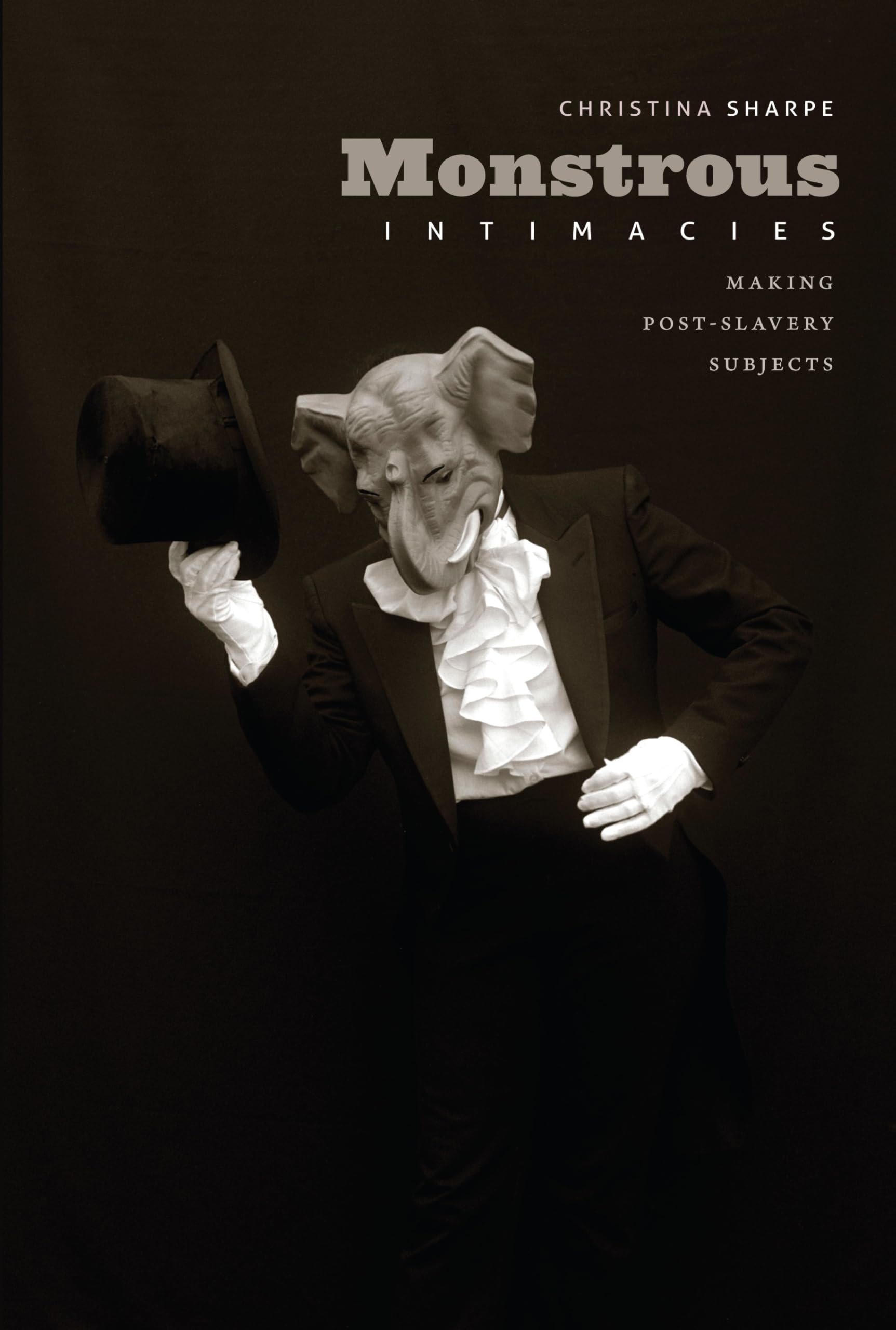



Arguing that the fundamental, familiar, sexual violence of slavery and racialized subjugation have continued to shape black and white subjectivities into the present, Christina Sharpe interprets African diasporic and Black Atlantic visual and literary texts that address those “monstrous intimacies” and their repetition as constitutive of post-slavery subjectivity. Her illuminating readings juxtapose Frederick Douglass’s narrative of witnessing the brutal beating of his Aunt Hester with Essie Mae Washington-Williams’s declaration of freedom in Dear Senator: A Memoir by the Daughter of Strom Thurmond , as well as the “generational genital fantasies” depicted in Gayl Jones’s novel Corregidora with a firsthand account of such “monstrous intimacies” in the journals of an antebellum South Carolina senator, slaveholder, and vocal critic of miscegenation. Sharpe explores the South African–born writer Bessie Head’s novel Maru —about race, power, and liberation in Botswana—in light of the history of the KhoiSan woman Saartje Baartman, who was displayed in Europe as the “Hottentot Venus” in the nineteenth century. Reading Isaac Julien’s film The Attendant , Sharpe takes up issues of representation, slavery, and the sadomasochism of everyday black life. Her powerful meditation on intimacy, subjection, and subjectivity culminates in an analysis of Kara Walker’s black silhouettes, and the critiques leveled against both the silhouettes and the artist. "Monstrous Intimacies succeeds in illuminating the complex entanglements of desire and horror at the heart of Black and White subjectification 'after' slavery. More profoundly, this text powerfully balances the fact of history's monstrous persistence ... (129)." --Sarah Cervenak, Women's Studies ""Monstrous Intimacies" is a remarkable study, lucid, engaging, and thoroughly engrossing."--Sharon Patricia Holland, author of "Raising the Dead: Readings of Death and (Black) Subjectivity" Christina Sharpe is Associate Professor of English and Director of American Studies at Tufts University. MONSTROUS INTIMACIES Making Post-Slavery Subjects By CHRISTINA SHARPE DUKE UNIVERSITY PRESS Copyright © 2010 Duke University Press All right reserved. ISBN: 978-0-8223-4609-8 Contents ACKNOWLEDGMENTS..............................................................................................................ixINTRODUCTION Making Monstrous Intimacies Surviving Slavery, Bearing Freedom.................................................1ONE Gayl Jones's Corregidora and Reading the "Days That Were Pages of Hysteria".............................................27TWO Bessie Head, Saartje Baartman, and Maru Redemption, Subjectification, and the Problem of Liberation.....................67THREE Isaac Julien's The Attendant and the Sadomasochism of Everyday Black Life.............................................111FOUR Kara Walker's Monstrous Intimacies.....................................................................................153NOTES........................................................................................................................189BIBLIOGRAPHY.................................................................................................................223INDEX........................................................................................................................243 Chapter One Gayl Jones's Corregidora and Reading the "Days That Were Pages of Hysteria" Slavery is the ghost in the machine of kinship. - SAIDIYA HARTMAN quoted in Butler 2002, "Is Kinship Always Already Heterosexual?" When the pro-slavery Mississippi statesman Henry Hughes wrote in A Treatise on Sociology: Theoretical and Practical (1854) that "Hybridism is heinous. Impurity of races is against the law of nature. Mulattoes are monsters. The law of nature is the law of God. The same law which forbids consanguineous amalgamation forbids ethnical amalgamation. Both are incestuous. Amalgamation is incest ," he performed an alchemical change whereby to break the different taboos of either incest or amalgamation-of morality and nature, blood and ethnicity-was to break the same law. Hughes was reinforcing an already accepted natural division of black from white, further delineated in a system that he called warrenteeism (a precursor to Plessy v. Ferguson 's [1896] so-called separate but equal mandate). His logic rested on the prior articulation of a black and white crisis in race, property, and labor relations in southern slavery in the mid-nineteenth century. When a number of late-twentieth-century critics read Hughes's curious statement and arrived at a similar conclusion that "The taboo of too different (amalgamation/miscegenation) is interchangeable with the taboo of too similar (incest), since both crimes rely on a pair of bodies which are mutually constitutive of each other's deviance, a pair of bodies in which each body is the signi